
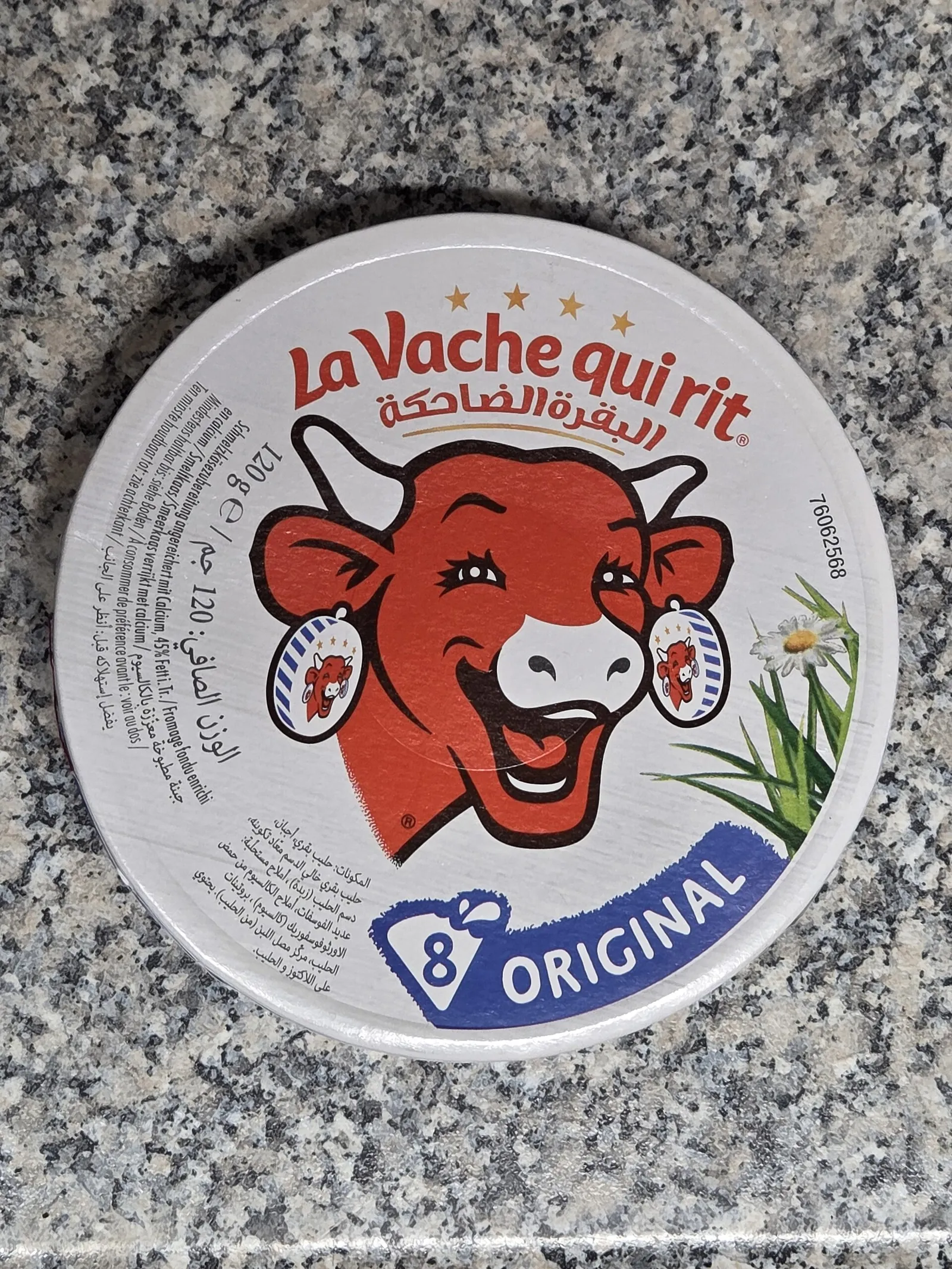
Bel's Canadian FAQ says the mix is heated above 212°F (100°C) so the cheeses melt and combine, then poured into triangular wedges, packaged and cooled.
Processed does not mean imitation. Bel's brand page says Léon Bel took a Swiss innovation, processed cheese, and launched The Laughing Cow in 1921. Its sister brand Babybel goes the other way: a natural cheese with no emulsifying salts.
Laughing Cow cheese at a glance
Here is Laughing Cow cheese at a glance, based on Bel's brand page, its Canadian and UK FAQs, USDA's record for the US Original Swiss wedge and the FDA standards for process cheese.
| Detail | The Laughing Cow |
|---|---|
| Maker | Bel, a French dairy group founded in 1865; Bel Brands USA lists it among its brands |
| Launched | 1921, by Léon Bel; the red cow logo was designed by Benjamin Rabier in 1924 |
| Type | Processed cheese, spreadable, sold in individual portions |
| Made from | Skim milk and cheeses such as Cheddar, Gouda, Edam, Emmental and Comté, melted and blended (Bel's Canadian and UK FAQs) |
| Made from (US Original Swiss) | Cheddar, Swiss and semisoft cheese, nonfat milk, whey, ultrafiltered nonfat milk, water, milkfat, sodium polyphosphate, citric acid and salt (USDA's branded-food record) |
| Per wedge, 21 g (US Original Swiss) | 50 calories, 4 g fat (2.5 g saturated), 2 g protein, 180 mg sodium |
| Heating | Above 212°F (100°C) in Bel's process |
| Product lines | Original and Light, flavors, plant-based, cheese dippers, cubes and cooking versions (Bel's brand page) |
What Laughing Cow cheese is made of
Laughing Cow cheese is made of a blend of cheeses and milk ingredients, and in the US the Original Swiss wedge lists cheddar, Swiss and semisoft cheese first, then nonfat milk, whey, ultrafiltered nonfat milk, water, milkfat, sodium polyphosphate, citric acid and salt, according to USDA's FoodData Central record for that product. Sodium polyphosphate is the emulsifying salt, and citric acid is one of the acidifying agents the FDA standard allows. Bel's Canadian and UK FAQs name Cheddar, Gouda, Edam, Emmental and Comté as examples of the cheeses in other markets. The UK FAQ compares the melting to a cheese fondue, and the Canadian one says Bel melts the cheeses, adds other milk ingredients and calls the procedure processing.
Recipes change by country and flavor, so the box in your cart is the authority on what is inside. The FDA's standard for pasteurized process cheese spread shows what such a blend may hold: one or more cheeses, optional dairy ingredients such as cream, milk, skim milk, buttermilk and whey, and emulsifying agents (phosphates, citrates or tartrates) at no more than 3 percent of the weight. Salt, water, spices and color are allowed, and so are stabilizers such as carob bean gum or guar gum (up to 0.8 percent), acids such as vinegar or lactic acid, and preservatives such as sorbic acid (up to 0.2 percent). Ingredient lists run from most to least by weight, so what comes first is the main component.
How Laughing Cow cheese is made
Laughing Cow cheese is made by melting selected cheeses and milk ingredients together, heating the blend above 212°F (100°C) so it combines into a creamy mass, and pouring it into triangular wedges that are packaged and cooled, as Bel's Canadian FAQ describes it.
A 2023 review in Molecules explains the middle step. Processed cheese starts with natural cheeses cleaned and cut into small pieces, mixed with water and sequestering salts, sheared under heat, then packed hot and cooled. The salts, mostly citrates and phosphates, lock up free calcium and loosen the protein network, so the casein takes up water and holds the melted fat in tiny droplets instead of letting it pool.
The FDA sets a floor for the heat: process cheese and process cheese spread are heated for at least 30 seconds at 150°F (66°C) or more. The American cheese guide covers the same process in slice form.
Laughing Cow cheese nutrition
Laughing Cow cheese nutrition for the US Original Swiss wedge, per USDA's branded-food record, is 50 calories, 4 grams of fat (2.5 grams saturated), 2 grams of protein and 180 milligrams of sodium in a 21-gram wedge, and USDA's generic rows for process cheese spread and process Swiss cheese show the pattern per ounce.
| Per ounce (28 g) | Process cheese spread | Process Swiss cheese | Cream cheese |
|---|---|---|---|
| Calories | 82 | 95 | 99 |
| Protein | 4.7 g | 7.0 g | 1.7 g |
| Fat | 6.0 g | 7.1 g | 9.8 g |
| Sodium | 461 mg | 388 mg | 89 mg |
| Calcium | 159 mg | 219 mg | 28 mg |
Per ounce, the process cheese spread carries about five times the sodium of cream cheese and almost six times the calcium, with fewer calories. A 21-gram wedge is about three quarters of an ounce, so the Original Swiss works out to roughly 68 calories and 243 milligrams of sodium per ounce, saltier than cream cheese but well below USDA's generic spread. Flavors and the Light line have their own labels, so read the box.
How to use Laughing Cow cheese
Use Laughing Cow cheese straight from the fridge as a spread on crackers, bagels, celery or apple slices, and stir it into hot dishes as a quick melter.
For a fast sauce, melt one or two wedges into a splash of milk over low heat, or stir a wedge into hot pasta, soup, mashed potatoes or scrambled eggs. The salts that make the cheese spreadable also help it melt without separating, and the cheese sauce science guide covers smooth melts in more depth. Keep the wedges in the fridge and rewrap what you do not finish.
What to use instead of Laughing Cow cheese
Use cream cheese, Boursin or American cheese instead of Laughing Cow cheese, depending on whether you need a plain spread, a garlic-and-herb spread or a melter.
For spreading, softened cream cheese is the closest swap, and it is far less salty: USDA's rows show 89 mg of sodium per ounce against 461 mg for process cheese spread, so a pinch of salt may help. Boursin, a garlic-and-herb spreadable that Bel also makes, stands in for the flavored wedges. For melting into pasta or eggs, a slice or two of American cheese, which is made the same way, melts just as smoothly.
What most Laughing Cow cheese advice gets wrong
Most Laughing Cow cheese advice gets three things wrong about what processed means, why it spreads and how long it keeps.
Processed cheese is made from real cheese
Processed cheese is made from real cheese: the FDA's standard for pasteurized process cheese describes one or more cheeses ground and mixed with the aid of heat and an emulsifying agent into a smooth, plastic mass. What changes is the structure, not the source, and the processed vs natural cheese guide compares the two.
Why a wedge spreads and a slice does not
A wedge spreads and a slice does not because spreads are allowed far more water: the FDA standard for process cheese spread permits more than 44 and up to 60 percent moisture, against a general limit of 43 percent for process cheese made from a single variety. A spread must also stay spreadable at 70°F (21°C) and carry at least 20 percent milkfat.
Heating does not make a wedge sterile
Heating does not make a wedge sterile, because melting cheese works like pasteurization on actively growing bacteria but not on spores, a review of processed cheese microbiology notes. It adds that shelf life depends on the quality of the raw materials, hygiene, packaging and storage conditions, and Bel's FAQs say to keep the wedges refrigerated even though the cheese was heated above 212°F.
Questions about Laughing Cow cheese
These are the questions about Laughing Cow cheese that come up most.
What kind of cheese is The Laughing Cow?
The Laughing Cow is a spreadable processed cheese, which Bel describes as a processed cheese product sold in individual portions.
Who makes The Laughing Cow?
The Laughing Cow is made by Bel, a French dairy group founded in 1865, and Bel Brands USA lists it among its brands.
Does The Laughing Cow need refrigeration?
The Laughing Cow should be kept refrigerated: Bel's Canadian FAQ gives 32 to 39°F (0 to 4°C), and its UK FAQ says to refrigerate it after purchase.
Can you melt The Laughing Cow?
You can melt The Laughing Cow into sauces, pasta, eggs and soups, because the emulsifying salts in processed cheese keep the fat and protein together as it heats.
Is The Laughing Cow vegetarian?
Bel's Canadian and UK FAQs say The Laughing Cow is suitable for vegetarians, and the Canadian one adds that the cheeses it starts from use microbial enzymes only, with no animal rennet. US flavors can differ, so check the box.
Is The Laughing Cow gluten-free?
Bel's Canadian and UK FAQs say The Laughing Cow cheese triangles contain no gluten ingredient, while the Canadian FAQ says the Cheese Dippers are not gluten-free. Check the US box if you avoid gluten.
Your next Laughing Cow cheese
For your next Laughing Cow cheese, read the ingredient list on the box, spread one wedge on a cracker and stir another into hot pasta to taste both jobs.
Sources
- The Laughing Cow and Bel Group home page, Bel Group
- FAQs, The Laughing Cow Canada, Bel
- FAQs and contact, The Laughing Cow UK, Bel
- 21 CFR 133.179, Pasteurized process cheese spread and 21 CFR 133.169, Pasteurized process cheese, Legal Information Institute, Cornell Law School
- A Review on the Effect of Calcium Sequestering Salts on Casein Micelles: From Model Milk Protein Systems to Processed Cheese (Deshwal and others, 2023), Molecules via PubMed Central
- Microflora of processed cheese and the factors affecting it (Buňková and Buňka, 2017), Critical Reviews in Food Science and Nutrition
- Bel Brands USA, Bel Brands USA
- USDA FoodData Central, SR Legacy: Cheese spread, pasteurized process, American, Cheese, pasteurized process, swiss and Cheese, cream, U.S. Department of Agriculture
- The Laughing Cow Creamy Original Swiss Cheese Spread, 6 oz (FDC ID 2756907), USDA FoodData Central, Branded Foods