
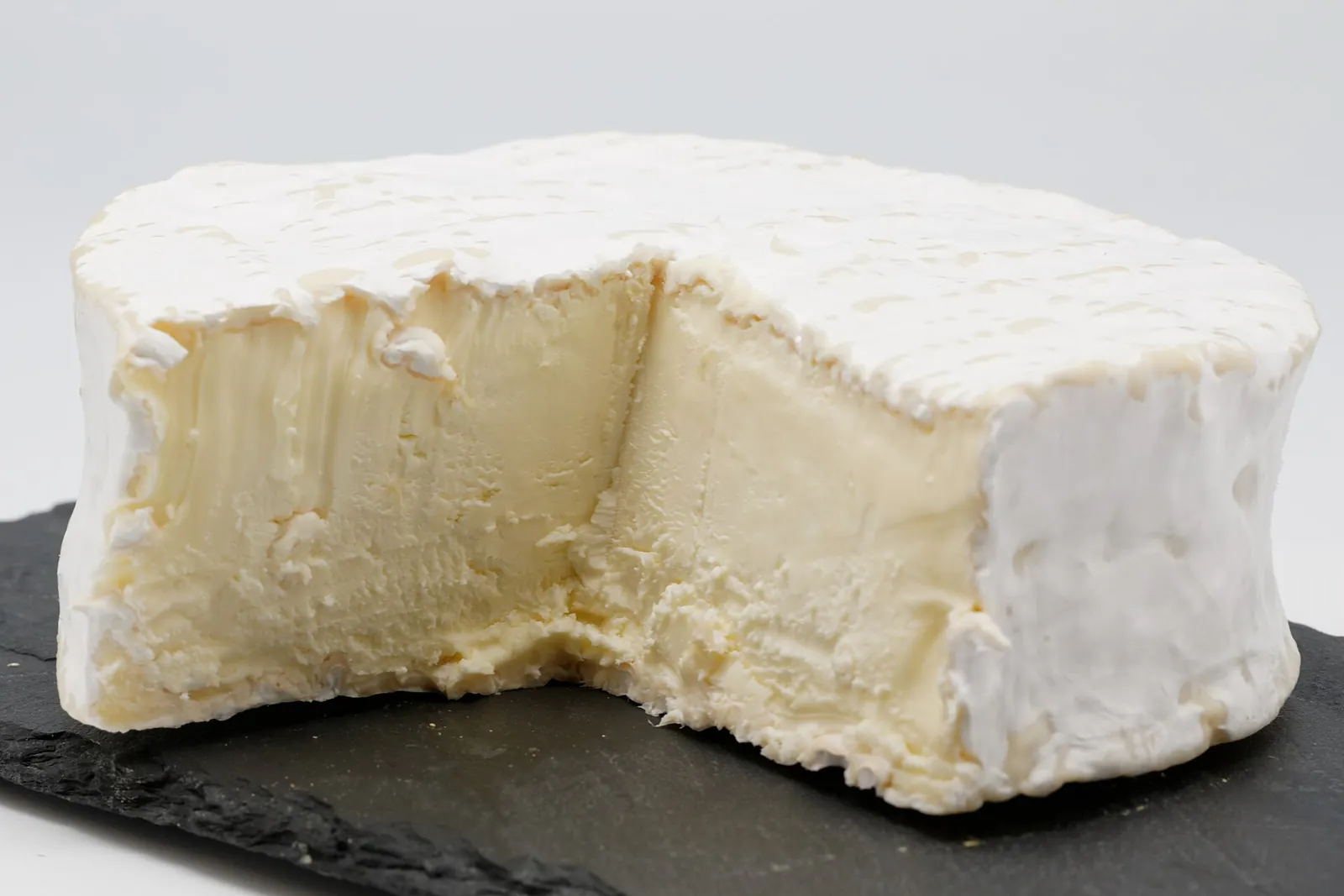
It is soft enough to spread, tastes of cream and fresh butter, and sits a notch richer than the Brie and Camembert most shoppers know.
Everything about it follows from that added cream. More fat means a finer, denser paste, a gentler tang and almost no chew, and it explains why the cheese is sold in small rounds rather than wheels.
Brillat-Savarin cheese at a glance
This is Brillat-Savarin cheese at a glance, taken from the French quality institute's product sheet and a French dairy trade guide.
| Detail | Brillat-Savarin |
|---|---|
| Milk | Cow's milk, enriched with cream before the cheese is made |
| Made in | From the south of Seine-et-Marne to the north of Saône-et-Loire, the old stretch from the Brie country to Burgundy |
| Protected name | PGI, registered by the European Commission on January 19, 2017 |
| Rind | Bloomy and flowery, white |
| Texture | Soft, unctuous, a very fine paste |
| Ripening | Sold young, or ripened for roughly 1 to 4 weeks |
| Size | Typically 100 to 500 grams (about 3.5 to 18 ounces) |
| Flavor | Pronounced lactic taste, cream and fresh butter; mushroom, undergrowth and hazelnut when ripened |
What Brillat-Savarin cheese is, and who named it
Brillat-Savarin cheese is a modern name on an old technique. The French quality institute INAO says, in its product sheet, that the practice of enriching cow's milk with cream was known in the production area from the Middle Ages, and that the Paris cheesemonger Henri Androuët gave the cheese its name. He renamed it in 1930 for Jean Anthelme Brillat-Savarin, the author of Physiologie du goût, published about a century earlier.
The PGI covers a defined zone, from the south of Seine-et-Marne to the north of Saône-et-Loire. A PGI ties a name to a place and a reputation without requiring every step to happen on one farm, which is why a Brillat-Savarin from this belt differs from a generic "triple-cream" label elsewhere. The guide to PDO and PGI labels explains the difference.
Fresh vs ripened Brillat-Savarin
Fresh vs ripened Brillat-Savarin is the one decision that changes what lands on your plate. A young round is dense, pale and tangy, closer to a very rich cream cheese than to Brie. A ripened one has had one to four weeks to grow its white down, so the paste softens from the rind inward and picks up earthy, mushroomy flavors.
Neither is the "correct" one. Pick fresh for a clean, lactic bite that cuts through jam or fruit, and ripened for a rounder, more savory cheese that pairs with Champagne. In a shop, a young round feels firm and springy under the wrapper; a ripened one gives gently, like a ripe peach, and shows a full white coat. If the label says affiné, it is the ripened style.
Brillat-Savarin flavor and texture
Brillat-Savarin flavor and texture are defined by the INAO sheet in three words: a pronounced lactic taste, a very fine paste, and flavors of cream and fresh butter. With ripening it adds mushroom, forest floor, discreet fruit and hazelnut.
On the tongue it behaves unlike most soft cheeses. There is almost no resistance, the fat coats the mouth, and the finish is clean with a light acidity. That acidity matters: without it the cheese would taste flat after two bites, which is why a squeeze of lemon in a salad or a tart fruit on the side makes it taste richer, not heavier.
How to serve Brillat-Savarin cheese
Serve Brillat-Savarin cheese at room temperature, after about 30 to 45 minutes out of the fridge, because cold fat mutes both the butter and the tang. Cut it with a knife dipped in hot water and wiped dry, which slides through the paste without smearing the rind.
Spread it thickly on baguette, brioche or plain crackers, and keep the rind on: it is the same soft bloomy white coat found on Brie, and most people eat it (rind types explained). Fruit is the easy partner: raspberries, strawberries, figs and grapes bring the acid it needs, and a thread of honey works with a young round. For wine, Champagne is the classic partner because bubbles and acidity scrub the fat away; the Champagne and cheese guide covers styles. Chardonnay and Sauternes also work, and a saison or wheat beer is a good non-wine choice.
Treat it as a cheese to eat rather than cook. Warmed too far, the high fat separates into oil, so if you want it in a sauce, stir a few slices into hot pasta or risotto off the heat and let the residual warmth melt it.
Brillat-Savarin substitutes
Brillat-Savarin substitutes are other soft triple-creams first, and rich double-creams second. Délice de Bourgogne is the nearest swap: a Burgundy triple-cream made in the same style. Saint-André and Explorateur are the other familiar triple-creams; any of them will do on a board or with fruit.
If you cannot find a triple-cream, a ripe Brie or Camembert is lighter and earthier but still spreads and takes the same toppings, and the substitute finder lists more options. Cream cheese mixed with a little crème fraîche mimics a young round for a dessert, but not a ripened one.
Brillat-Savarin mistakes that cost you flavor
Most Brillat-Savarin mistakes come down to temperature and wrapping.
Serving Brillat-Savarin straight from the fridge
Serving Brillat-Savarin straight from the fridge makes it taste like cold butter. Give it 30 to 45 minutes on the counter and the lactic tang comes forward.
Wrapping Brillat-Savarin in plastic
Wrapping Brillat-Savarin in plastic traps moisture against the rind, which turns slimy and picks up ammonia notes. Use wax or parchment paper inside a lidded container, as in the guide to storing cheese, and finish the round within about a week of opening.
Mistaking triple-cream for a style, not a name
Brillat-Savarin is a protected name; "triple-cream" is only a style, so a round labeled triple-cream brie may be a different cheese. Check for the Brillat-Savarin name on the label when you want this one.
Questions about Brillat-Savarin cheese
These are the questions about Brillat-Savarin cheese that come up most.
What is a triple-cream cheese?
A triple-cream cheese is a soft cheese made from milk enriched with extra cream, so it has a much higher fat content than an ordinary brie. Brillat-Savarin is a classic example.
Who was Brillat-Savarin?
Brillat-Savarin was Jean Anthelme Brillat-Savarin, the French author of Physiologie du goût. The Paris cheesemonger Henri Androuët named the cheese after him in 1930.
Can you eat the rind on Brillat-Savarin?
You can eat the rind on Brillat-Savarin, since it is a soft white bloomy rind like Brie's. If you dislike the mushroom note, trim it off.
What do you drink with Brillat-Savarin?
Champagne or another dry sparkling wine is the classic drink with Brillat-Savarin, because acidity and bubbles cut through the fat. Chardonnay and Sauternes also work.
Is Brillat-Savarin the same as Brie?
Brillat-Savarin is not the same as Brie: it is a protected triple-cream from a defined zone, richer and denser, while Brie is a larger-format cheese with its own protected versions.
Your first Brillat-Savarin
For your first Brillat-Savarin, buy one small round with the name on the label, let it sit out for 30 to 45 minutes, and eat it on baguette with raspberries and a glass of Champagne. Try a young and a ripened round side by side later to see which you prefer.
Sources
- Brillat-Savarin, product sheet (IGP), Institut national de l'origine et de la qualité (INAO)
- Brillat-Savarin PGI, Dairy Products from France
- Délice de Bourgogne, Culture: The Word on Cheese