
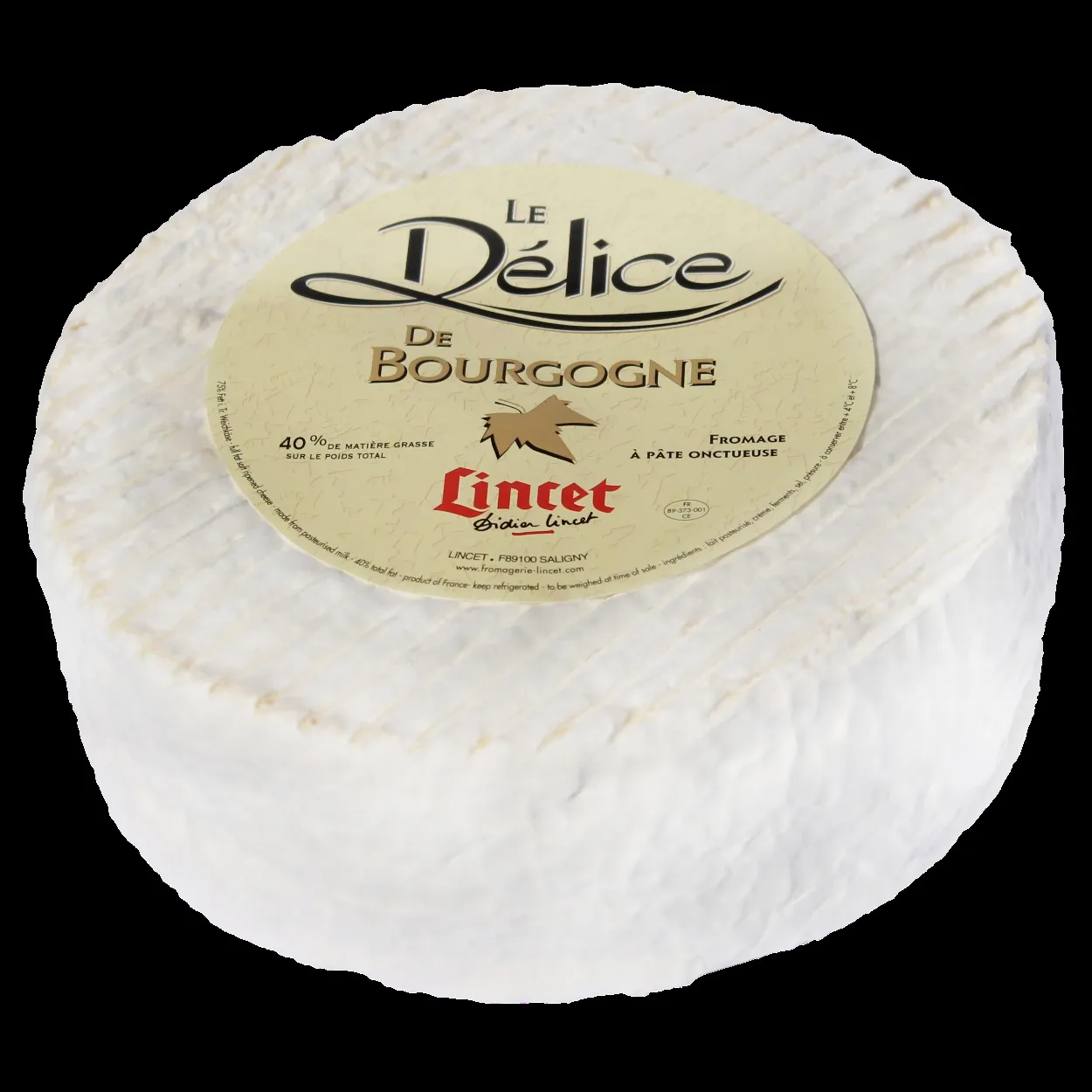
Its white rind is velvety, its center is ivory and almost runny, and it tastes of sweet butter with a faint salt and tang.
The name means "delight of Burgundy," and it is easy to mistake for a protected regional cheese. It is not one. It is a producer's cheese made in a style that Brillat-Savarin made famous, and that distinction decides how you buy it and what you can expect from it.
Délice de Bourgogne at a glance
Here is Délice de Bourgogne at a glance, taken from Culture magazine's cheese profile.
| Detail | Délice de Bourgogne |
|---|---|
| Milk | Full-fat cow's milk with added fresh cream or crème fraîche |
| Made by | Fromagerie Lincet, Burgundy, France |
| Fat | Listed at 75 percent butterfat in dry matter |
| Rind | White, velvety, grown from Penicillium candidum; smells of mushrooms |
| Texture | Plush, like pudding or buttercream, with a runny creamline along the ivory center |
| Flavor | Lactic, slightly salty, delicate butter, savory finish |
| Style | Made in the style of Brillat-Savarin and Explorateur |
What Délice de Bourgogne is
Délice de Bourgogne is a soft-ripened triple-cream, which means the cheese ripens from the outside in under a coat of white mold while the cream enrichment keeps the paste thick and spreadable. Culture magazine describes it as full-fat cow's milk with fresh cream or crème fraîche added, in line with what French rules require of triple-creams.
The crème fraîche is the useful detail. It is cultured cream, so it carries a little acidity into the milk, which is why this cheese tastes lactic and fresh rather than only fatty. That tang is what keeps a cheese this rich from tasting heavy.
Délice de Bourgogne vs Brillat-Savarin
Délice de Bourgogne vs Brillat-Savarin is mostly a question of protection and availability, not taste. Both are cream-enriched soft cheeses with a white bloomy rind, a lactic edge and flavors of butter and cream, and Culture says outright that Délice is made in the style of the classic Brillat-Savarin.
The differences are practical. Brillat-Savarin is a PGI, registered in 2017, made in a zone running from the south of Seine-et-Marne to the north of Saône-et-Loire, and the INAO product sheet calls out a very fine paste and a pronounced lactic taste; it comes young or ripened, in rounds of about 100 to 500 grams. Délice de Bourgogne has one maker, one recipe and a consistent house texture: plush and spoonable, with a runny layer under the rind. A Brillat-Savarin round is more likely to vary between producers, and a young one will be firmer and tangier than any Délice.
For a cheese board, they are interchangeable. If you want the protected name and a choice of young or ripened, buy Brillat-Savarin; if you want the pudding-soft version and your shop stocks it, buy Délice.
How to serve Délice de Bourgogne
Serve Délice de Bourgogne at room temperature on crusty bread, in a sandwich or on top of a salad. Take it out of the fridge 30 to 45 minutes ahead, because the paste only turns plush once the fat warms up.
Fig preserves are the pairing Culture singles out, and the sweetness against the salt and butter works well. For wine, dry white Burgundy such as Meursault or Champagne are the suggested pours: a Chardonnay-based wine echoes the creaminess, while Champagne cuts through it, and the Champagne and cheese guide explains the second approach. A pairing of the cheese with a white wine of the same region is the safe regional choice.
Eat it cold-cut rather than cooked. The runny paste is the point, and heat only separates the fat. Keep the rind on: it is edible and gives the mushroom note that balances the cream.
Délice de Bourgogne substitutes
Délice de Bourgogne substitutes are the other soft triple-creams. Brillat-Savarin is the closest swap and the one with the best-documented rules; Explorateur and Saint-André are the other familiar ones. A ripe Brie is less rich but spreads the same way.
If a recipe or board calls for Délice and you only find a stiffer, younger triple-cream, give it an extra 15 minutes at room temperature. The substitute finder has more matches for cheeses by style.
Délice de Bourgogne buying mistakes
Most Délice de Bourgogne buying mistakes come from assuming the name guarantees an origin.
Assuming a protected name
Assuming a protected name leads people to expect rules that do not exist. The INAO sheet shows what a real protected name gives you for Brillat-Savarin: a defined zone and a registration. For Délice, you are buying a producer, so check that Lincet is on the label.
Buying it too young
Buying Délice de Bourgogne too young gives you a chalky center and little flavor. Look for a round that gives slightly under your thumb through the wrapper, and a rind that is evenly white, not wet or ammoniated.
Cooking it
Cooking Délice de Bourgogne wastes it, because triple-creams lose their texture when baked, unlike a firmer Brie. Spoon it cold or at room temperature.
Questions about Délice de Bourgogne
These are the questions about Délice de Bourgogne that come up most.
What is Délice de Bourgogne?
Délice de Bourgogne is a soft triple-cream cow's milk cheese from Burgundy, made by Fromagerie Lincet with added cream, with a white bloomy rind and a plush, buttery paste.
Is Délice de Bourgogne the same as Brillat-Savarin?
Délice de Bourgogne is not the same as Brillat-Savarin, though it is made in that style. Brillat-Savarin is a PGI with a defined production zone, and Délice is one producer's cheese.
Can you eat the rind of Délice de Bourgogne?
You can eat the rind of Délice de Bourgogne, since it is a soft white bloomy rind. It tastes mildly of mushroom.
What do you drink with Délice de Bourgogne?
Champagne or a dry white Burgundy such as Meursault is the classic drink with Délice de Bourgogne.
Is Délice de Bourgogne pasteurized?
Whether a Délice de Bourgogne is pasteurized depends on the label, so check it, especially during pregnancy; the pregnancy cheese guide explains how to read it.
Your first Délice de Bourgogne
For your first Délice de Bourgogne, buy a small round, let it warm up for 30 to 45 minutes and spread it on baguette with fig preserves, with a glass of Champagne. If you like it, try a ripened Brillat-Savarin next to it and see which texture you prefer.
Sources
- Délice de Bourgogne, Culture: The Word on Cheese
- Brillat-Savarin, product sheet (IGP), Institut national de l'origine et de la qualité (INAO)
- Brillat-Savarin PGI, Dairy Products from France