
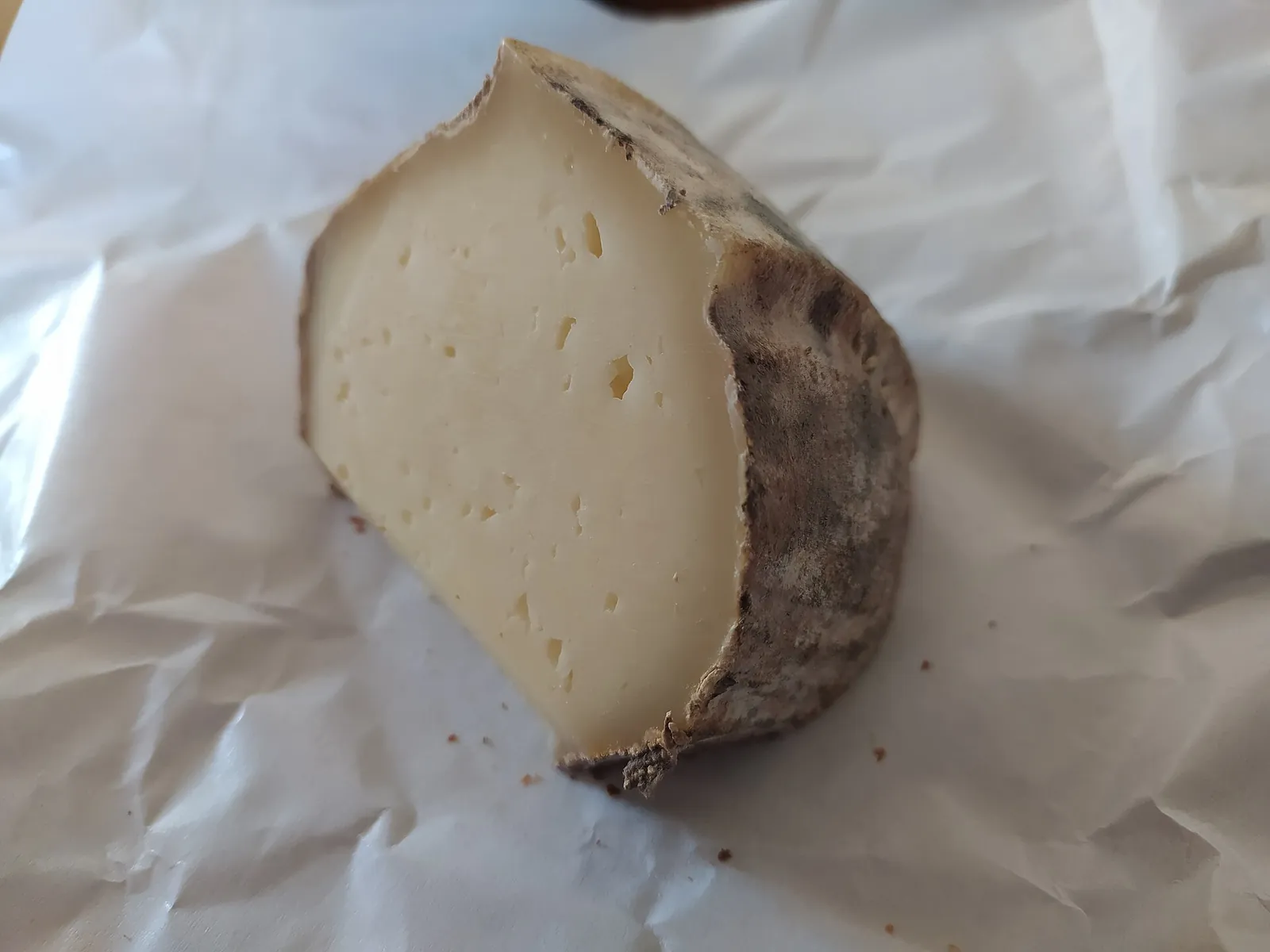
"Tomme" is a round, pressed mountain cheese and "brebis" is ewe, so the label can sit on anything from a farmhouse wheel in the Pyrenees to a supermarket round.
That is why two cheeses called tomme de brebis can taste quite different. What stays constant is sheep's milk: rich, sweet and a little nutty, with more fat and protein than cow's milk, which is why even a young wheel eats rounder than a cow's milk tomme of the same age.
Tomme de brebis at a glance
Here is tomme de brebis at a glance, using the protected cheeses that cover it in the Pyrenees.
| Detail | Tomme de brebis |
|---|---|
| Milk | Sheep (ewe) |
| Style | Round, pressed, uncooked mountain cheese |
| Best-known home | Béarn and the Basque Country, in the French Pyrenees |
| Protected name | None for the style; Ossau-Iraty AOP is the sheep-only one |
| Rind | Dry natural rind, ocher yellow to ashen gray on classic farm wheels |
| Texture | Firm but supple, ivory paste, sometimes a few small holes |
| Flavor | Nutty and buttery, with hay and dried fruit notes |
What tomme de brebis covers
Tomme de brebis covers any sheep's milk tomme, and no law says which cheeses may use the words. A cheesemaker in the Pyrenees, a dairy in the Basque Country and a producer elsewhere can all put them on a label. Shop by the more specific name when you can: the producer, the valley or the protected name.
The style comes from the mountains. The INAO, the French body that oversees protected names, notes that the Pyrenean tomme was designed as a keeping cheese, made by shepherds in summer, and that a cellar, boards and a brush were enough to age it before sale. A round that keeps is why the style spread: it could be carried down in autumn and eaten through winter.
Pyrenees sheep tommes and the protected names
Pyrenees sheep tommes fall under two protected names, and mixing them up is the most common mistake. Ossau-Iraty is an AOP (protected designation of origin) made only from the milk of three local sheep breeds in Béarn and the Basque Country; the Ossau-Iraty page covers its rules, breeds and flavor in depth.
Tomme des Pyrénées is a different thing. The INAO product sheet says this PGI (protected geographical indication, recognized in 1996) may be made from cow's, goat's or sheep's milk, or a mix, and that sheep's milk is allowed only in a mix. Most of it is a black-coated dairy tomme, and the sheet describes the black-rind version as concentrating the tart character of whey. So a Tomme des Pyrénées is not a sheep tomme by default. The PDO and PGI guide explains why those two labels promise different things.
For a pure sheep's milk tomme from the Pyrenees, look for Ossau-Iraty on the label. Other farm tommes may be pure sheep too, but then you are relying on the producer's word.
Tomme de brebis flavor and texture
Tomme de brebis flavor is nutty and buttery, with a slight sweetness from the milk and, on farm wheels, hay, dried fruit or fern. Young wheels are supple and mild; longer aging firms the paste and sharpens the savory edge without making it hard. The rind is dry and natural, from ocher yellow to ashen gray on the classic Basque wheels of about 4 pounds (2 kg); the larger Béarn wheels of around 9 pounds (4 kg) carry a thinner, sticky rind in red-orange to brown, according to the Ossau-Iraty press kit, and smell stronger, sometimes of the forest floor.
Sheep's milk makes the paste feel richer than its age suggests. A three-month sheep tomme tastes fuller than a three-month cow's milk one, so do not judge it as "mild" from the label.
How to buy tomme de brebis in the US
Buying tomme de brebis in the US is easiest at a cheese counter that cuts to order. Ask for the producer or region and whether it is raw or heat-treated milk. Wedges of Ossau-Iraty are the most reliable find; other Pyrenean sheep tommes turn up at specialty shops and in mixed cheese cases.
Raw-milk cheese sold in the US must be aged at least 60 days, and the Ossau-Iraty rules require at least 80, so raw-milk wheels can come in legally; the raw-milk cheese guide covers who should be careful. A good wedge looks ivory to pale yellow with a dry, intact rind and no wet or sticky patches on the paste.
How to use tomme de brebis
Tomme de brebis works first as a table cheese and then as a melter. Serve it at about 60 F (16 C), which is the temperature the Ossau-Iraty press kit says brings out its flavor, so take it out of the fridge an hour before the meal. The classic Basque partner is black cherry jam, and the cheese and jam guide covers other fruit spreads; honey and crusty bread also work.
For cooking, a young to medium wheel slices and melts cleanly over toast, into omelets and across the top of baked potatoes. Aged wheels grate onto pasta or soup like a mild Pecorino.
What most tomme de brebis advice gets wrong
Most tomme de brebis advice treats the name as a cheese you can pin down, and that costs you at the counter.
The words are not a guarantee
The words "tomme de brebis" guarantee only a sheep's milk tomme, so they say nothing about region, age or raw versus heat-treated milk. If the rind is wet and the wedge sweats, put it back, whatever the label says.
A black rind is not a sign of sheep
A black rind is not a sign of sheep's milk. The Tomme des Pyrénées sheet says the black-coated dairy version is the majority of what is made and that sheep's milk is allowed there only in a blend.
Tomme de brebis tastes flat served cold
Tomme de brebis tastes flat straight from the fridge, because cold dulls sheep's milk fat. Let it warm before serving, then rewrap the rest.
Substitutes for tomme de brebis
The best substitutes for tomme de brebis are other pressed sheep's milk cheeses. Ossau-Iraty is the closest. Manchego is a Spanish sheep cheese in the same firm, nutty family, and Idiazabal is a Basque-country relative with a smoky edge. If you only have cow's milk, Tomme de Savoie is a mild stand-in; the substitute finder lists more.
Questions about tomme de brebis
These are the questions about tomme de brebis that come up most.
What does tomme de brebis mean?
Tomme de brebis means a sheep's milk tomme: "tomme" is a round, pressed mountain cheese and "brebis" is ewe.
Is tomme de brebis one specific cheese?
Tomme de brebis is not one cheese but a category, so the label covers many wheels from many producers. Ossau-Iraty is the best-known protected one.
Is Ossau-Iraty a tomme de brebis?
Ossau-Iraty is a tomme de brebis in style, and it is also an AOP with strict rules: only milk from three local breeds, made and aged in Béarn and the Basque Country, at least 80 days.
What does tomme de brebis taste like?
Tomme de brebis tastes nutty, buttery and gently sweet, with a firm but supple paste that gets drier and more savory with age.
What goes with tomme de brebis?
Black cherry jam is the Basque classic with tomme de brebis, and honey, nuts and crusty bread suit it too. The pairing guide lists wine and fruit matches.
Your first tomme de brebis
For your first tomme de brebis, buy a small wedge of Ossau-Iraty cut to order, let it warm up and eat it with a spoonful of black cherry jam and bread. If you like it, try a pure sheep farm tomme from the same region next to compare.
Sources
- Tomme des Pyrénées (IG/50/94) product sheet, INAO (Institut national de l'origine et de la qualité)
- Dossier de presse Ossau-Iraty AOP, June 2018, Syndicat de défense de l'AOP Ossau-Iraty
- Ossau-Iraty, Syndicat de défense de l'AOP Ossau-Iraty