
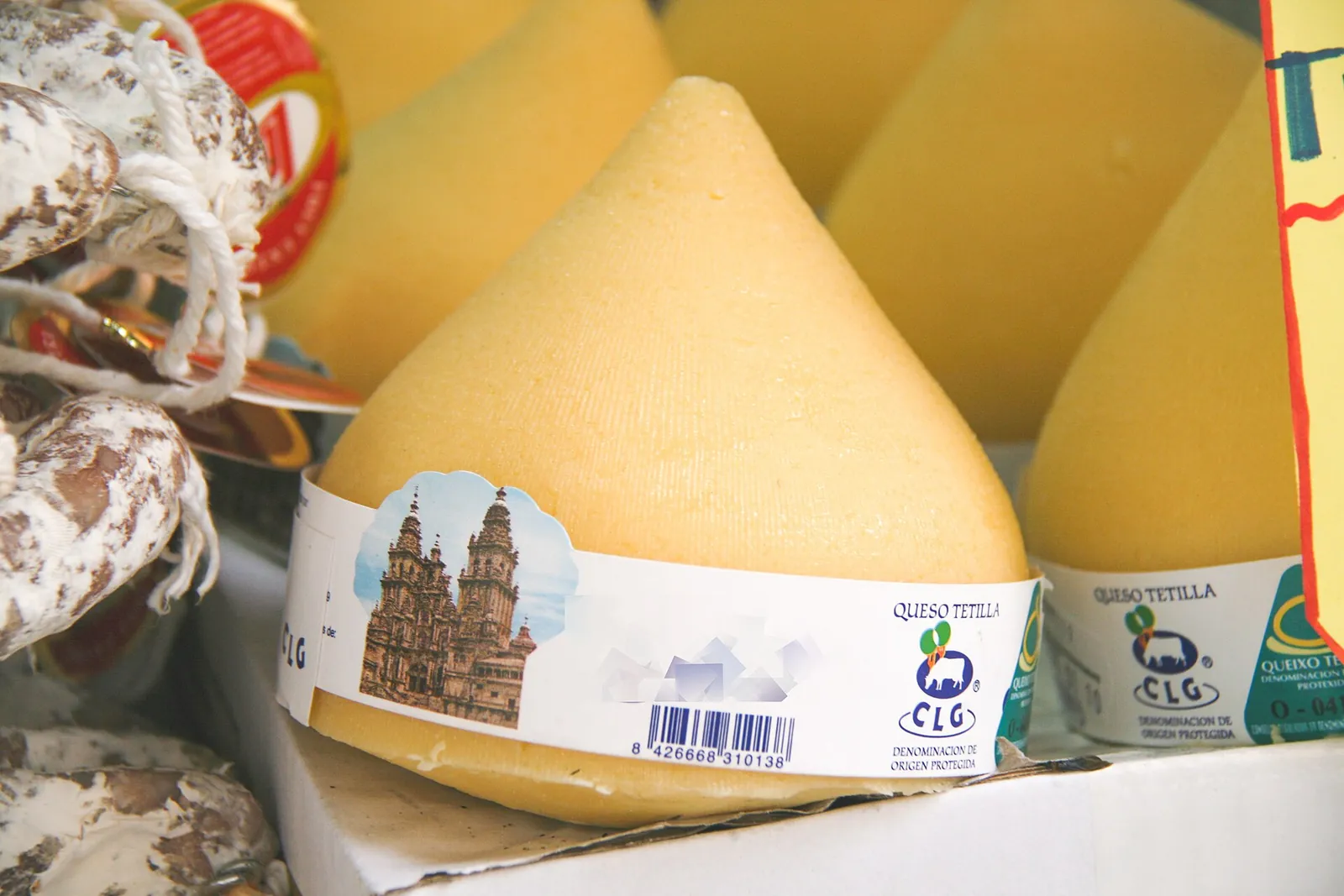
It is ripened for only about a week, so it stays creamy, milky and slightly tangy, and it works as well melted as it does sliced.
The name is Spanish for a small breast, and the product specification itself describes the shape that way. The shape is part of what is protected, which makes Tetilla one of the few cheeses whose silhouette is written into law.
Tetilla cheese at a glance
This Tetilla cheese at a glance table is drawn from the regulation behind the protected name and the EU amendment record.
| Detail | Queso Tetilla |
|---|---|
| Milk | Cow's milk from Friesian, Brown Swiss (Pardo Alpina) and Rubia Gallega cattle |
| Made in | Galicia, Spain |
| Protected name | PDO, EU No PDO-ES-0088 |
| Shape | Cone, convex-conical; base and height 90 to 150 mm |
| Weight | 0.5 to 1.5 kg |
| Aging | At least 7 days after salting |
| Rind | Thin (under 3 mm), straw yellow, no molds |
| Paste | Soft, creamy, ivory-white, few small holes |
| Fat | At least 45 percent of the dry matter |
What the Tetilla cheese name protects
The Tetilla cheese name protects the milk, the region and the shape. The regulation behind the name, published in Spain's official gazette in 1993, says milk comes from cows in Galicia, of the Friesian, Brown Swiss (Pardo Alpina) and Rubia Gallega breeds. It bans powdered milk, other caseinates and added fat, including butter, and any treatment meant to alter the rind.
Shape and size are fixed too: the height must be greater than the radius of the base and less than the diameter, with both between 90 and 150 mm. The EU application summary confirms the 0.5 to 1.5 kg weight and the seven-day minimum. A 2020 EU amendment record added a 10 percent margin on the base for cheeses over 1 kg, because wheels can swell slightly as they ripen. The PDO and PGI guide explains what the seal means.
How Tetilla cheese is made
Tetilla cheese is made by pressing the curd for at least three hours, salting it in brine of 17 to 18 degrees Baumé for no more than 24 hours, and ripening it at least seven days after salting. During those days the cheeses are turned and cleaned. That short clock is why the cheese is so soft: little moisture leaves it, and acid and salt have only a week to firm the paste.
The regulation puts dry matter at 45 to 50 percent, so half the cheese is water. That water is also why Tetilla melts into a smooth, stretchy layer instead of breaking.
Flavor and texture of Tetilla cheese
The flavor of Tetilla cheese is milky, buttery, slightly acidic and mildly salty, and the smell is soft and a little acidic, reminding you of the milk. The paste is soft, creamy and even, ivory-white to yellowish, with a few regularly spaced holes. The rind is thin, elastic and straw yellow.
Because it ripens so briefly, there is no wide age range to taste through. A Tetilla a few weeks old tastes about like one a few days old, just a bit firmer near the rind. It is mild by design, which is why it sits easily in a group of mild cheeses.
How to buy Tetilla cheese in the US
Buying Tetilla cheese in the US usually means a specialty cheese shop or an online importer. Look for the cone shape, an unbroken straw-yellow rind and a firm but slightly yielding feel. A cheese this young should not smell sharp or ammoniated.
A cheese ripened only seven days can legally reach the US only if it is made from pasteurized milk, since US rules require raw-milk cheeses to age at least 60 days; the raw-milk cheese page has the rule. Spanish-style "Tetilla" from outside Galicia lacks the protected name, so look for the PDO on the label.
How to use Tetilla cheese
Use Tetilla cheese where you want mild and creamy: sliced on bread with quince paste or fruit, cubed for a snack, or melted onto toast and sandwiches. It melts smoothly, which makes it a fair choice for grilled cheese. Galician cooks pair it with white wines like Albariño, and light reds and cider work as well. The white wine and cheese guide shows why crisp, acidic whites suit it.
A soft cheese like this should come out of the fridge about 30 minutes before serving. Store it wrapped in the fridge and eat it within a week or two.
What most Tetilla cheese advice gets wrong
Most Tetilla advice stays on the shape and skips the practical points.
Tetilla cheese is not aged
Tetilla cheese is not aged in the usual sense, because the rule requires only seven days of ripening. Do not buy it expecting depth that comes from months in a cellar; buy it for freshness.
Tetilla cheese is not a spreadable fresh cheese
Tetilla cheese is not a spreadable fresh cheese like cream cheese. It is a pressed, brined cheese with a rind and a sliceable paste, closer to a young Havarti.
Tetilla cheese shape is not a gimmick
Tetilla cheese shape is not a gimmick, since the specification fixes it. A flat wedge cut from something shaped differently is not Tetilla.
Questions about Tetilla cheese
These are the questions about Tetilla cheese that come up most.
Why is Tetilla cheese shaped like that?
Tetilla cheese is shaped like a cone because the product specification requires a convex-conical form, which the EU record describes as that of a female breast. The name means exactly that in Spanish.
What does Tetilla cheese taste like?
Tetilla cheese tastes milky and buttery with a slight acidity and mild salt, and its paste is soft and creamy.
How long is Tetilla cheese aged?
Tetilla cheese is aged for at least seven days after salting under the protected name, which is why it stays soft and mild.
Does Tetilla cheese melt?
Tetilla cheese melts smoothly because it is moist and young. Cured or aged cheeses are drier and melt less smoothly.
What is a good substitute for Tetilla cheese?
For Tetilla cheese, Havarti or Monterey Jack are the closest stand-ins for its mild, creamy melt. The substitute finder has more.
Your first Tetilla cheese
For your first Tetilla cheese, slice it on toast with quince paste and pour a glass of Albariño. If you like Spanish cheese with a more savory edge, move on to Manchego or the powerful blue Cabrales.
Sources
- Regulation of the Denominación de Origen "Queso Tetilla" (BOE no. 308, 1993), eAmbrosia, European Commission
- Queso Tetilla / Queixo Tetilla, PDO-ES-0088-AM02: approved minor amendment, eAmbrosia, European Commission
- Queso Tetilla application summary, Regulation (EEC) No 2081/92, eAmbrosia, European Commission