
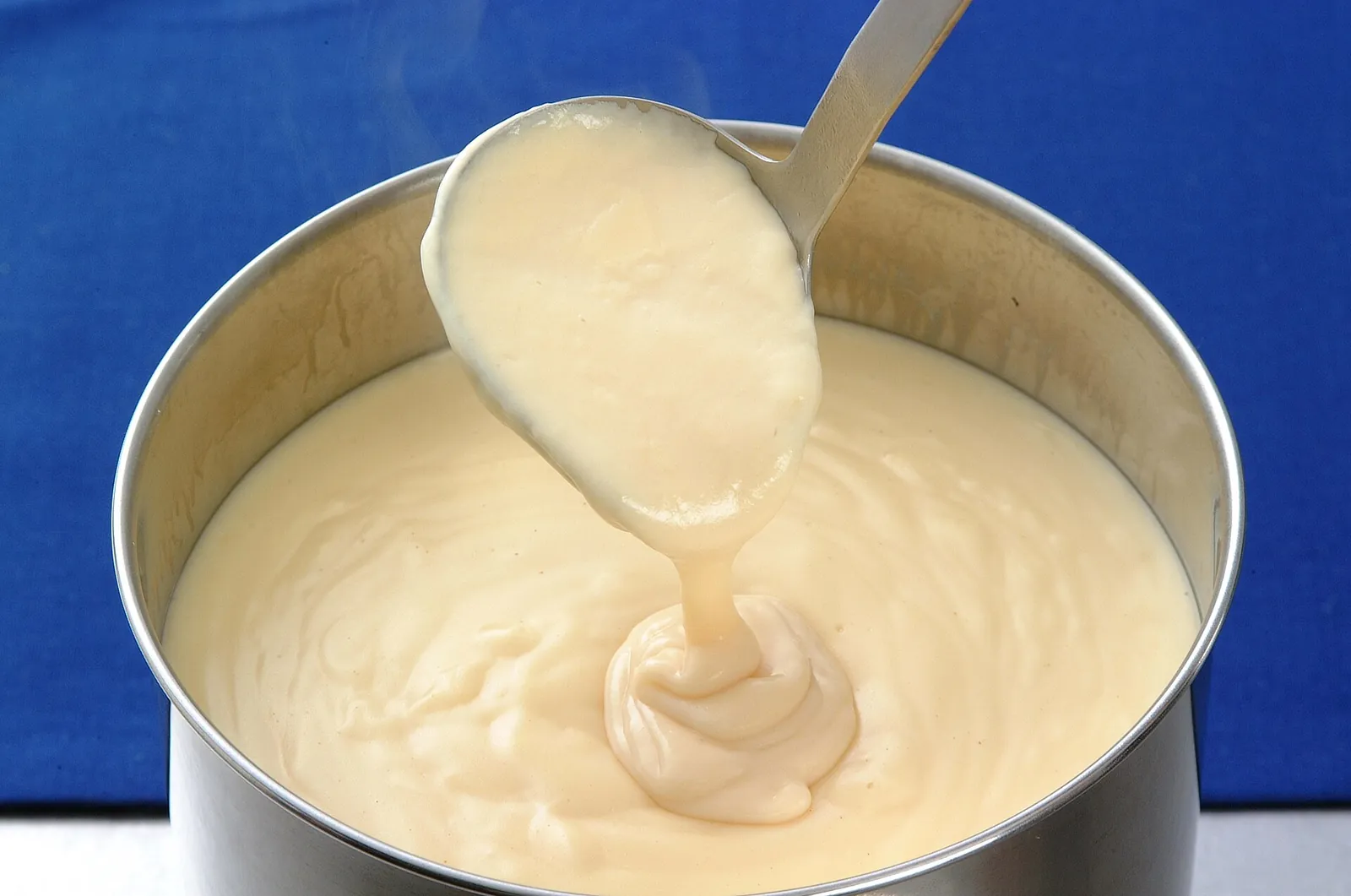
Anything that keeps those proteins apart, whether starch, emulsifying salts or just gentle heat, keeps the sauce smooth.
This page is the explanation. If you want the working recipe, the cheese sauce recipe walks through a roux-based version step by step.
Why cheese sauce splits: cheese is a held-together emulsion
Cheese is an emulsion of fat and water held in a mesh of casein protein, and calcium is what ties that mesh together. When you cold-slice a block, the structure is firm and stable. Heating melts the fat and softens the mesh, and from there the sauce is either smooth or broken depending on what happens to the proteins.
The US standard for cheddar shows how little help natural cheese gets: it caps moisture at 39 percent by weight and the FDA cheddar standard lists no emulsifying agents among the allowed ingredients. A cheddar sauce is just fat, protein and water, with nothing added to keep them together. The rest of the sauce has to do that job.
How heat makes cheese sauce split
Heat makes cheese sauce split because hot proteins contract and bond to each other, wringing out fat and water. A sauce that was glossy at a bare simmer can turn oily within a minute of a hard boil. Overheating is the most common cause, and the easiest to avoid: add cheese off the heat or at the lowest setting, and keep the pot below a simmer afterward.
Reheating works the same way. Microwaving a cold sauce on full power overheats the edges first, which is why leftover cheese sauce breaks so often. Low heat, a splash of milk and constant stirring reverse the damage when it is caught early.
How aged cheese and acid break a cheese sauce
Aged cheese breaks a sauce because aging dries the cheese and tangles its proteins. America's Test Kitchen describes how cheeses like Gruyère separate when melted: water evaporates over time, and aged proteins clump into tight groups that are too wrapped up in each other to emulsify well. That matches kitchen experience, where a 6-month cheddar melts better than a 3-year one. It is also why aged versus young cheddar matters at the stove.
Acid pushes the same way. Wine, beer, lemon juice or tomato lowers the sauce's pH and pulls calcium out of the protein mesh in a clumsy way, leaving stringy or sandy curds instead of a smooth blend. A little acid brightens a sauce, which is why fondue recipes use wine and sometimes a starch to offset it, but a lot of it at once splits the sauce. Add acid last and in small amounts.
How starch stabilizes cheese sauce
Starch stabilizes cheese sauce by getting in the way: swollen starch granules and thickened liquid physically separate the proteins so they cannot clump, and they hold fat droplets in place. This is the job flour does in a béchamel, and why a roux-thickened sauce is more forgiving than cheese and milk alone. A teaspoon of cornstarch stirred into cold milk and added to a sauce does it in a pinch.
Starch has limits. It makes a sauce that stays smooth through a normal dinner, but it will not rescue a sauce boiled hard or loaded with very aged cheese. It also thickens the sauce, which is why the best roux-based sauces stay a little thinner than you think they should at the pan.
How sodium citrate and emulsifying salts work
Sodium citrate and other emulsifying salts work by removing the calcium that holds casein together. The Cook's Illustrated explanation is that sodium takes the place of some of the calcium helping aged proteins cling, so that when the cheese is heated the proteins separate from one another and act as emulsifiers again. They grab fat on one side and water on the other, which is exactly what a smooth sauce needs.
This is also why processed cheese melts without breaking. The FDA's pasteurized process cheese standard permits emulsifying agents including sodium citrate, potassium citrate, calcium citrate and several phosphates, up to 3 percent of the weight of the finished cheese. The processed vs natural cheese page covers the labels, and the Velveeta guide covers a product built this way.
At home, a small pinch of food-grade sodium citrate dissolved in warm milk before the cheese goes in lets a young cheddar melt like a deli slice. Start with a small amount and follow the package, because the right dose depends on the cheese and the volume. The sauce can then be reheated and stay smooth. A slice or two of American cheese delivers a similar effect, because the salts are already in it.
Cheese sauce troubleshooting table
This cheese sauce troubleshooting table matches what you see in the pan to the cause behind it and the fix.
| What you see | Likely cause | Fix |
|---|---|---|
| Oil slick on top | Overheated | Off heat, whisk in warm milk |
| Sandy, grainy texture | Aged or pre-shredded cheese, or too much acid | Use medium-aged cheese; add acid last |
| Stringy clumps | Too much acid, or heat after cheese | Blend with a stick blender and a spoon of cornstarch slurry |
| Thin and watery | Not enough starch | Add a cornstarch slurry and heat gently |
| Breaks on reheating | Sauce not stabilized | Reheat low with milk; use sodium citrate next time |
For ready-made choices, the best melting cheeses ranks cheeses by how they behave, and the mac and cheese guide shows the same rules applied to pasta.
Questions about why cheese sauce splits
These questions about why cheese sauce splits cover the quick answers.
Why does cheese sauce turn oily?
Cheese sauce turns oily when the proteins tighten from heat and squeeze out fat. Take it off the heat and whisk in warm milk before it goes further.
Why is cheese sauce grainy?
Grainy cheese sauce comes from aged cheese, pre-shredded cheese coated in anti-caking agents, or too much acid. Use freshly grated, medium-aged cheese.
Does sodium citrate really work in cheese sauce?
Sodium citrate works in cheese sauce because it replaces calcium in the protein network, so the proteins emulsify the fat. It is the same family of salts the FDA allows in process cheese.
Does flour or cornstarch keep cheese sauce from splitting?
Flour or cornstarch keeps cheese sauce from splitting by thickening the liquid and keeping the proteins apart. It protects against normal handling, not against boiling.
Can a broken cheese sauce be fixed?
A broken cheese sauce can be fixed when caught early: pull it off the heat, whisk in warm milk, and add a cornstarch slurry if needed.
Cheese sauce science in short
Cheese sauce science comes down to keeping the proteins apart: gentle heat, medium-aged cheese, a little starch or a pinch of emulsifying salt. Next time a sauce breaks, check the heat first, then the cheese's age, then the acid. The working method is in the recipe page.
Sources
- 21 CFR 133.113, Cheddar cheese, Legal Information Institute, Cornell Law School (FDA standard of identity)
- 21 CFR 133.169, Pasteurized process cheese, Legal Information Institute, Cornell Law School (FDA standard of identity)
- Cook's Illustrated Explains Sodium Citrate, America's Test Kitchen