
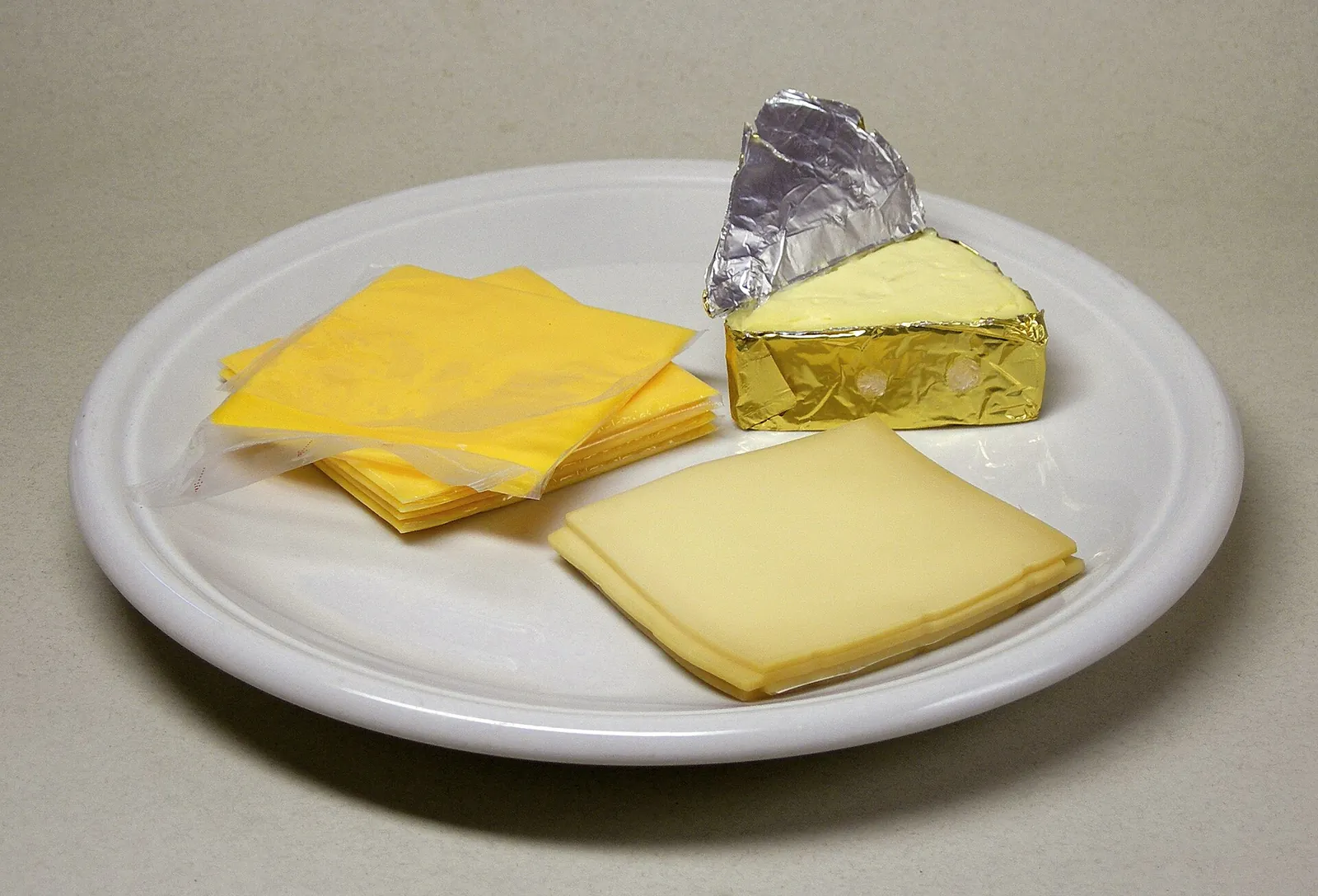
The step changes the melt, the shelf life and the label. The FDA gives process cheese, cheese food and cheese spread their own recipes, and a "cheese product" has none, so the name on the front tells you how much cheese you are buying.
Processed vs natural cheese at a glance
This processed vs natural cheese table compares natural cheddar with the four processed label names, using FDA standards and USDA data per ounce.
| Natural cheddar | Process cheese | Cheese food | Cheese spread | Cheese product | |
|---|---|---|---|---|---|
| Federal standard | 21 CFR 133.113 | 133.169 | 133.173 | 133.179 | None |
| Cheese in it | All of it | Made from cheese, plus salts and a few optional ingredients | At least 51% by weight | At least 51% by weight | Whatever the maker lists |
| Moisture limit | 39% at most | 43% at most for most cheeses; 40% for American | 44% at most | 44 to 60% | None |
| Milkfat | 50% of solids at least | No minimum | 23% at least | 20% at least | None |
| Emulsifying salts | Not allowed | Up to 3% of weight | Up to 3% | Up to 3% | Not set |
| USDA protein per ounce | 6.5 g | 5.1 g | 4.8 g | 4.7 g | 4.6 g |
| USDA fat per ounce | 9.4 g | 8.7 g | 7.3 g | 6.0 g | 6.5 g |
| USDA sodium per ounce | 185 mg | 474 mg | 364 mg | 461 mg | 363 mg |
The processed columns use USDA's American-style entries, as cheeses used for process cheese vary.
How processed cheese is made
Processed cheese is made by comminuting one or more natural cheeses and mixing them with heat and an emulsifying agent into a smooth mass. The FDA's process cheese standard says the mixture is heated at least 30 seconds at 150°F (66°C) or more, and that the emulsifying salts weigh no more than 3 percent of the finished cheese. It also allows cream or milkfat up to 5 percent, water, salt, color, spices, acidifying agents, mold inhibitors and lecithin.
Any cheese may go in except cream cheese, Neufchatel, cottage cheese, cook cheese, hard grating cheese, semisoft part-skim cheese, part-skim spiced cheese and skim milk cheese for manufacturing. That is why one pack can be made from cheddar and another from Swiss. Natural cheese has no second step. The cheddar standard lists color, calcium chloride, enzymes and a surface mold inhibitor as options, and no emulsifying salts.
Process cheese, cheese food, cheese spread and cheese product
Process cheese, cheese food, cheese spread and cheese product are four separate label names, and the cheese content falls as you go down the list. Process cheese is made entirely from cheese plus the allowed additions. Cheese food must be at least 51 percent cheese by weight, with 44 percent moisture at most and 23 percent milkfat at least, and it may include cream, milk, skim milk, buttermilk, whey and anhydrous milkfat.
Cheese spread is also at least 51 percent cheese, with 44 to 60 percent moisture, at least 20 percent milkfat and a spreadable texture at 70°F. It may carry stabilizers such as guar gum, carrageenan or xanthan gum, up to 0.8 percent of the weight combined. "Cheese product" has no standard, so its recipe is the maker's. The American cheese page shows how those names appear on Kraft slices, and the American vs real cheese comparison focuses on that one slice.
Why processed cheese melts so smoothly
Processed cheese melts so smoothly because the emulsifying salts change how its proteins hold fat. In natural cheese, calcium cross-links the casein proteins into a firm network, and heat squeezes fat out of it. The salts, usually citrates or phosphates, pull calcium out of that network, so the protein swells and coats the fat droplets and holds them in the melt instead of letting them pool.
The result is a slice or cube that softens evenly and does not go greasy. The same trick works at home: a pinch of food-grade sodium citrate in warm milk lets a young cheddar melt like a deli slice, as the science of a smooth cheese sauce shows. Processed cheese is also heated and packaged hot, which is why it keeps so well. The Velveeta guide covers a product that melts this way yet carries none of the three standard names.
Processed vs natural cheese nutrition
Processed vs natural cheese nutrition differs most in sodium: USDA lists 185 milligrams per ounce for cheddar and 474 for pasteurized process American, about two and a half times as much. Cheese food and cheese spread run 364 and 461 milligrams in USDA's entries.
Protein and fat drop as the cheese share drops. Cheddar has 6.5 grams of protein and 9.4 grams of fat per ounce, process American has 5.1 and 8.7, and the American-style cheese product has 4.6 and 6.5. Calcium is not a safe guess, since USDA lists 201 milligrams in cheddar and 296 in fortified process American. Compare the Nutrition Facts panels, and see low-sodium cheese options if salt is your concern.
When natural cheese is better
Natural cheese is better when flavor, texture or sodium count, and processed cheese is better when a melt must never break. Aging in natural cheese builds sharpness, crystals and complexity that a re-melted block cannot match, and its sodium is lower.
- Cheese boards, snacking and grating: natural cheese.
- Burgers, grilled cheese and nacho sauce: processed cheese, or natural cheese with sodium citrate.
- Baked pasta and pizza: low-moisture natural cheese such as mozzarella melts and stretches well on its own.
- Lower sodium: natural cheese, with a label check.
- A swap: young cheddar, Colby or Monterey Jack for process slices; the substitute finder lists more.
What most processed vs natural cheese advice gets wrong
Most processed vs natural cheese advice repeats three bits of shorthand: that processed cheese is not cheese, that all processed cheese is alike, and that processing makes it shelf-stable by chemicals alone.
Process cheese is made from cheese. The standard requires natural cheese as the base. Only the "product" names can drop below that, and the guide to reading a cheese label shows what to look for.
The names are not interchangeable. Process cheese, cheese food and cheese spread each have their own moisture and fat limits. A cheese product has none.
Heat does much of the keeping. The standard requires 150°F for 30 seconds, and the finished block is sealed, which is part of why it lasts. Check the date and storage line on the pack.
Questions about processed vs natural cheese
These are quick answers to common questions about processed vs natural cheese.
What is the difference between processed and natural cheese?
The difference between processed and natural cheese is one step. Natural cheese is curdled, drained and aged, while processed cheese is natural cheese ground, heated and blended with emulsifying salts, up to 3 percent of the weight, into a smooth, uniform product.
Is processed cheese real cheese?
Pasteurized process cheese is made from natural cheese, so it is real cheese in the FDA's terms. Cheese food and cheese spread must be at least 51 percent cheese, and a cheese product has no federal recipe.
Why does processed cheese melt better than natural cheese?
Processed cheese melts better than natural cheese because its emulsifying salts bind calcium and let the proteins keep fat spread evenly as it heats, so it does not separate. Natural cheese keeps its protein network and can split or turn greasy.
Is processed cheese unhealthy?
Processed cheese is not a separate health category, but USDA lists much more sodium per ounce, 474 milligrams for process American against 185 for cheddar. Check labels and use it where its melt matters.
What is the difference between cheese food and cheese product?
Cheese food has a federal standard that requires at least 51 percent cheese, up to 44 percent moisture and at least 23 percent milkfat. Cheese product has no standard, so the maker decides the recipe.
Choosing between processed and natural cheese
Choosing between processed and natural cheese is easiest with a taste test: melt a slice of processed cheese and a handful of young cheddar on toast side by side and compare. Then read the front of the processed pack, since the name tells you how much cheese is inside.
Sources
- 21 CFR 133.169, Pasteurized process cheese, 133.173, Pasteurized process cheese food and 133.179, Pasteurized process cheese spread, Legal Information Institute, Cornell Law School (FDA standards of identity)
- 21 CFR 133.113, Cheddar cheese, Legal Information Institute, Cornell Law School
- USDA FoodData Central (SR Legacy): Cheese, cheddar (173414), process American (170853), cheese food (171252), cheese spread (171254) and cheese product (171289), U.S. Department of Agriculture