
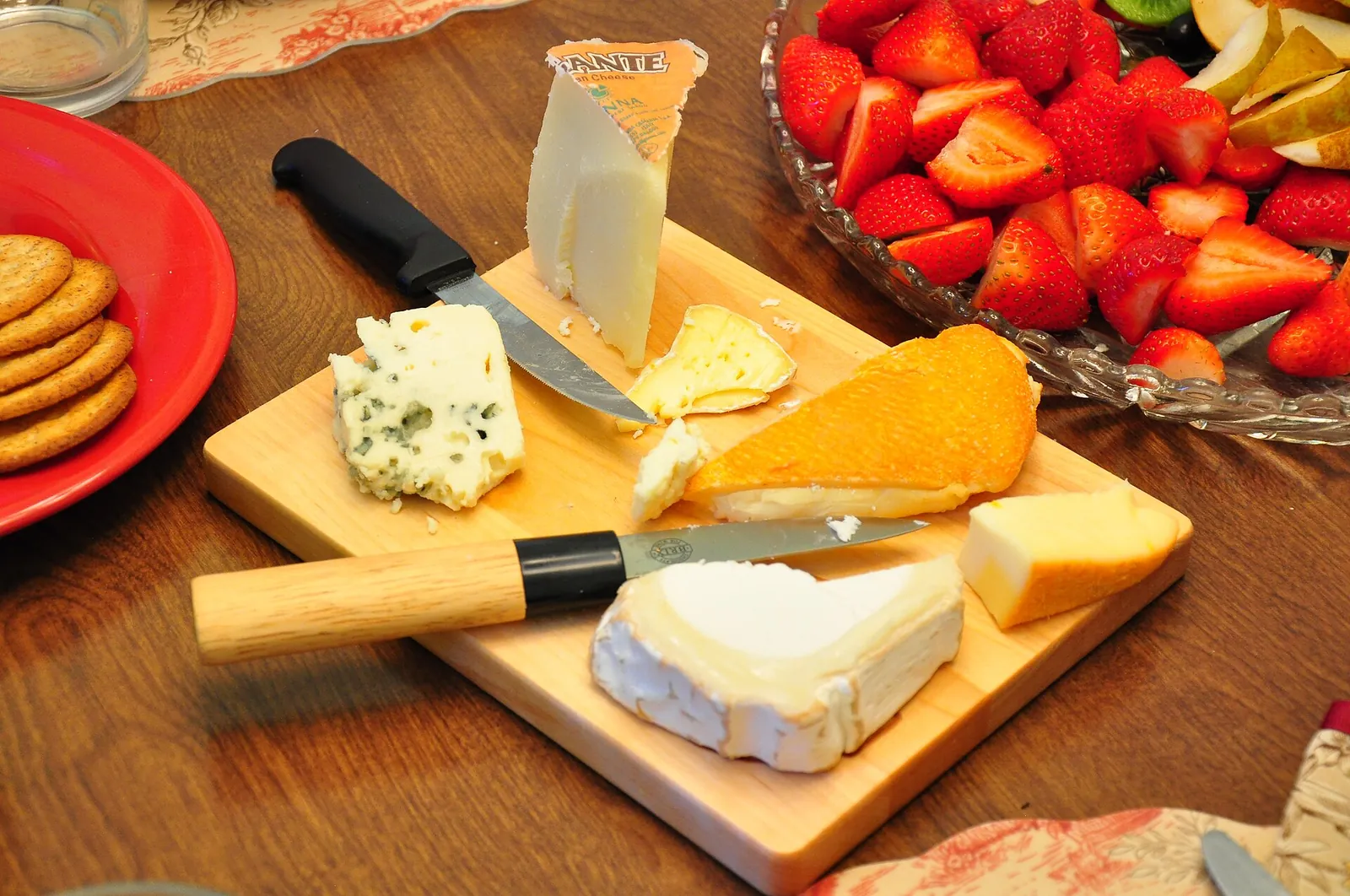
The groups are useful at the counter but fuzzier than they look. The only official yardstick is a moisture figure, and cheeses on either side of a boundary can be closer than their names suggest.
Soft vs semi-soft vs hard cheese at a glance
This soft vs semi-soft vs hard cheese at a glance table gives each class, its moisture from USDA's generic entries (grams of water per 100 grams of cheese) and the best uses.
| Class | Typical examples | Water (USDA) | Best uses |
|---|---|---|---|
| Soft | Brie 48.4%, Camembert 51.8%, ricotta 73.7%, cream cheese 52.6% | About 48 to 80% | Spreading, baking whole, filling, boards |
| Semi-soft | Monterey Jack 41.0%, Muenster 41.8%, Limburger 48.4% | About 41 to 48% | Melting, sandwiches, sauces, snacking |
| Hard | Cheddar 36.7%, Swiss 37.6%, Gruyère 33.2% | About 33 to 38% | Slicing, melting, boards |
| Extra hard | Parmesan 30.0% | About 30% | Grating, shaving, finishing |
The water figures are plain moisture, so they cannot separate classes on their own; the standard corrects for fat, as the next section explains.
How soft vs semi-soft vs hard cheese is defined
How soft vs semi-soft vs hard cheese is defined starts with the Codex General Standard for Cheese (CXS 283). It sorts cheese by moisture on a fat-free basis (MFFB), which is the weight of moisture divided by the total weight minus the fat, times 100. Removing the fat matters because fat weighs a cheese down without adding water, so a rich cheese and a lean one with the same softness would otherwise read differently.
Its table gives these ranges:
| MFFB | Codex designation |
|---|---|
| Under 51% | Extra hard |
| 49 to 56% | Hard |
| 54 to 69% | Firm or semi-hard |
| Over 67% | Soft |
Two things stand out. The bands overlap, so a cheese at 55 percent could be called hard or semi-hard. And Codex has no term "semi-soft": it goes soft, firm or semi-hard, hard, extra hard, with ripening named separately. "Semi-soft" is a trade word that cheese counters and cheese books use, generally for the supple middle of the range.
Running USDA's numbers through the formula shows where common cheeses land. Parmesan comes to about 40 percent MFFB, Gruyère 49, Swiss and cheddar 55, Gouda 57, Monterey Jack 59, Muenster 60, whole-milk mozzarella 64, Limburger 67, Brie 67 and ricotta 81. Brie sits right on the soft line, and a cheese at 59 to 60 percent, like Monterey Jack and Muenster, is what the trade calls semi-soft.
Soft cheese: examples and uses
Soft cheese is the group above roughly 67 percent MFFB, and it splits into fresh and ripened kinds. Fresh ones, like ricotta, cottage cheese and cream cheese, are wet and mild. Ripened ones, like Brie and Camembert, are softened from the outside in by a white mold and turn runny at room temperature.
Use soft cheese where you want spreadable or creamy: on toast, in fillings, baked whole in pastry, or as the mild piece on a board. They go off faster than other cheeses, so buy by the week. The related contrast of age is covered in fresh vs aged cheese.
Semi-soft cheese: examples and uses
Semi-soft cheese is the supple middle: firm enough to slice, soft enough to press with a thumb. Monterey Jack, Muenster, Havarti, young Gouda and fontina are the usual examples, and many washed-rind cheeses such as Taleggio and Reblochon belong here too, though their rind makes them stronger than the name suggests.
This is the melting class. Their moisture is high enough to keep the protein network loose and low enough that they do not weep, so they work in grilled cheese, quesadillas, mac and cheese and sauces. Look at the best melting cheeses for specific picks.
Hard cheese: examples and uses
Hard cheese is what is left after months of aging and drying, from about 49 to 56 percent MFFB, with an extra hard tier under 51. Cheddar, Gruyère, Swiss and Manchego are hard; Parmigiano-Reggiano and Pecorino Romano are extra hard.
The FDA's own limits show the range: its standards cap cheddar at 39 percent moisture and Parmesan at 32 (21 CFR 133.113 and 133.165). Use hard cheese for grating over pasta, slicing for a board, and for flavor in small amounts. Cheeses at the harder end of the class, Parmigiano-Reggiano for example, are poor candidates for a smooth sauce on their own.
What most soft vs semi-soft vs hard cheese advice gets wrong
Most soft vs semi-soft vs hard cheese advice treats the three words as official terms with fixed borders, and they are not.
The labels vary by source. Codex uses firm or semi-hard where US writers use semi-soft and semi-hard, and the ranges overlap. A cheese's class is a description, not a regulation.
Texture can change with age. A young Gouda is semi-soft and an old one is hard, and the same is true of cheddar, so a name does not fix a class.
Soft does not mean mild. Époisses is soft and loud, Parmesan is hard and also loud. Texture predicts melt and spreadability far better than it predicts strength.
Rind is a separate question. A soft cheese can have a bloomy rind, a washed one or none, which is covered in cheese rind types.
Questions about soft vs semi-soft vs hard cheese
These are quick answers about soft vs semi-soft vs hard cheese.
What is the difference between soft, semi-soft and hard cheese?
The difference between soft, semi-soft and hard cheese is moisture: soft cheese holds the most water and spreads or oozes, semi-soft is supple and sliceable, and hard cheese is dry, dense and often aged.
How are cheeses classified by hardness?
Cheeses are classified by hardness using moisture on a fat-free basis; the Codex General Standard for Cheese calls it extra hard under 51 percent, hard 49 to 56, firm or semi-hard 54 to 69, and soft above 67.
Is Brie a soft or semi-soft cheese?
Brie is a soft cheese: its USDA figures work out to about 67 percent moisture on a fat-free basis, which sits right at the soft boundary.
Which type of cheese melts best?
Semi-soft cheese melts best for most cooking, with Monterey Jack, young Gouda and fontina going smooth, while very hard cheese melts poorly and is better grated.
Is cheddar a hard or semi-hard cheese?
Cheddar is a hard cheese in the US trade and falls near the hard and semi-hard border in Codex terms, at about 55 percent MFFB by USDA data.
Choosing soft vs semi-soft vs hard cheese
Choosing soft vs semi-soft vs hard cheese starts with the task: soft to spread, semi-soft to melt, hard to grate or slice. A board that includes one of each gives variety, and the cheese board guide shows how to arrange it. Store them differently too, as in soft vs hard cheese storage.
Sources
- General Standard for Cheese (CXS 283-1978), Codex Alimentarius, FAO and WHO
- 21 CFR 133.113, Cheddar cheese and 133.165, Parmesan cheese, Electronic Code of Federal Regulations
- USDA FoodData Central (SR Legacy), water and fat per 100 g: Brie (172177), Camembert (172178), ricotta (171248), cream cheese (173418), Monterey (170844), Muenster (171245), Limburger (171243), Gouda (171241), cheddar (173414), Swiss (171251), Gruyère (171242), mozzarella (170845), Parmesan (170848)