
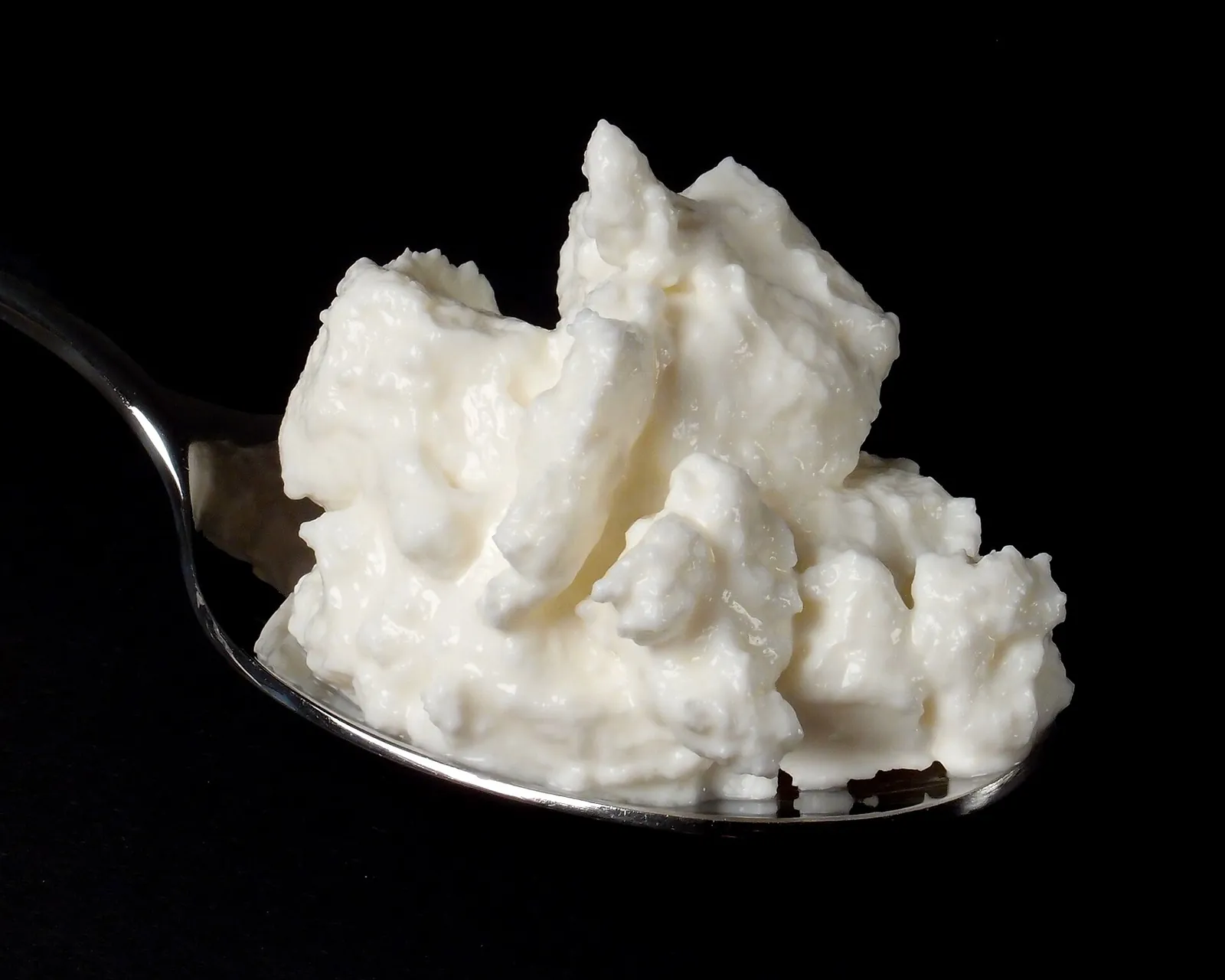
They are made differently, which explains the taste. Quark and cottage cheese are cheeses, Greek yogurt is a cultured milk strained to thickness, and that shows up in the sodium as much as in the texture.
Quark vs Greek yogurt vs cottage cheese at a glance
This quark vs Greek yogurt vs cottage cheese table compares texture, tang and nutrition per 100 g (about 3.5 ounces), using USDA data and a UK composition database for quark.
| Quark | Greek yogurt | Cottage cheese | |
|---|---|---|---|
| What it is | Fresh cheese soured with lactic bacteria | Yogurt with the whey strained out | Fresh curd cheese with a cream dressing |
| Texture | Smooth, thick, like sour cream but drier | Smooth, thick, creamy | Separate wet curds |
| Tang | Mild, gently sour | Most sour | Mild, salty, a little tangy |
| Protein | 14.6 g, fat-free | 10.19 g, nonfat | 12.39 g at 1%; 11.12 g creamed |
| Fat | 0 g, fat-free | 0.39 g, nonfat | 1.02 g at 1%; 4.3 g creamed |
| Calories | 75, fat-free | 59, nonfat | 72 at 1%; 98 creamed |
| Sodium | 45 mg, fat-free | 36 mg, nonfat | 406 mg at 1%; 315 mg creamed |
How they are made
How they are made explains the differences: quark, Greek yogurt and cottage cheese start from the same milk and end up as three different foods. Wikipedia's quark entry) says quark is soured with mesophilic lactic bacteria, with a little rennet added in industrial production while the milk is still around pH 6.1, then strained as it reaches about pH 4.6. About 80 percent of its dry matter is casein. The quark page has the German fat tiers.
Strained yogurt is regular yogurt with whey removed. Wikipedia notes the FAO standard asks for at least 5.6 percent protein in strained yogurt against 2.7 percent in regular, and that the liquid left behind is acid whey. Quark ferments with mesophilic bacteria and Greek yogurt with thermophilic ones, which is part of why yogurt tastes sharper.
Cottage cheese is a different build: curd cut, cooked and washed, then mixed with a creaming mixture. The federal cottage cheese standard calls for at least 4 percent milkfat and no more than 80 percent moisture in creamed cottage cheese, and a pasteurized creaming mixture. It also says a curd set by direct acid must be labeled "directly set" or "curd set by direct acidification." See the cottage cheese guide.
Texture and tang
Texture and tang are where the three diverge most. Quark and Greek yogurt are both smooth, but quark is slightly drier and denser, closer to sour cream, and cottage cheese is the only one with visible curds. Wikipedia notes quark can range from a little crumbly, like ricotta, to creamy.
On tang, Greek yogurt is the sourest, quark milder and cottage cheese the saltiest. If a recipe calls for one and you only have another, the closest swap is quark and Greek yogurt, which trade well in dips, bowls and baking. Cottage cheese needs blending first.
Nutrition: protein, fat and sodium
Protein, fat and sodium in these three vary less than the marketing suggests, except for sodium. Fat-free quark comes out highest in protein, at about 14.6 g per 100 g, according to the Nutrition Advance guide citing the UK CoFID database (32.12 g in a 220 g cup). USDA lists 1 percent cottage cheese at 12.39 g and nonfat Greek yogurt at 10.19 g.
Calories run the other way: Greek yogurt is lightest at 59 kcal per 100 g, then cottage cheese at 72 and quark at 75. Sodium is the real separator. Cottage cheese carries 406 mg at 1 percent, quark about 45 mg and Greek yogurt 36 mg, so people watching salt should check the cottage cheese tub. Full-fat versions shift all of these numbers, and brands vary. This is nutrition information, not medical advice. The high-protein cheeses list ranks cheeses by protein.
Which to pick: quark, Greek yogurt or cottage cheese
Which to pick, quark, Greek yogurt or cottage cheese, depends on the job:
- Breakfast bowls and smoothies: Greek yogurt for tang, or quark for a milder, thicker base.
- Dips and sour cream swaps: Greek yogurt, which is easy to find in any US store.
- Cheesecake and German baking: quark, which is the traditional base for Käsekuchen. Pat Greek yogurt dry first if you use it instead.
- Savory snacks: cottage cheese, with pepper, tomato or fruit.
- Lasagna and stuffed shells: drained, blended cottage cheese or quark; see the ricotta vs cottage cheese page for that swap.
- Low sodium: quark or Greek yogurt over cottage cheese.
What most quark vs Greek yogurt vs cottage cheese advice gets wrong
Most quark vs Greek yogurt vs cottage cheese advice treats them as interchangeable high-protein tubs, and it misses three differences.
Quark is a cheese, and Greek yogurt is not. The two taste alike on a spoon, but quark is soured and strained curd while Greek yogurt is yogurt with whey drained off. The yogurt vs cheese page covers the fermentation gap.
Cottage cheese is the salty one. At 406 mg of sodium per 100 g for the 1 percent tub, against 36 mg for nonfat Greek yogurt in USDA data, a swap changes the salt in a recipe by about ten times.
"Greek" does not guarantee protein. USDA's nonfat Greek yogurt has 10.19 g per 100 g, and Wikipedia reports strained yogurts ranging from 3.3 to 11 g of protein per 100 g. Quark and cottage cheese are not automatically lower. Compare the Nutrition Facts panel, not the front label.
Questions about quark vs Greek yogurt vs cottage cheese
These are quick answers to common questions about quark vs Greek yogurt vs cottage cheese.
What is the difference between quark, Greek yogurt and cottage cheese?
The difference between quark, Greek yogurt and cottage cheese is that quark is a smooth, mild fresh cheese, Greek yogurt is a strained, tangy yogurt, and cottage cheese is salty curds in a cream dressing.
Which has the most protein, quark, Greek yogurt or cottage cheese?
Fat-free quark has the most protein of the three, about 14.6 g per 100 g, ahead of 1 percent cottage cheese at 12.39 g and nonfat Greek yogurt at 10.19 g.
Can you substitute Greek yogurt for quark?
You can substitute Greek yogurt for quark in most recipes, since both are smooth and thick. Expect a tangier taste, and drain the yogurt first for baking.
Is quark healthier than Greek yogurt?
Quark is not clearly healthier than Greek yogurt: fat-free quark has more protein, while nonfat Greek yogurt has fewer calories, 59 against 75 per 100 g. The right pick depends on the brand and fat level.
Can you use cottage cheese instead of Greek yogurt?
Cottage cheese works instead of Greek yogurt in dips and bowls once it is blended smooth. It is saltier and less tangy, so taste before you add more salt.
Choosing between quark, Greek yogurt and cottage cheese
Choosing between quark, Greek yogurt and cottage cheese is easiest by sodium and texture: Greek yogurt for the easiest tang, quark for a mild, thick cheese if your store carries it, and cottage cheese when you want lumps and salt. Buy plain, unflavored tubs, and compare protein and sodium on the label before you commit.
Sources
- Quark (dairy product)), Wikipedia
- Strained yogurt, Wikipedia
- Quark: What Nutritional Benefits Does It Provide?, Nutrition Advance (citing the UK CoFID database)
- 21 CFR 133.128, Cottage cheese, Electronic Code of Federal Regulations (via Cornell Legal Information Institute)
- USDA FoodData Central (SR Legacy): Cheese, cottage, lowfat, 1% milkfat (173417), Cheese, cottage, creamed (172179) and Yogurt, Greek, plain, nonfat (170894)