
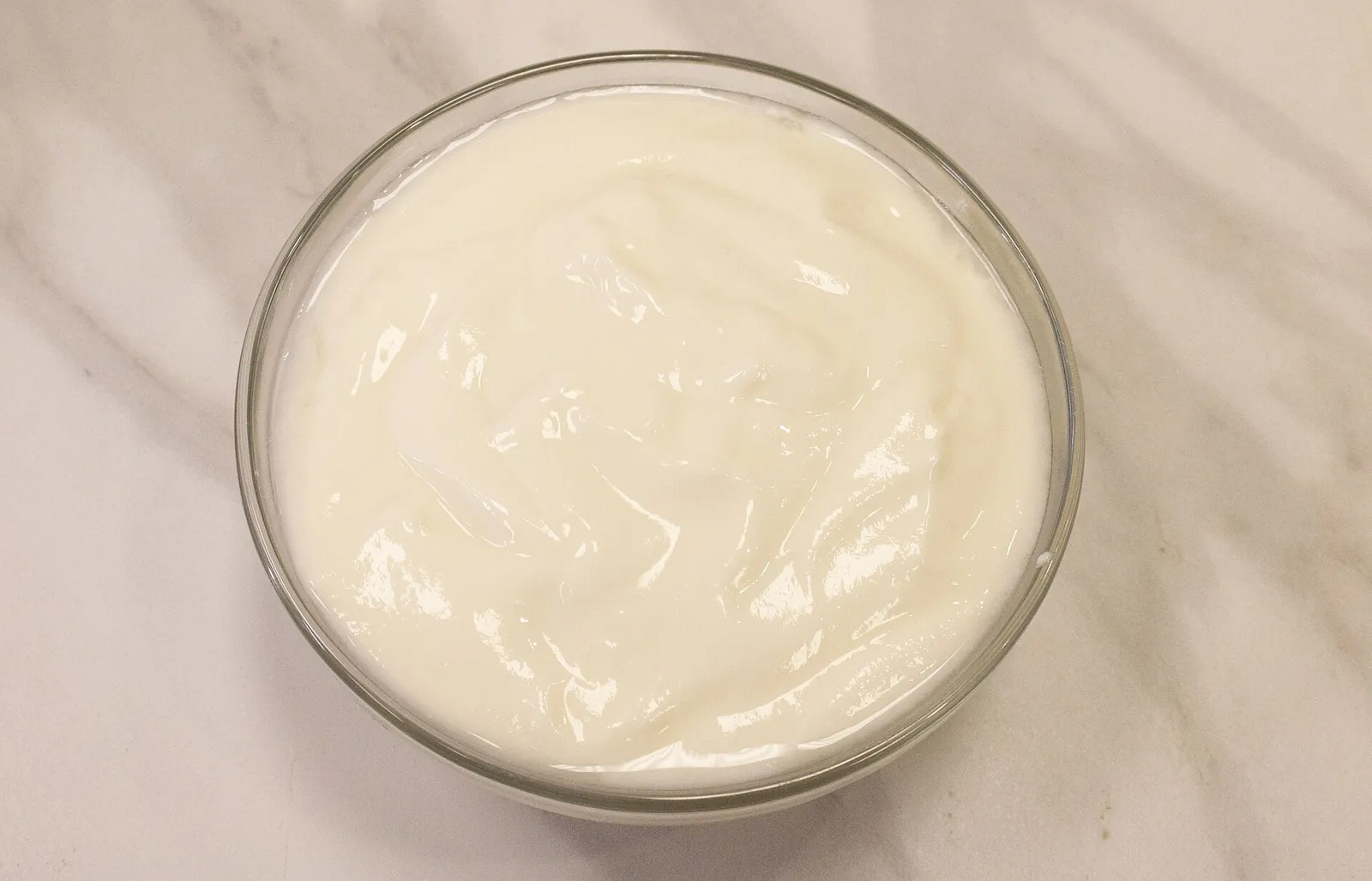
Both start as milk and both use bacteria, but only cheese separates the solids from the whey.
That one step changes everything downstream: how much lactose is left, how much salt is added, and whether the product keeps a week or years. Strained yogurt, such as Greek yogurt and labneh, sits between the two.
Yogurt vs cheese at a glance
This yogurt vs cheese table sets the main differences side by side.
| Yogurt | Cheese | |
|---|---|---|
| Starting point | Milk, heated, then cultured | Milk, cultured and curdled |
| Defining step | Fermentation sets the whole milk | Curd is cut and whey drained off |
| Cultures | Two named bacteria by law in the US | A starter culture chosen for the cheese |
| Rennet | Not used | Usually used (acid-set cheeses skip it) |
| Whey | Stays in (unless strained) | Drained away |
| Salt | Little to none | Added to most cheeses |
How yogurt is made
Yogurt is made by warming milk, adding live cultures and holding it warm until it thickens. A Missouri Extension yogurt guide has home cooks heat milk to 200°F, hold it for 10 minutes for thin yogurt, then incubate at 108 to 112°F for about 4 hours. The heat changes the milk proteins so the yogurt is firmer and the whey does not separate as easily. Above 115°F the culture can die, and below 100°F growth stops. A longer incubation gives a more tart yogurt.
The cultures eat lactose and make lactic acid, which gives yogurt its tang and thickness. The FDA standard sets the rules for yogurt sold in the US: it must be made with Lactobacillus delbrueckii subsp. bulgaricus and Streptococcus thermophilus, have at least 3.25 percent milkfat (with allowances for lower-fat types) and a pH of 4.6 or lower within 24 hours of filling (21 CFR 131.200). Nothing is drained: the whey stays in the pot.
How cheese is made
Cheese is made by curdling milk, cutting the curd and draining the whey. Penn State Extension describes the order: add a starter culture and wait for it to grow, add an enzyme such as rennet to coagulate the milk, then cut the mass so curds separate from the whey (Introduction to Making Cheese). After that the curd may be cooked, salted, pressed or aged, depending on the cheese.
Some cheeses skip rennet and use acid, like paneer and homemade cottage cheese, and others add it, like mozzarella. See rennet explained for the options. Because the whey is removed, the finished cheese is a concentrate of milk's protein and fat, which is why it is denser than yogurt.
Cultures in yogurt vs cheese
Cultures in yogurt vs cheese differ in how tightly they are specified. Yogurt has two legally required bacteria, named in the federal standard above. Cheese has no single set: each style uses a starter picked for its acidity, flavor and texture, and many add molds or other bacteria during aging.
A cheese culture and a yogurt culture are not interchangeable, but the roles overlap: in both, bacteria turn lactose into lactic acid. In yogurt, that acid is the whole point. In cheese, it helps the curd firm, drain and keep.
Strained yogurt: where the line blurs
Strained yogurt blurs the line because it takes yogurt and removes whey the way cheesemakers do. Penn State Extension notes Greek-style yogurt is centrifuged or strained after fermentation to concentrate the solids. Hang yogurt long enough and you have labneh; see labneh and how to make labneh. For the shelf comparison, quark vs Greek yogurt vs cottage cheese sets them side by side.
Yogurt vs cheese nutrition per 100 g
Yogurt vs cheese nutrition differs mostly in concentration: cheese has far more protein, fat, calcium and usually sodium per 100 g because the whey has been removed. This table uses the USDA FoodData Central SR Legacy data for 100 g (about 3.5 ounces).
| Food (USDA) | kcal | Protein | Fat | Sugars | Sodium | Calcium |
|---|---|---|---|---|---|---|
| Whole milk | 61 | 3.15 g | 3.25 g | 5.05 g | 43 mg | 113 mg |
| Yogurt, plain, whole milk | 61 | 3.47 g | 3.25 g | 4.66 g | 46 mg | 121 mg |
| Greek yogurt, plain, nonfat | 59 | 10.19 g | 0.39 g | 3.24 g | 36 mg | 110 mg |
| Cottage cheese, 1% | 72 | 12.39 g | 1.02 g | 2.72 g | 406 mg | 61 mg |
| Cheddar | 403 | 22.87 g | 33.31 g | 0.48 g | 653 mg | 710 mg |
| Mozzarella, low moisture, part skim | 295 | 23.75 g | 19.78 g | 1.9 g | 666 mg | 697 mg |
Plain whole-milk yogurt is nearly the same as whole milk in calories and fat, because nothing was removed. Strained yogurt and fresh cheese sit in between, and aged cheese is a different food by weight. A serving matters too: a 6-ounce yogurt cup is much bigger than the 1 to 2 ounces of cheese most people eat. This is nutrition information, not medical advice.
Lactose in yogurt vs cheese
Lactose in yogurt vs cheese differs because cheese loses lactose in the whey and yogurt does not. Penn State Extension says some of the lactose is drained with the whey during cheesemaking and some is used by the cultures, and aged cheese loses more because the cultures have more time (Selecting Cheese for Health). It gives Parmesan as 0 grams per ounce, Swiss as 0.02, cheddar as 0.07 and Brie as 0.13, against 12.32 grams in a cup of whole milk.
Yogurt's bacteria use up part of the lactose, but the whey stays, so the USDA's total sugars for plain whole-milk yogurt, 4.66 g, are close to milk's 5.05 g, while cheddar has 0.48 g. The numbers by cheese are in lactose in cheese, where a 2020 review gives cheddar at 0.5 g and fresh ricotta at 3.5 g per 100 g against 4.9 g in whole milk. Fresh cheese keeps more than aged. People with lactose intolerance differ, so follow your own tolerance and your doctor's advice.
What most yogurt vs cheese advice gets wrong
Most yogurt vs cheese advice gets the lactose point wrong in one of two ways. One says all fermented dairy is lactose-free. It is not: yogurt keeps most of milk's sugar, and fresh cheeses such as cottage cheese and ricotta keep a good share.
The other says all cheese is low in lactose. Aged hard cheeses are, but the range is wide, from under 0.01 g per 100 g for Parmigiano-Reggiano to 3.5 g for ricotta. The right comparison is style against style, not yogurt against cheese in general.
Questions about yogurt vs cheese
These questions about yogurt vs cheese cover the points readers ask most.
What is the main difference between yogurt and cheese?
The main difference between yogurt and cheese is that yogurt is fermented whole, while cheese is curdled and the whey drained off.
Is yogurt a cheese?
Yogurt is not a cheese, but strained yogurt such as labneh is used as one in cooking because the whey has been removed.
Does yogurt have more lactose than cheese?
Yogurt generally has more lactose than cheese, because whey stays in yogurt. Plain whole-milk yogurt has 4.66 g sugars per 100 g against 0.48 g in cheddar.
Do yogurt and cheese use the same cultures?
Yogurt and cheese cultures are different: US yogurt must use two named bacteria, while cheese uses a starter chosen for each style.
Can you make cheese from yogurt?
Making cheese from yogurt works by straining it, which gives labneh. A true rennet-set cheese needs fresh milk.
Choosing between yogurt and cheese
Choosing between yogurt and cheese depends on what you want from the plate. Pick yogurt for a light, tangy, spoonable food, and cheese for dense flavor in small amounts. To see the making difference yourself, try homemade cottage cheese and then a batch of yogurt from a Missouri Extension recipe, and compare the two.
Sources
- Making Yogurt at Home: Country Living Series, University of Missouri Extension
- Introduction to Making Cheese, Penn State Extension
- Selecting Cheese for Health, Penn State Extension
- 21 CFR 131.200, Yogurt, Cornell Legal Information Institute
- USDA FoodData Central, SR Legacy, U.S. Department of Agriculture