
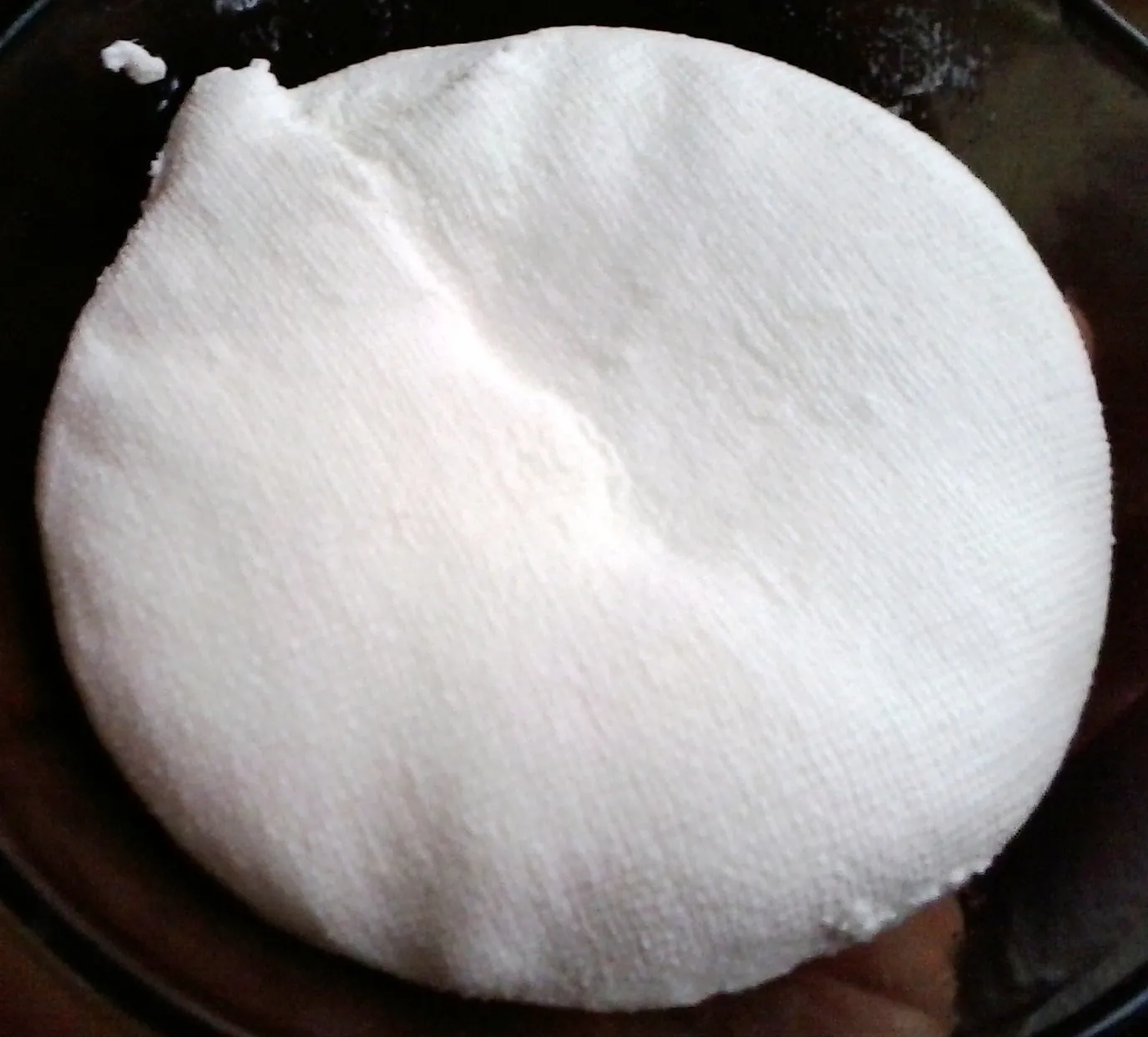
It has no rind, no aging and no culture.
The name is loose. It is not a protected name and, as far as this page can source, it is not a federal standard of identity, so a package labeled farmer's cheese can be soft and spreadable or dry and crumbly. What matters is how much whey is left in it, and at home you control that.
Farmer's cheese at a glance
This farmer's cheese at a glance table covers the recipe below and what the cheese is for.
| Homemade farmer's cheese | |
|---|---|
| Yield | About 12 oz (340 g) from 1 gallon of milk |
| Active time | About 30 minutes |
| Total time | About 1 hour for soft, 3 to 4 hours for pressed |
| Temperature | Heat milk to 185°F (85°C) |
| Milk | Pasteurized whole milk |
| Set with | White vinegar or lemon juice, no rennet |
| Make-ahead | Keeps a few days at 40°F (4°C) or below |
How to make farmer's cheese
Here is how to make farmer's cheese in about an hour of attention. It is the acid-set method, close to ricotta and paneer, with the milk heated hotter and drained or pressed to your chosen dryness.
Ingredients for farmer's cheese
These ingredients for farmer's cheese are a gallon of milk and two pantry items.
- 1 gallon (3.8 liters) pasteurized whole milk
- 1/4 cup (60 ml) white vinegar or fresh lemon juice, plus 2 tablespoons if needed
- 1 teaspoon fine salt
- Equipment: a heavy 6-quart pot, a thermometer, a slotted spoon, a sieve and a large piece of cheesecloth or thin cotton towel
Steps for making farmer's cheese
These steps for making farmer's cheese give a soft cheese at step 6 and a dry, pressed one at step 8.
- Pour the milk into the pot and heat it over medium heat, stirring every minute or two so the bottom does not scorch, until it reaches 185°F (85°C) and the surface steams and foams slightly.
- Remove the pot from the heat. Pour in the 1/4 cup vinegar in a thin stream while stirring gently for 10 seconds.
- Stop stirring and let the pot sit 10 minutes. The curds clump into soft white masses and the whey turns thin, cloudy and yellow-green. If the whey is still milky, stir in 1 more tablespoon of vinegar and wait 5 minutes.
- Line the sieve with damp cheesecloth over a large bowl or the sink. Ladle the curds into the cloth with a slotted spoon, then pour the rest through.
- Rinse the curds briefly under cool running water to remove the sharp vinegar taste. Skip the rinse if you used lemon juice and like a little tang.
- Sprinkle on the salt and fold it through gently. For a soft spread, gather the cloth, twist it, and let it drain 15 to 30 minutes until it is moist but holds together.
- For a drier cheese, tie the cloth into a bundle and hang it from a spoon for 1 to 2 hours, squeezing gently every 30 minutes.
- For a firm, sliceable cheese, wrap the curds into a flat block, set a plate on top with a quart jar or can of water as weight, and press for 2 to 4 hours, then chill it.
The best milk for farmer's cheese
The best milk for farmer's cheese is pasteurized whole milk, because the fat makes a tender, more yielding curd. Skim milk gives a squeakier, drier cheese with a smaller yield.
Look at the carton: a lot of long-life milks are ultra-pasteurized, and gentler pasteurization usually curdles better, so choose a carton that says only pasteurized when you can. The cottage cheese page and the cottage cheese recipe from University of Illinois Extension use vinegar to set a lean curd at 120°F; farmer's cheese uses hotter milk and a smaller amount of acid, and the curds are drained as a whole mass. Starting from raw milk? Read pasteurization at home first.
Farmer's cheese compared with similar cheeses
Farmer's cheese is easy to confuse with several fresh cheeses, and the differences are mostly in the milk, the set and how dry the curd ends up.
| Cheese | How it is set | Texture |
|---|---|---|
| Farmer's cheese | Acid and heat | Soft to dry and crumbly, drained or pressed |
| Ricotta | Acid and heat, often from whey | Soft, fine, moist |
| Paneer | Acid and heat | Pressed firm, slices and holds its shape in cooking |
| Cottage cheese | Acid or culture | Small moist curds in a creamy dressing |
| Quark | Culture, little or no rennet | Thick, smooth and spoonable |
Press a farmer's cheese long enough and you have something much like paneer; leave it soft and it resembles ricotta. Queso fresco, by contrast, is set with culture and rennet, not acid.
Using farmer's cheese in cooking
Farmer's cheese is at its best in cooking when it is dry, because dry cheese absorbs flavors and does not water down fillings. The cheese pierogi page uses 1 cup (about 8 oz or 225 g) of crumbled dry farmer's cheese, called twaróg in Polish, with mashed potato and fried onion. The same dry cheese goes into sweet fillings with sugar, an egg yolk and vanilla, into blintzes, and into baked cheese pastries.
The soft version works as a spread on toast with honey or herbs, on pancakes, or stirred into scrambled eggs in the last minute. If a recipe asks for dry farmer's cheese and yours is wet, press it again or squeeze it in cloth before you mix.
Farmer's cheese mistakes and fixes
These farmer's cheese mistakes and fixes cover the usual problems, and almost all are about heat or too much squeezing.
Tiny curds and a low yield. Milk that was not hot enough or was stirred too hard after the acid goes in gives fine, scattered curds. Reach 185°F and stop stirring once the acid is in.
Rubbery, squeaky cheese. Too much acid, boiling the milk or pressing too long toughens it. Add acid slowly and stop at the first clear whey.
Bland cheese. Salt it while the curds are still loose, since salt does not penetrate a dry block.
Sharp vinegar taste. Rinse the curds briefly in cool water, or use lemon juice.
Dry crumbles that will not hold. Press while the curds are still warm, which helps them knit into a block.
Storing farmer's cheese
Storing farmer's cheese means treating it as a perishable fresh cheese. Wrap or box it and keep it at 40°F (4°C) or below, and use it within a few days. New Mexico State University Extension lists the refrigerated life of soft cheeses at only five to seven days. Penn State Extension lists farmer's cheese among fresh cheeses made to be consumed within days or weeks. Discard any cheese that smells sour in a yeasty way, feels slimy or shows color. Pressed cheese can be frozen, but it turns crumbly and is best used in cooked dishes afterward.
Questions about farmer's cheese
These questions cover what farmer's cheese is and what can stand in for it.
What is farmer's cheese made of?
Farmer's cheese is made of milk and an acid such as vinegar or lemon juice, plus salt, with no culture or rennet in the acid-set version. The curds are drained, and sometimes pressed.
Is farmer's cheese the same as ricotta?
Farmer's cheese is not the same as ricotta, though they are close relatives. Ricotta is finer and moister, while farmer's cheese is drained or pressed until it crumbles.
Is farmer's cheese the same as cottage cheese?
Farmer's cheese is not the same as cottage cheese, which is small curds in a cream dressing. Dry curd cottage cheese is the nearest match to a pressed farmer's cheese.
What can replace farmer's cheese?
The best substitute for farmer's cheese is dry-pressed ricotta, quark or dry-curd cottage cheese, drained in cloth until crumbly. The pierogi page lists quark and drained ricotta as stand-ins.
Can you make farmer's cheese with lemon juice?
You can make farmer's cheese with lemon juice at the same quantity as vinegar. The flavor is brighter and a bit fruity.
Farmer's cheese is worth a Saturday
Farmer's cheese needs one pot, one acid and some patience at the sieve. Make a half batch the first time, press one half and leave one soft, and use the dry cheese in pierogi while it is still fresh.
Sources
- Making Homemade Cheese (E-216), New Mexico State University Cooperative Extension Service
- Home-Made Cottage Cheese (quick recipe), University of Illinois Extension
- Farmstead and Artisan Cheesemaking, Penn State Extension