
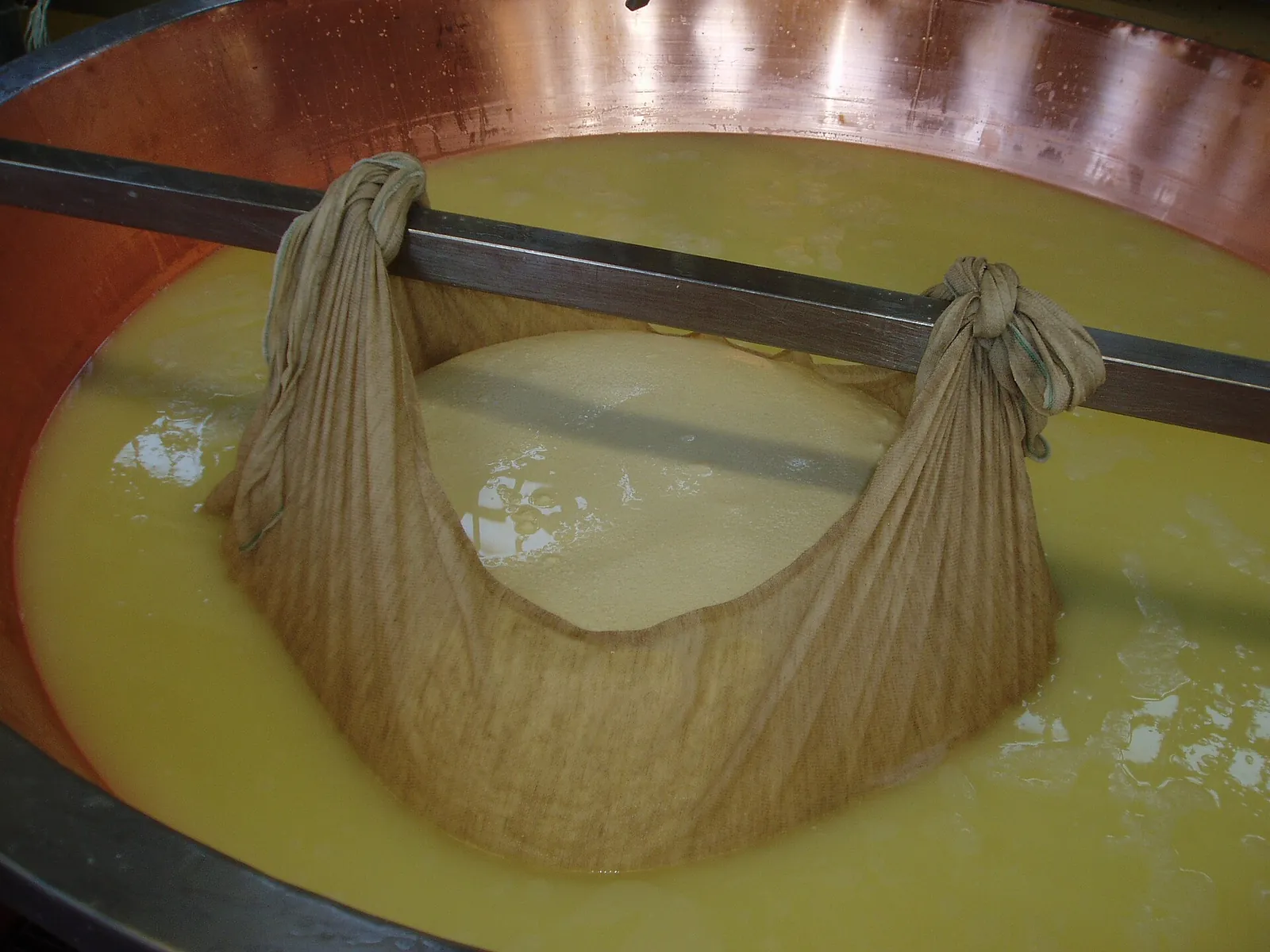
Bacteria sour the milk, rennet or acid sets it into a gel, and the gel is cut so whey can drain from the curd. Then comes cheese forming, when the curd is packed into molds and, for firm cheeses, pressed, before salt and time finish the job.
The idea that makes the rest click: cheesemaking is controlled water removal. Milk is about 87 percent water and cheddar about 38 percent, according to the University of Wisconsin's Center for Dairy Research, and 85 to 90 percent of the milk leaves the vat as whey. Cutting, cooking and pressing decide how much water stays, and that water sets how soft the cheese is and how fast it ripens.
The cheesemaking steps at a glance
The cheesemaking steps below run in order for a typical rennet-set cheese such as cheddar; fresh cheeses stop early and skip several.
| Step | What happens | How it changes the cheese |
|---|---|---|
| 1. Treat the milk | Pasteurized (161°F for 15 seconds) or used raw; fat adjusted; calcium chloride or annatto color may go in | Raw milk keeps its own enzymes for fuller flavor, but US raw-milk cheese must age 60 days |
| 2. Add starter cultures | Lactic bacteria turn milk sugar into lactic acid for 45 to 60 minutes | Acid speeds the set, pushes out whey, holds back spoilage bacteria, builds flavor |
| 3. Coagulate | Rennet sets warm milk to a gel in 30 to 40 minutes, or acid sets it with little or no rennet | Rennet curd can be cut, cooked and aged; acid curd makes soft fresh cheese |
| 4. Cut the curd | Gel cut from rice-grain size up to about 3/4 inch | Smaller pieces lose more whey, for a drier, harder cheese |
| 5. Cook and stir | Curd warmed slowly, to about 102°F for cheddar and 126°F for Swiss | More heat and acid shrink the curd: firmer, drier cheese |
| 6. Drain, wash or cheddar | Whey drained; some curd rinsed with water or stacked in slabs | Washing keeps a moist cheese from turning too acidic; cheddaring builds acid and texture |
| 7. Form and press | Curd packed into molds (forms or hoops); firm cheeses pressed | Sets size, shape and surface, and knits the curd into one piece |
| 8. Salt | Salt stirred into the curd, rubbed on, or brined | Slows acid, draws whey, checks spoilage, seasons |
| 9. Ripen | Days to years at a set temperature and humidity | Enzymes and microbes turn protein and fat into flavor and soften the body |
From milk to curd
Turning milk into curd takes three moves: treat it, sour it, set it.
Treating the milk
Treating the milk starts with choosing it: cow's, goat's, sheep's or buffalo milk, adjusted so its fat and protein suit the cheese. It is then used raw or pasteurized, which under the federal definition means heating every particle to 161°F (72°C) for 15 seconds or 145°F (63°C) for 30 minutes. Raw milk keeps its own enzymes and more traditional flavor, but US raw-milk cheese must age at least 60 days.
Starter cultures
Starter cultures are lactic acid bacteria that turn the milk's sugar, lactose, into lactic acid, usually for 45 to 60 minutes before the rennet goes in. Cheddar and most soft cheeses use mesophilic cultures, happiest at 86 to 95°F (30 to 35°C); Swiss and Italian hard cheeses use thermophilic ones that thrive at 102 to 122°F (39 to 50°C). Secondary cultures supply the holes in Swiss, brie's white rind and the veins in blue, as the guide to cheese cultures explains.
Coagulation with rennet or acid
Coagulation with rennet or acid turns liquid milk into a soft gel, and which one does the work decides the family of cheese. Rennet's enzyme, chymosin, clips one milk protein, kappa-casein, so the casein clumps into a firm gel. Acid-set cheeses such as cottage cheese and cream cheese use little or no rennet: the culture drops the milk to pH 4.6 to 4.8 and it gels on its own. Ricotta and paneer add acid to milk heated above 167°F (75°C). How rennet works covers vegetarian types.
Cutting, cooking and draining the curd
Cutting, cooking and draining the curd decide how much whey leaves, and that sets the cheese's moisture.
Cutting the curd
Cutting the curd starts when the gel passes the clean-break test: a flat blade slid in at a 45-degree angle and lifted should split it cleanly. Cut too early and the curd shatters into fines that wash away; too late and it turns brittle. Size is the main dial, from rice grains for Italian hard cheeses to about 3/16 inch (0.5 cm) for cheddar and 3/4 inch (2 cm) for soft-ripened cheeses.
Cooking and stirring
Cooking and stirring drive out more whey, because heat and rising acidity make each piece of curd contract, a process called syneresis. The University of Guelph's cheddar recipe warms the curd from 86°F to 102°F (30 to 39°C) over half an hour. US standards cook Swiss to about 126°F and Parmesan to 115 to 125°F, and cap Parmesan at 32 percent moisture. Rushing the heat backfires, since each curd grows a tough skin that traps moisture.
Draining, washing and cheddaring
Draining always happens, while washing and cheddaring are extras that set whole families of cheese apart. Curd drained at a higher pH keeps more calcium and turns out firmer and more elastic, which is why Swiss is drained before much acid develops. Washing swaps part of the whey for water to rinse out lactose, so moist cheeses like Gouda, Colby and Monterey Jack do not turn too acidic. Cheddaring builds acid instead: the curd knits into mats that are cut, stacked and flipped for about two hours, then milled and salted.
Cheese forming: molding and pressing
Cheese forming is the step that gives curd its shape: it goes into perforated molds, called forms or hoops, where it drains and knits into one piece. Fittingly, French fromage and Italian formaggio come from Medieval Latin formaticum, something made in a form, from Latin forma, a mold, according to the Online Etymology Dictionary.
Dipping soft cheeses
Soft cheeses such as brie, Camembert and blue are dipped: curd and whey are ladled or pumped into forms that are turned while the whey drains for several hours. There is little or no pressing, so they stay at 45 to 60 percent moisture, and gaps between loose curds can survive as mechanical openings, the irregular holes in Havarti.
Pressing firm cheeses
Pressing firm cheeses squeezes out the last free whey and fuses the curd into a solid wheel or block. The Guelph cheddar recipe presses overnight at 20 to 30 pounds per square inch, starting low and building up, and Le Gruyère AOP spends almost 24 hours under up to 900 kilograms (about 2,000 pounds) of force, per its interprofession. Swiss, Comté and Parmigiano curd is gathered under the whey in a cloth and lifted straight into forms, and Gouda is often pressed under the whey; fusing it submerged prevents irregular gaps and gives the elastic body that round eyes need. Cheddar, salted before hooping, ends up coarser; large plants form it into rindless blocks of up to 640 pounds.
Stretching pasta filata
Pasta filata cheeses such as mozzarella are formed by stretching instead of pressing: under the US mozzarella standard, the curd is kneaded and stretched in hot water until smooth, then molded and firmed in cold water, just as in the home mozzarella method.
Salting the cheese
Salting the cheese happens one of three ways: stirred into the curd before pressing, as with cheddar; rubbed onto the surface; or by soaking the wheel in brine. Salt also pulls out whey, slows the culture so the acid does not overshoot, and checks spoilage bacteria, which tolerate salt less well than lactic bacteria. Brines usually run 20 to 23 percent salt, and a rule of thumb allows about 1 hour per pound of cheese per inch of thickness. Salt's role in cheesemaking has home amounts.
Ripening and aging
Ripening, or aging, is where most of the flavor comes from: enzymes from the rennet, the milk and the bacteria break proteins and fats into smaller, tastier pieces, softening the body as they go. It lasts from no time for fresh cheese to five years or more for some hard cheeses, mostly at 50 to 59°F (10 to 15°C).
The rind decides the room. Mold-ripened cheeses need 85 to 90 percent humidity and moving air, washed rinds 90 to 95 percent. Camembert ripens from the surface in, its pH climbing from about 4.6 to 7.0, which is why a ripe one turns soft and smooth. Swiss gets its eyes in a room near 75°F, where propionic bacteria make carbon dioxide, and blue wheels are pierced so air can feed the veins, as the blue cheese guide explains.
The seven basic types of cheese, by how they are made
The seven basic types of cheese in the University of Guelph's cheese families are sorted by method, a map of how the steps combine.
| Family | Examples | How it is made | Moisture | Aging |
|---|---|---|---|---|
| 1. Acid-set fresh | Cottage cheese, cream cheese, quark | Culture sours milk to pH 4.6 to 4.8; little or no rennet | 60 to 70% | None; keeps 2 to 4 weeks |
| 2. Rennet-set fresh | Queso fresco, panela, halloumi | Rennet, with little or no culture | 50 to 70% | None; keeps 2 to 4 weeks |
| 3. Heat-acid | Ricotta, paneer | Acid added to milk heated above 167°F | 55 to 80% | Usually none |
| 4. Soft-ripened | Brie, Camembert, blue, feta | Big curds dipped into forms, little or no pressing | 45 to 60% | 2 to 8 weeks |
| 5. Semi-hard washed | Gouda, Edam, Colby, Muenster | Curd washed with water | 40 to 50% | 2 weeks to 9 months |
| 6. Firm, mesophilic | Cheddar | Cheddared, salted, then pressed | 35 to 39% | 1 to 36 months |
| 7. Hard, high-cook | Parmesan, Romano, Swiss | Small curd cooked to 115 to 131°F | Under 40% | 1 to 36 months |
What most explanations of cheese forming miss
Most explanations of cheese forming treat the mold and press as the moment a cheese is made, but by then the big decisions are locked in.
The curd decides before the mold does. By the time curd reaches the press, its acidity and calcium have fixed its structure. Guelph's text is blunt: Swiss curd at that stage cannot become cheddar, though feta and a brie-type cheese can come from the same curd. A Center for Dairy Research specialist adds that missing a pH 5.2 target by three or four tenths means "you've basically made a different cheese."
Weight is not pressure. Pressure is force divided by area, so a weight that suits a small mold presses one twice as wide with a quarter of the force per square inch. Scale the weight to the mold's face.
Ultra-pasteurized milk barely sets. Guelph suggests 167°F (75°C) for 16 seconds as the most heat cheese milk should get, because overheated whey proteins coat the casein and leave weak curd or none. Ultra-pasteurized milk gets at least 280°F (138°C) for 2 seconds, so check the carton.
"Enzymes" can mean animal rennet. US standards let makers list animal, plant or microbial clotting enzymes simply as "enzymes," so the ingredient list often cannot tell a vegetarian which was used.
Questions about how cheese is made
These are the questions about how cheese is made that come up most.
Does milk turn into cheese naturally?
Milk can turn into a simple cheese naturally, up to a point: left warm, raw milk's own lactic bacteria sour it until the acid sets it. It becomes cheese only when the whey is drained off.
Is the animal killed to get rennet?
Animal rennet is extracted from the fourth stomach of calves, young goats or lambs, so it comes from slaughtered animals. Fermentation-made chymosin and plant or microbial enzymes are legal alternatives under 21 CFR 184.1685 and US cheese standards.
How long does it take to make cheese?
Cheese takes a few hours to make in the vat, then anywhere from no time to years to age. In Guelph's sample schedules, Swiss reaches the press about 2 3/4 hours after the starter goes in and cheddar about 7 hours; US Parmesan then cures at least 10 months.
Can cheese be made from raw milk in the US?
Cheese can be made from raw milk in the US, but standardized raw-milk cheeses must cure at 35°F or warmer for at least 60 days. Soft-ripened cheeses usually ripen only 2 to 8 weeks, which keeps young raw-milk brie out of US stores; see pasteurized and raw-milk cheese for the trade-offs.
What does pressing do to cheese?
Pressing cheese squeezes out free whey, closes gaps between curds and knits them into a solid wheel with a smooth surface for the rind.
Seeing cheese forming at home
To see cheese forming at work, make one fresh cheese and one pressed cheese and compare them. Start with ricotta, set by heat and acid and drained. Then try a first aged cheese, cut, cooked, molded and pressed, using milk not labeled ultra-pasteurized. Taste it at a few weeks and again at a few months.
Sources
- University of Guelph, Cheese Making Technology e-Book (Arthur Hill and Mary Ann Ferrer): The Basic Process, Cheese Families, Cultures, Cheese Making Step-by-Step, Ripening and Packaging and Process Control, University of Guelph
- University of Guelph, Cheese Making Technology e-Book: Treatment of Milk for Cheese Making, Factors Affecting Cheese Yield, Whey Processing and Firm to Hard Cheese: Provolone, Cheddar, University of Guelph
- Measuring and Controlling Acidity and Moisture During the Cheesemaking Process, Center for Dairy Research, University of Wisconsin-Madison
- Introduction to Making Cheese, Penn State Extension
- 21 CFR Part 133: 133.3 Definitions, 133.113 Cheddar cheese, 133.155 Mozzarella cheese, 133.165 Parmesan cheese, 133.182 Soft ripened cheeses and 133.195 Swiss cheese, Electronic Code of Federal Regulations
- 21 CFR 184.1685, Rennet and chymosin preparation, Electronic Code of Federal Regulations
- Characteristics of Le Gruyère AOP, Interprofession du Gruyère
- Fromage, Online Etymology Dictionary