
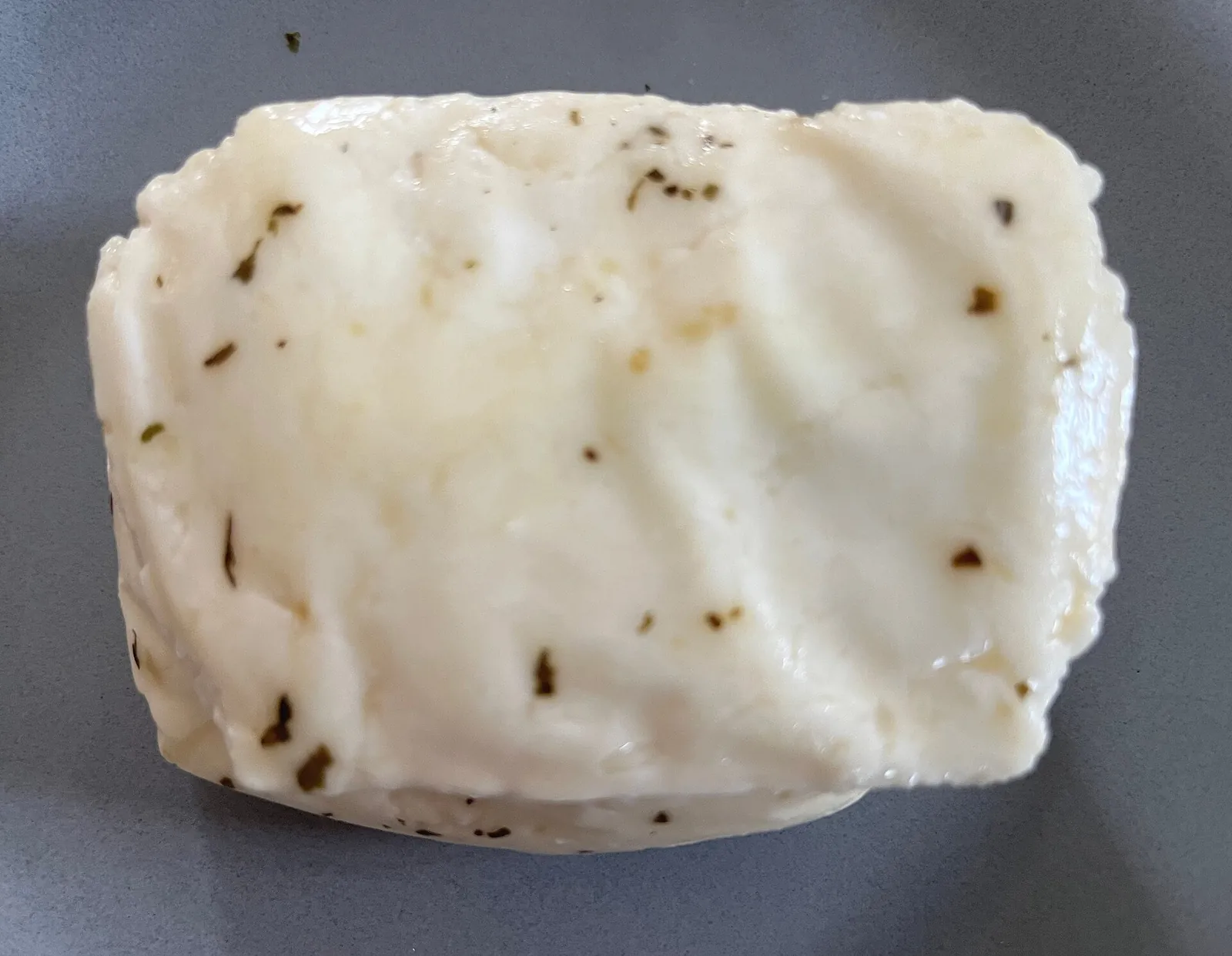
That cooking is why halloumi browns in a pan instead of melting into a puddle, and it is the step most home recipes for other cheeses never ask of you.
The work is gentler than it sounds. Nothing needs aging, and you can eat the cheese the day after it brines. A gallon of whole milk gives about a pound, which grills into roughly eight thick slices.
Halloumi at a glance
This table shows the numbers to hit when you make halloumi, from setting to brining.
| Homemade halloumi | |
|---|---|
| Yield | About 1 pound (450 g) from 1 gallon of cow's milk |
| Active time | About 2 hours, split between curd work and whey cooking |
| Setting temperature | About 93°F (34°C) |
| Curd warming | To 104°F (40°C), stirring |
| Whey cooking | Above 194°F (90°C) for at least 30 minutes |
| Brine | 1 to 3 days for fresh halloumi |
| Best milk | Pasteurized whole milk, not ultra-pasteurized |
How to make halloumi
Making halloumi has two stages: a simple rennet curd, then a long poach in the whey that sets the cheese. The recipe below is for cow's milk, which is what most home makers use, though Cypriot halloumi uses sheep's and goat's milk.
Ingredients for making halloumi
These are the ingredients for making halloumi, using one gallon of milk and a handful of pantry items.
- 1 gallon (3.8 liters) pasteurized whole milk, not ultra-pasteurized
- 1/2 teaspoon liquid single-strength rennet, diluted in 1/4 cup (60 ml) cool non-chlorinated water
- 1/4 teaspoon calcium chloride in 1/4 cup (60 ml) water, optional, for store-bought milk that sets weakly
- 2 tablespoons dried mint, crumbled
- 2 tablespoons (35 g) non-iodized salt, plus 1/4 cup (about 70 g) more for the brine
- 1 quart (1 liter) of the cooked whey for the brine, plus about 1 quart cool water
Steps for making halloumi
Follow these steps for making halloumi, and do not discard the whey until the very end.
- Warm the milk in a stainless steel pot to 93°F (34°C), stirring gently, and stir in the calcium chloride if you are using it.
- Stir in the diluted rennet with an up-and-down motion for 1 minute, then leave the pot still and covered for 40 minutes, until the curd splits cleanly around a knife.
- Cut the curd into 1/2 inch (1.3 cm) cubes, rest 5 minutes, then warm it slowly to 104°F (40°C) over 15 minutes, stirring gently so the cubes do not stick.
- Ladle the curds into a cheesecloth-lined colander set over a second pot, so the whey is saved, and press with your hands, then a plate, then a 2 pound (1 kg) weight for about 30 minutes until the curd forms a firm slab.
- Cut the slab into 4 to 6 blocks, about 3 by 4 inches (8 by 10 cm) and 1 inch (2.5 cm) thick, then bring the saved whey to a simmer above 194°F (90°C), stirring it so it does not scorch.
- Lower the blocks into the whey and hold it at 194°F to just under a boil for 30 minutes. They sink at first, then float and turn firm and springy.
- Lift the blocks onto a rack and let them cool for 10 minutes, then sprinkle the salt and mint over one side.
- Fold each block in half around the mint, pressing the cut edges together, and cool them completely on the rack.
- Make the brine from 1 quart of the cooked whey, 1 quart of cool water and 1/4 cup salt, cool it, and submerge the folded halloumi for 1 to 3 days in the fridge before slicing and cooking.
Why the whey cooking makes halloumi grill
Why the whey cooking makes halloumi grill comes down to heat and pH. The PDO document calls the 30 minutes above 194°F (90°C) a feature unique to halloumi, and the finished cheese keeps a high pH and plenty of calcium, which holds its protein network rigid when it hits a hot pan. Cheeses that are acidic or low in calcium, like feta, soften and slump. The full explanation is on the halloumi page.
The practical lesson: do not cut the poach short. Under 30 minutes at a bare simmer, the blocks stay soft and can fall apart in the skillet. The halloumicheese.eu account of the traditional method gives the same temperature and time, then salting on the surface, mint, folding and brining for 1 to 3 days for fresh halloumi.
The best milk for halloumi
The best milk for halloumi is pasteurized whole cow's milk if you are at home, and a sheep's and goat's blend if you can buy it. Under the PDO, the sheep and goat milk must outweigh any cow's milk, so a pure cow's milk batch is halloumi-style, but it cooks the same. America's Test Kitchen warns that ultra-pasteurized milk makes it difficult for curds to form, so check the carton.
Use whole milk. Fat keeps the slab tender and gives the browned crust something to fry in. Low-fat milk gives a squeaky, dry cheese.
Making halloumi mistakes and fixes
Making halloumi mistakes mostly come from skipping heat or crowding the pot. Fixes are simple.
Soft blocks that crumble were cooked too briefly or too cool. Hold the whey above 194°F for the full 30 minutes. Rubbery, dry halloumi was pressed too hard or cooked far past 30 minutes. Cheese that is too salty can soak in cool water for 20 minutes before frying. Curd that will not set means weak milk or old rennet, covered in troubleshooting common cheesemaking problems.
Variations on homemade halloumi
Variations on homemade halloumi change the herb and the milk. Leave out the mint for a plain block, add chili flakes with it, or use half goat's milk. Dried mint is traditional, and fresh mint adds moisture, so use dried if you want a longer brine.
Storing and cooking homemade halloumi
Storing and cooking homemade halloumi starts with the fridge: keep the cheese in its brine at 40°F (4°C) or below. The Cypriot account of the traditional method says fresh halloumi is kept below 45°F (7°C). Plan on a week or so, which is a cautious estimate for a home brine rather than a tested limit, and throw it out if it turns slimy or smells off.
To cook it, cut slices about 1/2 inch (1.3 cm) thick, pat them dry, and brown them in a hot pan for 2 minutes per side. Serve with lemon, watermelon or mint, or cut it into sticks for halloumi fries. The halloumi vs paneer page compares it with the other cheese that holds its shape, and make paneer is the easier project if you want one.
Questions about making halloumi
These questions about making halloumi cover what readers ask most.
Is it hard to make halloumi at home?
It is not hard to make halloumi at home, but it takes a thermometer and about two hours. The only unusual step is cooking the pressed curd in hot whey.
Why does homemade halloumi not melt?
Homemade halloumi does not melt because cooking the curd in hot whey leaves it high in pH and calcium. The PDO document describes the cooking step.
Can you make halloumi with cow's milk?
You can make halloumi with cow's milk; it will be halloumi-style, since the PDO requires sheep's and goat's milk to outweigh cow's. It cooks the same way.
Do you need to age homemade halloumi?
You do not need to age homemade halloumi. Fresh halloumi rests 1 to 3 days in brine, while mature halloumi stays in brine for at least 40 days.
Is homemade halloumi safe?
Homemade halloumi is safest when made with pasteurized milk and kept cold. Read pasteurized vs raw-milk cheese if you are pregnant or at higher risk.
Make halloumi this weekend
To make halloumi this weekend, buy a gallon of pasteurized whole milk, rennet and a good thermometer, and keep the whey. Make it the day before you want to grill. The equipment guide lists the basics.
Sources
- Halloumi PDO publication, Official Journal of the European Union
- How Halloumi Is Made, Cyprus halloumi producers' information site
- How to Make Cheese from Scratch, America's Test Kitchen