
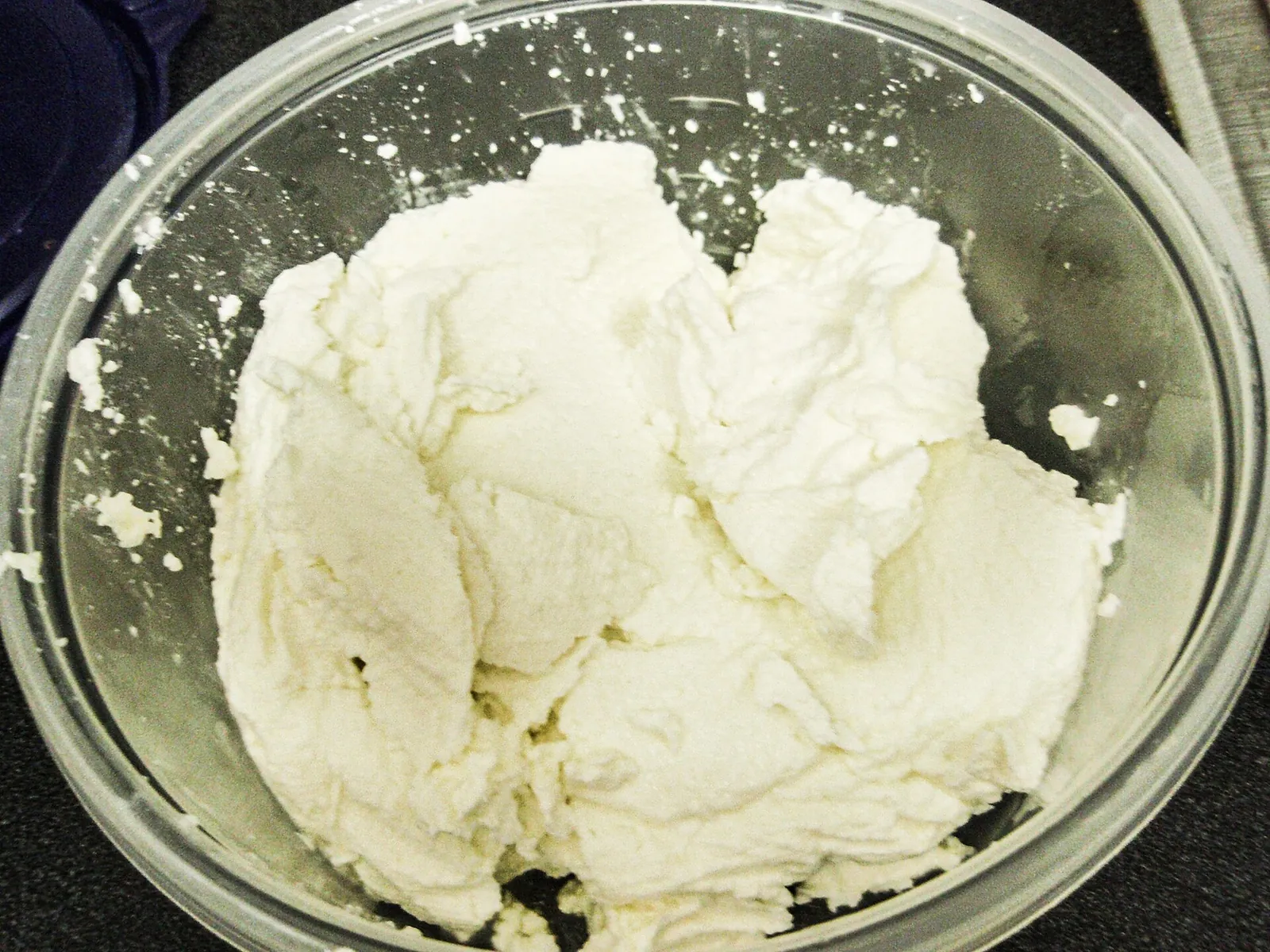
Nothing is cooked hard and nothing is pressed, so the work is mostly waiting.
Two things give cream cheese its character: lactic bacteria turn some milk sugar into acid, which gives the tang, and a good amount of cream gives the richness. The quick lemon-and-heat shortcut produces a ricotta-style curd instead, so this page sticks to the cultured method.
Cream cheese at a glance
This cream cheese at a glance table covers the yield, the time and the milk you need.
| Homemade cream cheese | |
|---|---|
| Yield | About 1 3/4 cups (400 g) |
| Active time | About 25 minutes |
| Total time | 18 to 30 hours, mostly culturing and draining |
| Temperature | Warm to 85°F (29°C), culture at room temperature |
| Milk | Pasteurized whole milk and heavy cream |
| Set with | Cultured buttermilk and a drop of rennet |
| Make-ahead | Keeps in the fridge about a week |
How to make cream cheese
Here is how to make cream cheese in one batch, from warming the dairy to the last salt. The recipe is original and follows the same sequence as New Mexico State University Extension's cream cheese method: milk and cream, buttermilk as the culture, rennet, a cut curd, overnight draining and salt.
Ingredients for cream cheese
These ingredients for cream cheese make one small batch, and everything except the rennet is in a normal grocery cart.
- 1 quart (950 ml) pasteurized whole milk
- 1 cup (240 ml) pasteurized heavy cream
- 2 tablespoons cultured buttermilk with live cultures
- 2 drops liquid rennet, stirred into 2 tablespoons of cool, unchlorinated water
- 1/2 teaspoon fine salt, plus more to taste
- Equipment: a pot, a thermometer, a clean ladle, a large jar or bowl, a sieve and a piece of cheesecloth or a thin cotton towel
Steps for making cream cheese
These steps for making cream cheese run about 25 minutes of work spread across two days.
- Sanitize the pot, ladle, jar and cloth with very hot water, since fresh cheese has no rind or acid to protect it yet.
- Pour the milk and cream into the pot and warm it over low heat, stirring, to 85°F (29°C). Take it off the heat as soon as the thermometer reads 85°F.
- Whisk in the buttermilk, then the diluted rennet, stirring gently for 30 seconds.
- Pour into the jar, cover loosely with a cloth, and leave at 70 to 75°F (21 to 24°C) for 12 to 18 hours, until it has set like soft yogurt and pulls cleanly away from the side when tilted.
- Line the sieve with damp cheesecloth over a bowl. Ladle the curd in, in large pieces, without stirring it.
- Gather the cloth, tie it, and hang it over the bowl or leave the sieve in the fridge for 6 to 12 hours. At 6 hours the cheese is soft and a little loose; by 12 it is thick and holds a peak.
- Scrape the cheese into a bowl, add the salt, and beat with a spoon or whisk (or pulse in a food processor for 15 seconds) until smooth. Taste, add salt if needed, and pack it into a clean container.
- Refrigerate at 40°F (4°C) or below, and pour off any whey that collects on top.
The best milk for cream cheese
The best milk for cream cheese is pasteurized whole milk plus pasteurized heavy cream, because the fat is what makes the finished cheese rich. Using all milk gives a leaner, grainier, farmer's-cheese-like result, and all cream gives something closer to butter.
For comparison, the FDA standard for cream cheese requires at least 33 percent milkfat and no more than 55 percent moisture, and it describes the cheese as made from pasteurized dairy ingredients cultured with lactic bacteria and set with a clotting enzyme. Factory cream cheese may also contain stabilizers up to 0.5 percent of its weight. Homemade cream cheese needs none, which is why it is softer and tastes more like cultured cream, a point the cream cheese page explores for the store-bought kind.
Read the carton before you buy. Some creams are labeled ultra-pasteurized, and gentler pasteurization usually sets a better curd for home cheesemaking, so choose the cream and milk that say only "pasteurized" where you can. If you start with raw milk, see pasteurization at home first.
Cream cheese mistakes and fixes
These cream cheese mistakes and fixes cover the failures that show up most often, and nearly all of them come down to temperature or time.
It never set. The culture needs warmth. A cold kitchen under about 68°F slows the bacteria, so move the jar to the top of the fridge or near an oven with just the light on, and give it up to 24 hours. A dead or heat-treated buttermilk also fails, so use one that lists live cultures.
The curd is grainy or rubbery. Too much rennet or too much heat is the usual cause. Rennet is potent: two drops for a gallon-sized batch scale is plenty. Do not warm past 85°F.
It is too wet. Drain longer. An extra 3 to 6 hours in the fridge thickens it, and a spoon of the whey can be stirred back in later if you overdo it.
It is too thin or too sour. Over-culturing past 18 hours makes it tangier and loosens the body. Stop at the yogurt stage.
It tastes flat. Salt it. Most home batches need more than 1/2 teaspoon once they are beaten smooth.
Variations on homemade cream cheese
Variations on homemade cream cheese are easiest after the cheese is drained and smooth, so a single batch can become several spreads.
- Herb and garlic: fold in 2 tablespoons of chopped chives, parsley and a small grated garlic clove.
- Scallion and black pepper: the usual bagel shop flavor.
- Honey and cinnamon: 1 tablespoon honey per cup of cheese, or a spoonful of jam.
- Cheesecake or frosting base: drain it a full 12 hours so it is thick and not weepy, then beat with sugar.
- Thicker spread: if you want something firmer, strain it a further 4 to 6 hours.
For a different rich cultured cheese, mascarpone is made from cream alone, and the cream cheese vs mascarpone page shows how they differ.
Storing cream cheese you have made
Storing cream cheese you have made is simple if you treat it like any fresh cheese: keep it covered and cold. Penn State Extension lists fresh cheeses as made to be eaten within days or weeks, and NMSU Extension puts the refrigerated life of cream cheese at 7 to 10 days, and says it can be frozen for 4 to 6 months, though frozen cream cheese turns crumbly and is better for baking than spreading. Keep it at 40°F or below, use a clean spoon each time, and discard it if it smells yeasty or shows pink, orange or fuzzy spots.
Questions about how to make cream cheese
These questions cover how to make cream cheese with fewer steps and what to do with the whey.
Can you make cream cheese without rennet?
You can make cream cheese without rennet by culturing the dairy with buttermilk alone, which gives a softer, more yogurt-like set that drains well. The curd is looser than with rennet, so drain it a little longer.
Can you make cream cheese with lemon juice?
You can make cream cheese with lemon juice, but the result is a ricotta-style curd, not a true cultured cream cheese. It is faster and mild, and works as a spread when beaten smooth with a little cream.
How long does homemade cream cheese last?
Homemade cream cheese lasts about a week in the refrigerator, and NMSU Extension gives 7 to 10 days. Keep it at 40°F or below and use clean utensils.
What do you do with the whey from cream cheese?
The whey from cream cheese is good to use in bread dough, pancakes, smoothies or soups in place of water or milk. It is acidic and mildly tangy, so it works best in baked goods.
Why is homemade cream cheese runny?
Homemade cream cheese is runny when it was drained for too short a time or the culture ran too long. Drain it another 3 to 6 hours in the fridge.
Make cream cheese your first soft cheese
Make cream cheese once and you will know the pattern behind most fresh cheeses: a warm start, a patient set and a long drain. For your first batch, use the exact amounts above, check the thermometer at 85°F, and drain until the cheese holds a peak. If you want an even simpler cheese, labneh needs only yogurt and a strainer.
Sources
- Making Homemade Cheese (E-216), New Mexico State University Cooperative Extension Service
- 21 CFR 133.133, Cream cheese, Cornell Legal Information Institute (FDA standard of identity)
- Farmstead and Artisan Cheesemaking, Penn State Extension