
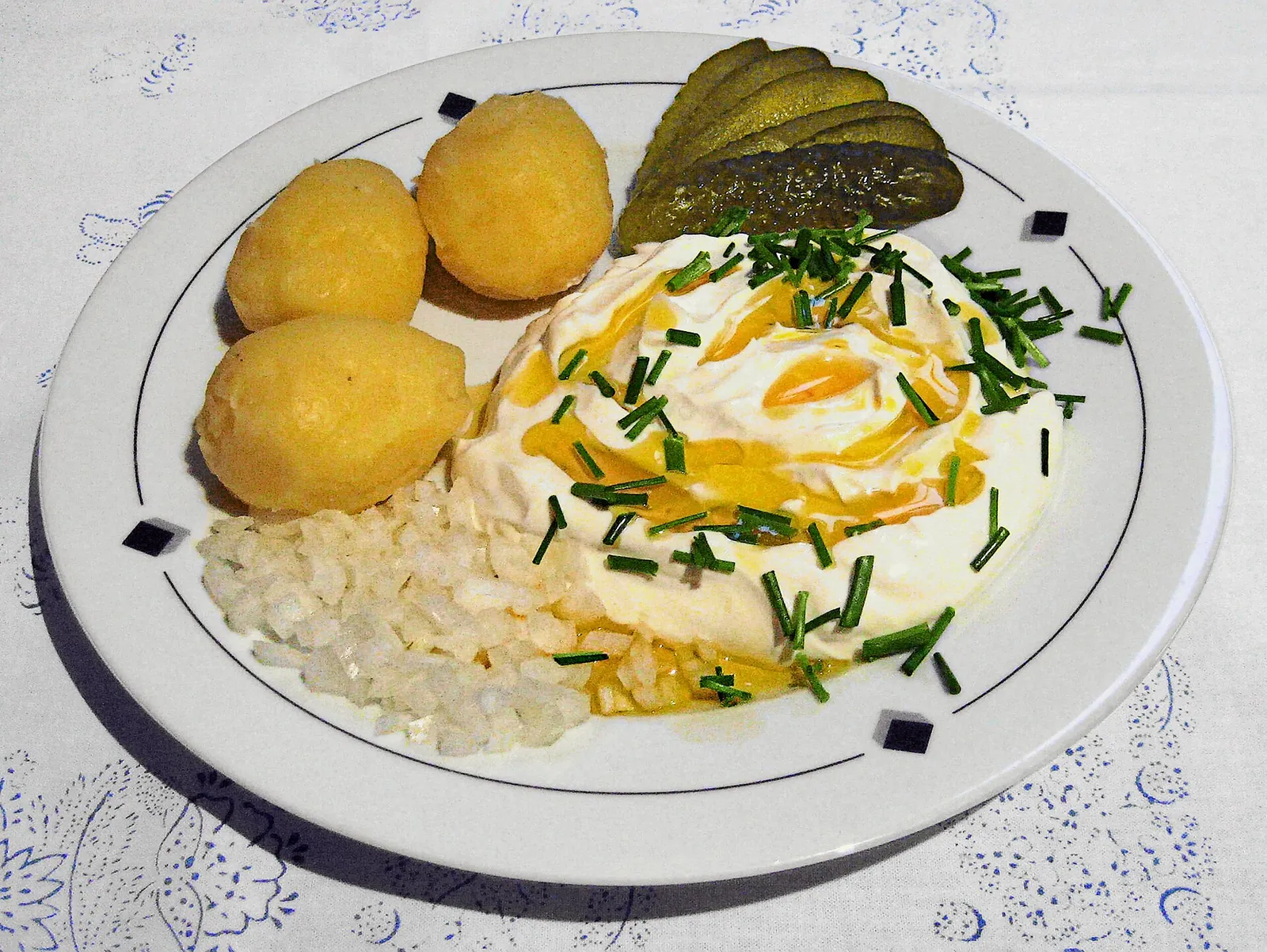
It looks like a smooth, very thick yogurt and tastes mild and a little tangy.
The key to quark is that it is an acid-set cheese rather than a rennet cheese, so the curd stays soft and wet, and how much whey is drained decides whether you get a loose spoonful or a firm, dense dollop.
Quark at a glance
Here is quark at a glance, with details from Wikipedia's quark entry).
| Detail | Quark |
|---|---|
| Milk | Cow's milk, whole or skimmed |
| Origin | Germany and Central Europe; the name comes from West Slavic languages |
| Set with | Lactic bacteria, with at most a little rennet |
| Texture | Soft, thick, smooth; spoonable to dense depending on whey removed |
| Flavor | Mild, fresh, slightly tangy |
| Fat tiers (Germany) | Magerquark under 10% fat in dry matter; regular 20%; Sahnequark 40% |
| Other names | Topfen (Austria), tvorog (Russian), twaróg (Polish), kvarg (Swedish and Norwegian) |
How quark is made
Quark is made by adding a mesophilic starter culture of Lactococcus bacteria to milk, which turns the milk sugar into lactic acid and thickens it. A small amount of rennet may be added when the milk reaches pH 6.1, though traditional quark can be made without any. The whey is then removed, either by hanging the curd in cheesecloth or in a centrifuge at a factory.
Because acid does most of the work, the curd is fine and creamy rather than firm. About 80 percent of its dry matter is casein, the milk protein that makes the curd, and Wikipedia gives basic quark about 0.2 percent fat. For the home version of a similar fresh curd, see making cottage cheese at home.
Quark vs Greek yogurt, cottage cheese and cream cheese
Quark vs Greek yogurt, cottage cheese and cream cheese is a question of process and texture. All four are soft, tangy dairy foods, but they are set and handled differently.
- Greek yogurt is yogurt strained to thickness, so its tang comes from yogurt bacteria, and it is more sour than quark. Quark is cheese, soured with different cultures and often a touch of rennet.
- Cottage cheese is a cooked, cut and washed curd with a salty cream dressing, so it comes in lumps. Quark is smooth. The full cottage cheese guide covers curd sizes.
- Cream cheese is made from cream-enriched milk and is far richer and denser, with 34 g of fat per 100 g in USDA data, versus almost none in fat-free quark. Cream cheese is the swap when you want richness.
Because quark sits between them, it can stand in for any of the four in many recipes. The longer side-by-side is on the quark vs Greek yogurt vs cottage cheese page.
Quark nutrition
Quark nutrition depends mostly on the fat tier, and fat-free quark is the leanest, most protein-dense of the group. The nutritionadvance.com guide, citing the UK CoFID database, gives a 220 g cup of fat-free quark 164 kcal, 32.12 g of protein, 0 g of fat, 264 mg of calcium and 99 mg of sodium, which works out to about 14.6 g of protein and 75 kcal per 100 g.
The table puts that beside USDA numbers per 100 g for the nearest foods.
| Food (per 100 g) | Protein | Fat | Energy | Sodium |
|---|---|---|---|---|
| Quark, fat-free (CoFID, via Nutrition Advance) | 14.6 g | 0 g | 75 kcal | 45 mg (99 mg per 220 g) |
| Greek yogurt, plain, nonfat (USDA) | 10.19 g | 0.39 g | 59 kcal | 36 mg |
| Cottage cheese, 1% milkfat (USDA) | 12.39 g | 1.02 g | 72 kcal | 406 mg |
| Cottage cheese, creamed (USDA) | 11.12 g | 4.3 g | 98 kcal | 315 mg |
| Cream cheese (USDA) | 6.15 g | 34.44 g | 350 kcal | 314 mg |
Fat-free quark has more protein than the others and little sodium, which explains its reputation as a gym food. Quark is not a medical food, though, and the numbers vary by brand, so read the label on the tub.
How to use quark
Quark is used wherever you would use a thick, mild yogurt, a spreadable fresh cheese or a lighter cream cheese. It is milder and more neutral than yogurt, so it takes sweet and savory flavors well.
Savory quark
Savory quark is a spread or a dip. Stir in chives, parsley, garlic or onion, add lemon and salt, and serve it on rye bread or with boiled potatoes, a traditional German pairing. It also loosens into a creamy sauce or dressing, and it can replace sour cream or ricotta in many dishes. Stir it in off the heat so it stays smooth.
Sweet quark
Sweet quark is a breakfast and a dessert. Top it with berries, honey or jam for a thick, high-protein bowl, and fold it into pancake batter, dumplings and fruit desserts. It is also the base of German cheesecake (Käsekuchen), which is lighter and less dense than the cream-cheese kind.
Where to buy quark in the US
You can buy quark in the US in the specialty or European section of well-stocked supermarkets and in German, Polish or Eastern European shops, where it is often sold as twaróg or tvorog. Wikipedia notes that domestic production is limited, and names Vermont Creamery as one US maker. Imported tubs cost more, and they may be in the refrigerated international aisle rather than the cheese case.
Check the date on the lid, because quark is a fresh, perishable cheese. Keep it in the fridge, and stir in any whey that separated on top rather than pouring it off, since that whey carries flavor and some protein.
What most quark advice gets wrong
Most quark advice treats it as just a fancy yogurt, which skips three useful points.
Quark is not Greek yogurt
Quark is not Greek yogurt. It is a fresh cheese soured with lactic bacteria and sometimes rennet, and it tastes milder and less sour than a strained yogurt, which matters in a cheesecake where you do not want a sharp tang.
Quark is not always low-fat
Quark is not always low-fat. German tiers run from Magerquark (under 10 percent fat in dry matter) through 20 percent to Sahnequark (40 percent), and those percentages are fat in the dry matter, not in the whole tub. A 40 percent quark is not 40 percent fat by weight, but it is much richer than Magerquark.
Quark can split when it is cooked hard
Quark can turn grainy when it is boiled or baked hard, since it is mostly protein. Keep sauces below a simmer and bake cheesecakes gently, and mix it with a little flour or egg when a recipe calls for it.
Questions about quark
These are the questions about quark that come up most.
What is quark similar to?
Quark is similar to thick yogurt, cottage cheese and cream cheese at once: smoother than cottage cheese, milder than cream cheese and less sour than Greek yogurt.
Is quark healthy?
Quark is high in protein and, in its fat-free form, has about 75 kcal and 0 g of fat per 100 g according to the CoFID figures; choose the fat level that suits your diet.
Can you bake with quark?
Quark bakes well, and it is the classic filling for German Käsekuchen and for pastries and dumplings.
What can replace quark?
Quark can be replaced with thick plain Greek yogurt, or with blended cottage cheese, or in baking with ricotta or cream cheese, adjusting for richness.
Is quark cheese or yogurt?
Quark is a cheese, an acid-set fresh cheese made with lactic cultures and sometimes rennet, even though it is eaten like yogurt.
Your first quark
For your first quark, buy a plain tub, mix a few spoonfuls with chives and lemon and put it on rye bread, then try the rest with berries and honey the next morning. If you want to bake, find a Käsekuchen recipe and use full-fat quark.
Sources
- Quark (dairy product)), Wikipedia
- Quark: What Nutritional Benefits Does It Provide?, Nutrition Advance (citing the UK CoFID database)
- Cheese, cottage, lowfat, 1% milkfat (FDC ID 173417), USDA FoodData Central, SR Legacy
- Yogurt, Greek, plain, nonfat (FDC ID 170894), USDA FoodData Central, SR Legacy