
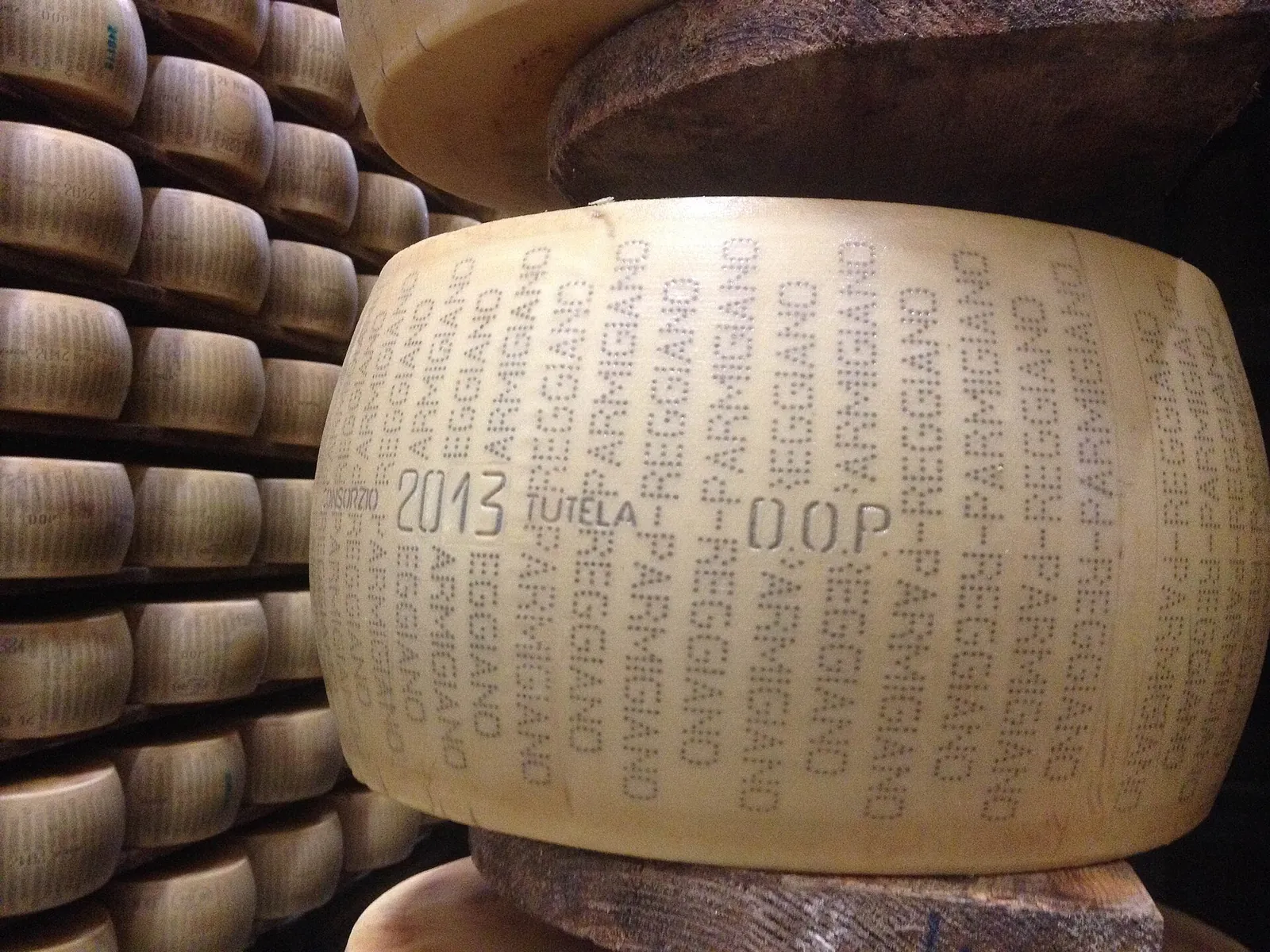
In USDA's FoodData Central, an ounce of hard Parmesan carries 10.1 grams of protein, ahead of Romano at 9.0, hard goat cheese at 8.7, Gruyère at 8.5 and Swiss at 7.6. If protein per bite is the goal, those five lead the case.
Count calories instead of ounces and the order flips. Hard cheeses are dense because they hold little water, but they carry plenty of fat, while low-fat cottage cheese is mostly water and protein. Per 100 calories, 1% cottage cheese delivers 17.2 grams of protein, nearly twice Parmesan's 9.1 and three times cheddar's 5.7. The best cheese for protein depends on whether you are counting bites or calories.
High protein cheese ranked by protein per ounce
This high protein cheese ranking uses USDA SR Legacy figures per ounce (28.35 g), with protein per 100 calories computed from the same rows.
| Cheese | Protein per oz | Calories per oz | Protein per 100 calories | Sodium per oz |
|---|---|---|---|---|
| Parmesan, hard | 10.1 g | 111 | 9.1 g | 333 mg |
| Romano | 9.0 g | 110 | 8.2 g | 406 mg |
| Goat cheese, hard | 8.7 g | 128 | 6.8 g | 120 mg |
| Gruyère | 8.5 g | 117 | 7.2 g | 202 mg |
| Swiss | 7.6 g | 111 | 6.9 g | 53 mg |
| Provolone | 7.3 g | 100 | 7.3 g | 206 mg |
| Fontina | 7.3 g | 110 | 6.6 g | 227 mg |
| Gouda | 7.1 g | 101 | 7.0 g | 232 mg |
| Edam | 7.1 g | 101 | 7.0 g | 276 mg |
| Mozzarella, part skim | 6.9 g | 72 | 9.6 g | 176 mg |
| Monterey Jack | 6.9 g | 106 | 6.6 g | 170 mg |
| Mozzarella, low-moisture part-skim | 6.7 g | 84 | 8.1 g | 189 mg |
| Cheddar | 6.5 g | 114 | 5.7 g | 185 mg |
| Mozzarella, whole milk | 6.3 g | 85 | 7.4 g | 138 mg |
| Blue cheese | 6.1 g | 100 | 6.1 g | 325 mg |
| Brie | 5.9 g | 95 | 6.2 g | 178 mg |
| Camembert | 5.6 g | 85 | 6.6 g | 239 mg |
| Goat cheese, soft | 5.3 g | 75 | 7.0 g | 130 mg |
| Feta | 4.0 g | 75 | 5.4 g | 323 mg |
| Cottage cheese, 1% | 3.5 g | 20 | 17.2 g | 115 mg |
| Ricotta, part skim | 3.2 g | 39 | 8.3 g | 28 mg |
| Cottage cheese, creamed (4%) | 3.2 g | 28 | 11.3 g | 89 mg |
| Cream cheese | 1.7 g | 99 | 1.8 g | 89 mg |
Why hard aged cheeses have the most protein
Hard aged cheeses have the most protein per ounce because they have the least water. In USDA's data, hard Parmesan is 30 percent water, Swiss 38 percent, whole-milk mozzarella 50 percent and 1% cottage cheese 82.5 percent. What isn't water is mostly protein and fat, so a drier cheese packs more protein into every bite.
The rules build that dryness in. The FDA standard for parmesan calls for curd cut no bigger than wheat kernels, cooked to 115 to 125°F, pressed and cured at least 10 months, and it caps moisture at 32 percent. The cottage cheese standard allows up to 80 percent. (The Italian original, Parmigiano-Reggiano, follows its own rulebook.)
Fat decides the rest. Hard goat cheese is just as dry as Parmesan, 29 percent water against 30, but it carries 35.6 grams of fat per 100 grams against Parmesan's 25, and it lands at 8.7 grams of protein per ounce instead of 10.1.
The best cheese for protein per calorie
Among regular cheeses, the best cheese for protein per calorie is 1% cottage cheese, at 17.2 grams of protein per 100 calories, computed from USDA's figures; only fat-free cheeses, covered below, score higher. The reason is arithmetic: the calorie factors in USDA's cheese records count about 8.8 calories per gram of fat and 4.3 per gram of protein, so every gram of fat a cheese sheds raises the share of its calories that come from protein.
After cottage cheese in all its fat levels (12.9 grams for 2 percent, 11.3 for creamed), the next best is part-skim mozzarella at 9.6 grams, followed closely by Parmesan at 9.1. Parmesan is fatty, but it is so protein-dense that it still beats Swiss (6.9) and cheddar (5.7). Cream cheese sits at the bottom with 1.8 grams.
Cottage cheese and ricotta per half cup
Cottage cheese and ricotta look weak per ounce because they are mostly water, but a half cup is the usual serving, and USDA lists its weight for each.
| Per 1/2 cup (USDA weight) | Protein | Calories | Sodium |
|---|---|---|---|
| Cottage cheese, 1% (113 g) | 14.0 g | 81 | 459 mg |
| Cottage cheese, 2% (113 g) | 11.8 g | 92 | 348 mg |
| Cottage cheese, creamed 4%, small curd (112.5 g) | 12.5 g | 110 | 354 mg |
| Ricotta, part skim (124 g) | 14.1 g | 171 | 123 mg |
| Ricotta, whole milk (124 g) | 9.3 g | 186 | 136 mg |
A half cup of 1% cottage cheese weighs about 4 ounces and delivers as much protein as 1.4 ounces of Parmesan, for 81 calories instead of about 154. Part-skim ricotta matches it on protein with about a quarter of the sodium, at twice the calories. There is more on cottage cheese as a fitness food and on ricotta itself.
The sodium trade-off
The sodium trade-off is the catch with several high protein cheeses, and sodium varies far more than protein does. This table divides each cheese's sodium by its protein, computed from the same USDA rows.
| Cheese | Sodium per oz | Sodium per gram of protein |
|---|---|---|
| Swiss | 53 mg | 7 mg |
| Ricotta, part skim | 28 mg | 9 mg |
| Goat cheese, hard | 120 mg | 14 mg |
| Gruyère | 202 mg | 24 mg |
| Mozzarella, part skim | 176 mg | 26 mg |
| Cheddar | 185 mg | 29 mg |
| Parmesan, hard | 333 mg | 33 mg |
| Cottage cheese, 1% | 115 mg | 33 mg |
| Romano | 406 mg | 45 mg |
| Parmesan, grated | 511 mg | 64 mg |
| Feta | 323 mg | 80 mg |
| Roquefort | 513 mg | 84 mg |
Swiss stands out, with 7.6 grams of protein for 53 mg of sodium per ounce. The Daily Value for sodium is 2,300 mg under FDA labeling rules, so a half cup of 1% cottage cheese (459 mg) uses about a fifth of it. USDA also lists 1% cottage cheese with no salt added, at 15 mg per half cup, and low-sodium Swiss, mozzarella and cheddar at 14 to 21 mg per 100 grams. The low-sodium cheese guide covers more options.
High-protein cheese products
High-protein cheese products mostly get there by removing fat, and the label claim has a legal definition. In USDA's data, fat-free mozzarella has 9.0 grams of protein and 40 calories per ounce (22.5 grams per 100 calories), and fat-free cheddar and Swiss land above 20 grams per 100 calories, but they carry 211 to 284 mg of sodium per ounce. Low-fat Swiss is the quiet exception, with 8.1 grams of protein, 51 calories and 56 mg of sodium per ounce.
On a US package, "high" protein means a food supplies at least 20 percent of the Daily Value per reference amount, under 21 CFR 101.54, and the Daily Value for protein is 50 grams, so the bar is about 10 grams (the rule also adjusts for protein quality). The reference amounts are 110 grams for cottage cheese, 55 grams for ricotta, 5 grams for grated hard cheese and 30 grams for most other cheese. Run USDA's numbers through them and 1% cottage cheese holds 13.6 grams, block Parmesan just clears the bar at 10.7, Romano falls short at 9.5, and part-skim ricotta, judged on 55 grams, reaches 6.3. String cheese, cheese crisps made from baked Parmesan and cottage cheeses marketed for protein inherit these numbers, so check the grams per serving and the serving size.
What most high protein cheese lists get wrong
Most high protein cheese lists mix serving sizes and product types, so their numbers can't be compared.
They compare a half cup with an ounce. "Ricotta has 14 grams of protein" is true per half cup, which weighs 124 grams, more than four ounces. Per ounce, part-skim ricotta has 3.2 grams. Compare per ounce, per calorie or per the serving you actually eat.
They treat grated Parmesan like block Parmesan. USDA's grated Parmesan has 8.1 grams of protein per ounce against 10.1 for the hard block, and a tablespoon of grated weighs 5 grams, so a spoonful over pasta adds about 1.4 grams.
They list mozzarella as one cheese. USDA's part-skim mozzarella has 6.9 grams of protein and 72 calories per ounce, low-moisture part-skim (the firm style sold shredded and in blocks) 6.7 grams and 84 calories, and whole-milk 6.3 grams and 85 calories. The label wording moves calories more than protein, as the guide to mozzarella styles explains.
Questions about high protein cheese
These questions about high protein cheese come up most when people shop for protein.
What cheese has the most protein?
The cheese with the most protein per ounce is Parmesan: 10.1 grams for hard Parmesan in USDA's data, and 10.7 for drier shredded Parmesan. Romano is second at 9.0.
Is cottage cheese high in protein?
Cottage cheese is high in protein for its calories: a full cup of 1% cottage cheese (226 grams) has 28 grams of protein and 163 calories.
What cheese has more protein than eggs?
Most firm cheeses have more protein than eggs by weight. USDA lists a large egg (50 grams) at about 6.3 grams of protein, roughly what an ounce of cheddar holds, while an ounce of Parmesan has 10.1.
Is cheese a good source of protein?
Most firm cheese counts as a good source of protein under FDA labeling rules, which means 10 to 19 percent of the Daily Value per 30-gram reference amount. By USDA's figures, cheddar comes in at about 14 percent and Swiss at about 16.
How much protein is in a slice of cheese?
The protein in a 1-ounce slice of cheese (USDA weighs it at 28 grams) runs about 7.5 grams for Swiss, 7.2 for provolone and 6.4 for cheddar.
Choosing a high protein cheese
Choose a high protein cheese by how you eat it. For protein per bite, grate or shave block Parmesan or Romano, or slice Swiss, which pairs 7.6 grams of protein with the least sodium of any firm cheese here. For protein per calorie, start with 1% cottage cheese or part-skim ricotta by the half cup, and reach for part-skim mozzarella when you want a cheese that melts. If carbs are your focus instead, see the best cheeses for keto and how cheese fits a keto diet.
Sources
- FoodData Central, SR Legacy dataset, USDA Agricultural Research Service
- Cheese, parmesan, hard (FDC 170848), USDA FoodData Central
- Cheese, cottage, lowfat, 1% milkfat (FDC 173417), USDA FoodData Central
- Cheese, ricotta, part skim milk (FDC 171248), USDA FoodData Central
- 21 CFR 133.165, Parmesan and reggiano cheese, Electronic Code of Federal Regulations
- 21 CFR 101.9, Nutrition labeling of food (Daily Reference Values), Electronic Code of Federal Regulations
- 21 CFR 101.54, Nutrient content claims for "good source," "high," "more," and "high potency", Electronic Code of Federal Regulations
- 21 CFR 101.12, Reference amounts customarily consumed per eating occasion, Electronic Code of Federal Regulations