
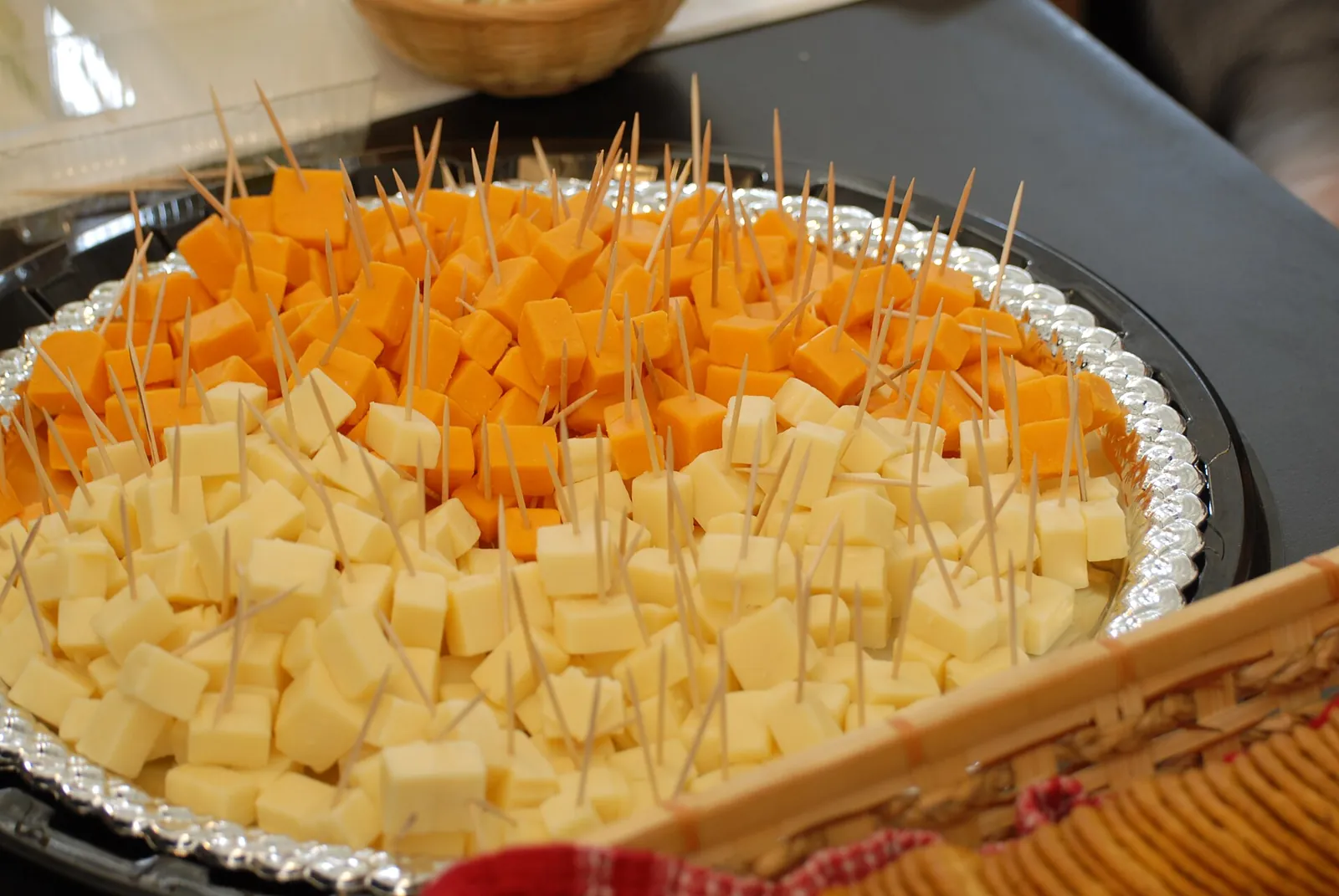
Gruyère, Brie and Camembert come next at about 0.1 gram, and Monterey Jack, Muenster, Swiss, Edam and fontina all stay under half a gram. Cheese has no fiber, so its net carbs and total carbs are the same number, and 27 of the 34 natural cheeses ranked below have less than 1 gram per ounce.
The big gaps in the ranking follow milk sugar. Lactose mostly drains away with the whey when curds form, and lactic acid bacteria consume much of what stays behind as a cheese ages, as a 2020 review of lactose in foods explains. The cheeses that climb the carb list hold onto whey, are made from it, or have milk and whey added back: cottage cheese, ricotta, process cheese food and spreads, and Norway's brown gjetost.
Keto friendly cheese ranked by net carbs per ounce
This keto friendly cheese ranking orders 34 natural cheeses by net carbs per ounce, computed from USDA FoodData Central (SR Legacy figures per 100 grams, multiplied by 0.2835), with fat, protein and calories for the same ounce.
| Rank | Cheese | Net carbs | Fat | Protein | Calories |
|---|---|---|---|---|---|
| 1 | Goat cheese, soft (chèvre) | 0.0 g | 6.0 g | 5.3 g | 75 |
| 2 | Goat cheese, semisoft | 0.0 g | 8.5 g | 6.1 g | 103 |
| 3 | Gruyère | 0.1 g | 9.2 g | 8.5 g | 117 |
| 4 | Brie | 0.1 g | 7.8 g | 5.9 g | 95 |
| 5 | Camembert | 0.1 g | 6.9 g | 5.6 g | 85 |
| 6 | Limburger | 0.1 g | 7.7 g | 5.7 g | 93 |
| 7 | Port Salut | 0.2 g | 8.0 g | 6.7 g | 100 |
| 8 | Monterey Jack | 0.2 g | 8.6 g | 6.9 g | 106 |
| 9 | Muenster | 0.3 g | 8.5 g | 6.6 g | 104 |
| 10 | Edam | 0.4 g | 8.1 g | 7.1 g | 101 |
| 11 | Swiss | 0.4 g | 8.8 g | 7.6 g | 111 |
| 12 | Fontina | 0.4 g | 8.8 g | 7.3 g | 110 |
| 13 | Tilsit | 0.5 g | 7.4 g | 6.9 g | 96 |
| 14 | Roquefort | 0.6 g | 8.7 g | 6.1 g | 105 |
| 15 | Cheddar, sharp, sliced | 0.6 g | 9.6 g | 6.9 g | 116 |
| 16 | Provolone | 0.6 g | 7.5 g | 7.3 g | 100 |
| 17 | Goat cheese, hard | 0.6 g | 10.1 g | 8.7 g | 128 |
| 18 | Gouda | 0.6 g | 7.8 g | 7.1 g | 101 |
| 19 | Blue cheese | 0.7 g | 8.1 g | 6.1 g | 100 |
| 20 | Mozzarella, whole milk | 0.7 g | 6.3 g | 6.3 g | 85 |
| 21 | Mozzarella, low-moisture whole milk | 0.7 g | 7.0 g | 6.1 g | 90 |
| 22 | Colby | 0.7 g | 9.1 g | 6.7 g | 112 |
| 23 | Mozzarella, part-skim | 0.8 g | 4.5 g | 6.9 g | 72 |
| 24 | Brick | 0.8 g | 8.4 g | 6.6 g | 105 |
| 25 | Queso fresco | 0.8 g | 6.8 g | 5.1 g | 85 |
| 26 | Parmesan, hard | 0.9 g | 7.1 g | 10.1 g | 111 |
| 27 | Cheddar | 1.0 g | 9.4 g | 6.5 g | 114 |
| 28 | Romano | 1.0 g | 7.6 g | 9.0 g | 110 |
| 29 | Feta | 1.1 g | 6.1 g | 4.0 g | 75 |
| 30 | Cotija | 1.1 g | 8.5 g | 5.7 g | 104 |
| 31 | Asadero | 1.2 g | 7.1 g | 6.4 g | 101 |
| 32 | Cream cheese | 1.6 g | 9.8 g | 1.7 g | 99 |
| 33 | Chihuahua | 1.6 g | 8.4 g | 6.1 g | 106 |
| 34 | Mozzarella, low-moisture part-skim (block) | 1.6 g | 5.6 g | 6.7 g | 84 |
Ties at one decimal are ordered by USDA's unrounded figures. Cheddar appears twice because USDA lists it twice: 0.6 gram for sliced sharp cheddar and 1.0 for the general entry. Most gaps between natural cheeses are smaller than that, so choose among them by taste and fat.
The best cheeses for keto, pick by pick
The best cheeses for keto pair near-zero carbs with plenty of fat, and these seven picks cover snacking, melting and baking.
Goat cheese
Goat cheese is the closest thing to a zero-carb cheese: USDA lists soft goat cheese at 0.0 grams per ounce and semisoft goat cheese at 0.03. Buy plain fresh logs labeled chèvre or goat cheese, not the honey or fruit versions, and crumble them over salad, stuff them into mini peppers or spread them on cucumber rounds. The weak spot is fat. Soft goat cheese is 61 percent water, so an ounce holds only 6.0 grams of fat. For more fat per bite, hard aged goat cheese carries 10.1 grams, the most of any cheese in the table, with 0.6 gram of carbs. The guide to French goat cheese covers the styles.
Brie and Camembert
Brie and Camembert both sit at 0.1 gram of carbohydrate per ounce in USDA's figures, with 7.8 and 6.9 grams of fat. Their curds shed most of their lactose with the whey, and the cultures that ripen them consume most of the rest, which is how two soft, creamy cheeses outrank most hard ones. Serve them at room temperature with celery, fennel or toasted pecans instead of crackers, or bake a small wheel and scoop it with endive leaves. Camembert is the saltier of the two, at 239 milligrams of sodium per ounce against Brie's 178. For ripeness and buying tips, see the Brie guide.
Gruyère and Swiss
Gruyère and Swiss are the Alpine pair for keto: Gruyère has 0.1 gram of carbohydrate per ounce and Swiss 0.4, with 9.2 and 8.8 grams of fat. The 2020 review lists both Gruyère and Emmentaler, the original Swiss cheese, at under 0.1 gram of lactose per 100 grams. Swiss has the least sodium of any cheese ranked here, 53 milligrams an ounce, which makes it the everyday slice for lettuce wraps and bunless burgers. Gruyère melts into cauliflower gratin and onion soup without breaking. The trade-off is calories: at 117 an ounce, Gruyère is second only to hard goat cheese. The two are compared side by side in Swiss, Gruyère and Emmental.
Monterey Jack and Muenster
Monterey Jack and Muenster are the low-carb melting cheeses, at 0.2 and 0.3 gram per ounce. Both are young, moist, mild cheeses that melt quickly and smoothly, so reach for them in cheese sauce for roasted broccoli, a frittata or a skillet of chili. Buy them in blocks and shred them yourself; Port Salut, at 0.2 gram, melts the same way. The weak spot is flavor itself: on their own they taste mild, so pair them with a sharper cheese when a dish needs bite.
Cheddar, Colby and Gouda
Cheddar, Colby and Gouda run a little higher, from 0.6 to 1.0 gram per ounce in USDA's data, and they are still easy keto cheeses. Cheddar earns its place with fat: 9.4 grams an ounce, 73 percent of its calories. The 2020 review puts cheddar's lactose at 0.5 gram per 100 grams, so very little of that carbohydrate is sugar. Buy blocks of sharp or extra-sharp cheddar for snacking, and bake shredded cheddar into crisp shells with the keto cheese recipes. Young Gouda and Colby melt more readily than aged cheddar, which can turn grainy in sauces.
Parmesan and Romano
Parmesan and Romano carry 0.9 and 1.0 gram of carbohydrate per ounce, but on keto their bigger story is protein: 10.1 and 9.0 grams an ounce, the most of any cheeses here. The 2020 review lists Parmigiano Reggiano and Pecorino Romano at under 0.01 gram of lactose per 100 grams, so their gram of carbohydrate is not sugar. Fat makes up only 56 percent of hard Parmesan's calories and 61 percent of Romano's, the lowest of the full-fat cheeses. Use them as seasoning rather than as the main event: grated over zucchini noodles, folded into meatballs instead of breadcrumbs, or baked into crisps.
Cream cheese
Cream cheese has more carbohydrate than most cheeses, 1.6 grams per ounce, yet it is the most keto-shaped cheese in USDA's table: 86 percent of its calories come from fat. An ounce carries 9.8 grams of fat and only 1.7 of protein. Unlike aged cheese, most of its carbohydrate is real milk sugar: USDA lists 3.76 grams of lactose in its 5.52 grams of carbohydrate per 100 grams. Two tablespoons (29 grams) hold 1.6 grams of carbohydrate. It binds fathead dough, enriches sauces and makes the cheesecake. Skip flavored and sweetened tubs, and note that fat-free cream cheese has more carbs, 2.2 grams an ounce, with almost no fat. More on how it's made is in the cream cheese guide.
High fat cheeses for keto
High fat cheeses for keto rank differently depending on whether you count fat per ounce or fat's share of calories, and the second number says more about how a cheese fits a high-fat diet.
| Cheese | Fat per oz | Share of calories from fat | Net carbs per oz |
|---|---|---|---|
| Goat cheese, hard | 10.1 g | 69% | 0.6 g |
| Cream cheese | 9.8 g | 86% | 1.6 g |
| Cheddar, sharp, sliced | 9.6 g | 73% | 0.6 g |
| Cheddar | 9.4 g | 73% | 1.0 g |
| Gruyère | 9.2 g | 69% | 0.1 g |
| Colby | 9.1 g | 72% | 0.7 g |
| Roquefort | 8.7 g | 73% | 0.6 g |
| Brie | 7.8 g | 73% | 0.1 g |
| Limburger | 7.7 g | 73% | 0.1 g |
| Parmesan, hard | 7.1 g | 56% | 0.9 g |
| Mozzarella, part-skim | 4.5 g | 55% | 0.8 g |
The shares are computed from the same USDA rows, using the 8.79 calories per gram of fat that USDA's cheese records use. Most full-fat cheeses land between 65 and 73 percent, so the share mainly flags the outliers at either end. How those numbers add up over a day, including the fat-to-protein ratio that ketogenic diets are built on, is covered in how cheese fits a keto diet.
Full fat vs low fat cheese on keto
Full fat cheese beats low fat cheese on keto because removing fat raises the share of protein every time and usually adds carbohydrate. Ketogenic diets are built on fat, and the ketogenic ratio (grams of fat divided by grams of protein plus carbohydrate) shows the cost. All figures are per ounce, from USDA.
| Cheese | Net carbs | Fat | Protein | Keto ratio |
|---|---|---|---|---|
| Cheddar | 1.0 g | 9.4 g | 6.5 g | 1.3 |
| Cheddar, reduced fat | 0.8 g | 5.8 g | 7.8 g | 0.7 |
| Cheddar, fat-free | 2.0 g | 0 g | 9.1 g | 0 |
| Swiss | 0.4 g | 8.8 g | 7.6 g | 1.1 |
| Swiss, low fat | 1.0 g | 1.4 g | 8.1 g | 0.2 |
| Cream cheese | 1.6 g | 9.8 g | 1.7 g | 3.0 |
| Cream cheese, fat-free | 2.2 g | 0.3 g | 4.4 g | 0.0 |
| American, fat-free | 3.0 g | 0 g | 6.0 g | 0 |
Fat-free American cheese has three times the carbs of regular process American (1.0 gram), and fat-free cheddar has twice those of cheddar. Reduced-fat cheddar is the one exception, with slightly fewer carbs than regular. The package claims have legal meanings under 21 CFR 101.62: "reduced fat" means at least 25 percent less fat than the regular food, "low fat" means 3 grams or less per reference serving, and "fat free" means less than half a gram. For keto, buy the regular cheese with none of those words on it. Full-fat cheese also still counts against calories, saturated fat and sodium: four ounces of cheddar hold 3.8 grams of carbohydrate but 21 grams of saturated fat, just over the 20-gram Daily Value, so weigh big portions.
Cheeses to limit on keto
Cheeses to limit on keto are the fresh, whey-based and processed ones, plus two convenience forms, and the table shows each in the serving people actually eat, computed from USDA.
| Cheese or product | Serving | Net carbs |
|---|---|---|
| Ricotta, whole milk | 1/2 cup (124 g) | 9.0 g |
| Ricotta, part-skim | 1/2 cup (124 g) | 6.4 g |
| Cottage cheese, 2% | 1/2 cup (113 g) | 5.4 g |
| Cottage cheese, creamed (4%) | 1/2 cup (112.5 g) | 3.8 g |
| Gjetost (Norwegian brown cheese) | 1 oz | 12.1 g |
| Imitation mozzarella (cheese substitute) | 1 oz | 6.7 g |
| Parmesan, grated | 1 oz | 3.9 g |
| Fat-free American cheese | 1 oz | 3.0 g |
| Process cheese product, American | 1 oz | 2.5 g |
| Process cheese spread, American | 1 oz | 2.5 g |
| Process cheese food, American | 1 oz | 2.4 g |
| Mozzarella, low-moisture part-skim, shredded | 1 oz | 2.3 g |
Cottage cheese and ricotta
Cottage cheese and ricotta are fresh, wet cheeses, and fresh cheeses keep more of milk's lactose because their curds hold more whey, the 2020 review explains. USDA lists 2.67 grams of lactose per 100 grams of creamed cottage cheese. A spoonful on a salad is nothing to worry about. A half cup of creamed or 2 percent cottage cheese uses 3.8 to 5.4 grams of carbohydrate, and a half cup of whole-milk ricotta in a bake uses 9.0.
Process cheese food, spreads and cheese product
Process cheese food and spreads carry 2.4 to 2.5 grams of carbohydrate per ounce in USDA's data, more than twice the 1.0 gram in plain process American cheese, and the federal standards show why. The standard for pasteurized process cheese food lets makers add cream, milk, skim milk, buttermilk and cheese whey, and USDA lists 5.41 grams of lactose per 100 grams of it against 2.15 in process American cheese. The standard for process cheese spread allows sweeteners, including sugar, dextrose, corn syrup, glucose syrup, maltose and hydrolyzed lactose. Both standards require the full name, such as "pasteurized process cheese food," on the front of the package, so read it before the Nutrition Facts.
Bagged shreds and grated Parmesan
Bagged shreds and grated Parmesan can carry more carbohydrate than the same cheese in a block. USDA lists shredded low-moisture part-skim mozzarella at 2.3 grams per ounce against 1.6 for the block, and grated Parmesan at 3.9 grams against 0.9 for hard Parmesan (its shredded Parmesan matches the block at 1.0). The federal standard for grated cheeses, which covers shredded cheese too, permits anticaking agents, and a Virginia Tech study of shredded mozzarella tested cellulose, potato starch and blends that included dextrose. A tablespoon of grated Parmesan adds just 0.7 gram, so this matters when you use a cup of shreds, not a sprinkle. Shred your own; the block versus bagged comparison covers the melt, too.
Gjetost and brown cheese
Gjetost, the caramel-colored Norwegian brown cheese, is the one cheese that can sink a keto day by itself: USDA lists it at 12.1 grams of carbohydrate per ounce. It is made by cooking whey until the liquid evaporates, so it keeps everything that was in the whey, and a 2019 study in Scientific Reports puts brown cheese at 35 to 47 percent lactose. The brunost guide explains the family.
What most keto cheese lists get wrong
Most keto cheese lists get the order wrong and read the carb number as sugar, which hides where the real carbohydrate is.
Aged is not the same as lowest. The usual line is that hard, aged cheeses have the fewest carbs. In USDA's data, the lowest are soft goat cheese, Gruyère, Brie and Camembert, while hard Parmesan (0.9 gram per ounce) and cheddar (1.0) rank 26th and 27th of 34. Gruyère and Parmesan are both long-aged, so age alone doesn't predict the number.
The carb number is not sugar. Nutrition labels and USDA both calculate carbohydrate by difference: under 21 CFR 101.9, total carbohydrate is what remains after protein, fat, moisture and ash are subtracted from a food's weight. USDA's 3.37 grams of carbohydrate per 100 grams of cheddar include only 0.12 gram of lactose. For aged cheese, most of that gram is whatever the subtraction leaves over. For fresh cheese, much of it really is lactose, which is why cream cheese and cottage cheese deserve the attention aged cheese gets.
Per serving hides the comparison. Creamed cottage cheese has 1.0 gram of carbohydrate per ounce, the same as cheddar. Lists that call it a high-carb cheese are comparing a half cup, which weighs about 4 ounces, with a 1-ounce slice. The cheese isn't the problem; the portion is.
Carbs alone don't make a keto cheese. Part-skim mozzarella has fewer carbs per ounce than cheddar, 0.8 gram against 1.0, but less than half the fat, 4.5 grams against 9.4. On a diet built on fat, the cheddar is the better fit.
Questions about keto friendly cheese
These questions about keto friendly cheese come up most in searches about which cheeses fit a ketogenic diet.
What cheese is keto friendly?
Almost any natural, full-fat cheese is keto friendly: in USDA's figures, 27 of the 34 cheeses ranked above have under 1 gram of carbohydrate per ounce, and none has more than 1.6. The exceptions are whey-heavy and processed products such as ricotta, cheese spreads and gjetost.
What is the best cheese with no carbs for keto?
The best cheese with no carbs for keto is soft goat cheese, which USDA lists at 0.0 grams per ounce; semisoft goat cheese has 0.03. Gruyère, Brie and Camembert follow at 0.1 gram.
What cheese should you avoid on keto?
The cheese to avoid on keto is gjetost, at 12.1 grams of carbohydrate per ounce. Limit whole-milk ricotta (9.0 grams per half cup), cottage cheese, process cheese food and spreads, and imitation mozzarella (6.7 grams per ounce).
Is Swiss cheese keto?
Swiss cheese is keto friendly, with 0.4 gram of carbohydrate, 8.8 grams of fat and 7.6 grams of protein per ounce in USDA's data. It also has the least sodium of any cheese ranked here, 53 milligrams an ounce.
Is cottage cheese keto?
Cottage cheese fits keto in small portions: creamed cottage cheese has 1.0 gram of carbohydrate per ounce, the same as cheddar, but a half cup holds 3.8 grams and the same amount of 2 percent cottage cheese holds 5.4.
Is mozzarella keto?
Whole-milk mozzarella is keto friendly at 0.7 gram of carbohydrate per ounce. The firm low-moisture part-skim block has 1.6 grams, and USDA's shredded version of it has 2.3.
Will eating cheese kick you out of ketosis?
Whether eating cheese will kick you out of ketosis depends on your whole day's carbohydrate, not on the cheese: an ounce of most natural cheese adds less than 1 gram. A half cup of ricotta or an ounce of gjetost is a different story.
Choosing keto friendly cheese
Keto friendly cheese is easy to shop for once you read the front of the package: buy natural cheese in a block, wedge or log, and keep fresh and processed cheeses to measured spoonfuls. For a first shop, pick up a log of plain chèvre, a wedge of Brie and a block of Monterey Jack or sharp cheddar for cooking, plus a wedge of Parmesan for grating.
Sources
- FoodData Central, SR Legacy dataset, USDA Agricultural Research Service
- 21 CFR 101.9, Nutrition labeling of food, Electronic Code of Federal Regulations
- 21 CFR 133.146, Grated cheeses, Electronic Code of Federal Regulations
- 21 CFR 133.173, Pasteurized process cheese food, Electronic Code of Federal Regulations
- 21 CFR 133.179, Pasteurized process cheese spread, Electronic Code of Federal Regulations
- Nutritional management of lactose intolerance: the importance of diet and food labelling (Facioni et al., 2020), Journal of Translational Medicine via PubMed Central
- High lactose whey cheese consumption and risk of colorectal cancer (Barnung et al., 2019), Scientific Reports via PubMed Central
- 21 CFR 101.62, Nutrient content claims for fat, fatty acid, and cholesterol content of foods, Electronic Code of Federal Regulations
- Effects of Starch-based Anti-caking Agents on the Functional Properties of Shredded Mozzarella Cheese (Akins, 2002), Virginia Tech master's thesis