
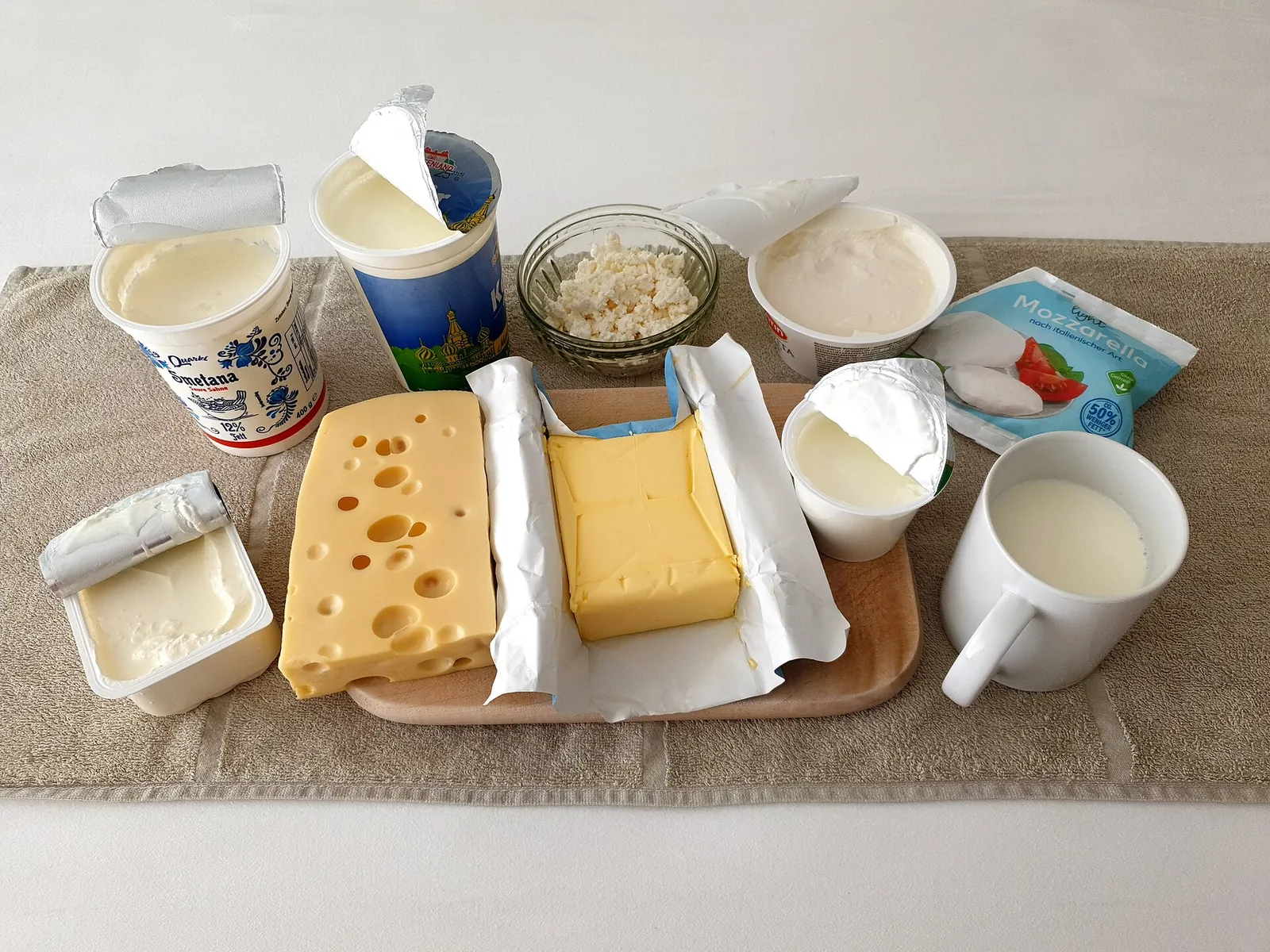
The drier and firmer the cheese, the more calcium sits in each ounce.
The reason is concentration. Calcium is carried in the milk solids, and a cheese that has lost more water holds more of it by weight. This page covers the numbers and the daily amounts; whether cheese actually protects bones is a separate question, taken up in cheese and bone density. This page is general information, not medical advice.
Calcium in cheese per ounce
Calcium in cheese per ounce is listed below for common types, taken from USDA's FoodData Central (SR Legacy) and rounded to the nearest milligram. The right column is the share of the 1,300 mg Daily Value that the Nutrition Facts label uses for adults and children 4 and older.
| Cheese (1 oz, 28 g) | Calcium (mg) | Share of 1,300 mg DV |
|---|---|---|
| Parmesan, hard | 336 | 26% |
| Romano | 302 | 23% |
| Pasteurized process American | 296 | 23% |
| Gruyère | 287 | 22% |
| Swiss | 252 | 19% |
| Mozzarella, part skim | 222 | 17% |
| Provolone | 214 | 16% |
| Cheddar | 201 | 15% |
| Gouda | 198 | 15% |
| Blue | 150 | 12% |
| Feta | 140 | 11% |
| Camembert | 110 | 8% |
| Ricotta, part skim | 77 | 6% |
| Ricotta, whole milk | 58 | 4% |
| Brie | 52 | 4% |
| Cream cheese | 28 | 2% |
| Cottage cheese, 1% | 17 | 1% |
The percentages are simple division and the label rounds differently, so a pack may show a slightly different figure. Brands vary too, which is why the Nutrition Facts panel on the pack beats any table.
How much calcium you need each day
How much calcium you need each day depends on age and sex. The NIH Office of Dietary Supplements calcium fact sheet lists these Recommended Dietary Allowances:
- Children 4 to 8 years: 1,000 mg
- Ages 9 to 13 and 14 to 18: 1,300 mg
- Adults 19 to 50: 1,000 mg
- Men 51 to 70: 1,000 mg
- Women 51 to 70: 1,200 mg
- Adults over 70: 1,200 mg
- Pregnant or breastfeeding, ages 14 to 18: 1,300 mg
- Pregnant or breastfeeding, ages 19 to 50: 1,000 mg
Those are totals from all foods and any supplements. A needs figure for your own case, especially during pregnancy, with kidney stones or with a bone diagnosis, is a question for your doctor or a registered dietitian.
Why calcium in cheese varies so much
Calcium in cheese varies because of water content and how the curd is made. Aged hard cheeses such as Parmesan, Romano and Gruyère have lost the most moisture, so a 1 ounce slice is mostly concentrated milk solids. Fresh cheeses such as cottage cheese, ricotta and cream cheese hold far more water, and USDA's numbers show it: cottage cheese has about a twelfth of Parmesan's calcium per ounce.
Fat is not the driver. Cheddar and its reduced-fat version are close in the USDA table (201 and 216 mg per ounce), and fat-free Swiss has 272 mg against 252 for regular Swiss. Cutting fat removes weight that is not calcium, which can leave a little more calcium in each ounce.
Brie and Camembert are an easy trap: they taste rich, yet a ripe soft-ripened cheese is wetter, and Brie lists only 52 mg per ounce. For single-cheese profiles, see Parmigiano-Reggiano, Gruyère and cottage cheese.
Calcium in cheese on the Nutrition Facts label
Calcium in cheese on a label is shown as milligrams and as a percent of the Daily Value. Under 21 CFR 101.9 the Daily Value for calcium is 1,300 mg for adults and children 4 and older, so 20 percent or more per serving counts as high, and 5 percent or less as low.
Serving sizes differ by product, and that trips people up. A label that says 15 percent for a slice and one that says 15 percent for a 1.5 ounce portion are not the same cheese amount. Compare per ounce, as the table does.
What most calcium in cheese advice gets wrong
Most advice on calcium in cheese skips two points: portion size and what else comes with the calcium.
An ounce is small. Reaching 1,000 mg from cheddar alone would take about 5 ounces, or about 3 ounces of hard Parmesan. Few people plan that, and the cheese-per-person guide shows 1 to 2 ounces is a typical serving on a board. Cheese is one source among several, not a plan.
Calcium comes with salt and saturated fat. Parmesan has 333 mg of sodium per ounce and cheddar has 185 in the USDA table, so a high-calcium cheese is not automatically the best pick if you watch sodium. Low-sodium cheeses and the cheese and blood pressure page cover that tradeoff.
Fresh is not "bad" for calcium. Cottage cheese and ricotta are modest per ounce but are eaten by the half cup, so a serving gives more than the per-ounce row suggests.
Questions about calcium in cheese
These are quick answers to common questions about calcium in cheese.
Which cheese has the most calcium?
The cheese with the most calcium in the USDA table is hard Parmesan at 336 mg per ounce, followed by Romano at 302 and Gruyère at 287. Pasteurized process American, at 296, also ranks high.
Is cheese a good source of calcium?
Cheese is a good source of calcium when it is a hard or semi-hard type: cheddar gives about 15 percent of the Daily Value per ounce. The NIH fact sheet names milk, yogurt and cheese as rich natural sources.
How much calcium is in cheddar cheese?
Calcium in cheddar cheese is 201 mg per ounce in USDA's entry, about 15 percent of the 1,300 mg Daily Value. Sharp, mild and reduced-fat versions land close to that number.
Does cottage cheese have a lot of calcium?
Cottage cheese has little calcium per ounce: USDA lists 17 mg for 1% cottage cheese and 24 mg for nonfat. A half cup is a bigger portion than an ounce, so check the label for your tub.
How much calcium do adults need?
Adults need 1,000 mg a day from ages 19 to 50, and women over 50 and everyone over 70 need 1,200, per the NIH Office of Dietary Supplements.
Choosing calcium in cheese
Choosing calcium in cheese comes down to hardness: pick Parmesan, Gruyère, Swiss, provolone or cheddar for the most per ounce, and treat Brie, cream cheese and cottage cheese as flavor and texture choices rather than calcium sources. Next, compare your usual cheese's Nutrition Facts panel against the 1,300 mg Daily Value, then read how the research looks at cheese and your teeth.
Sources
- Calcium: Health Professional Fact Sheet, NIH Office of Dietary Supplements
- USDA FoodData Central, SR Legacy cheese entries, U.S. Department of Agriculture (cheddar: 173414)
- 21 CFR 101.9, Nutrition labeling of food, Cornell Legal Information Institute