
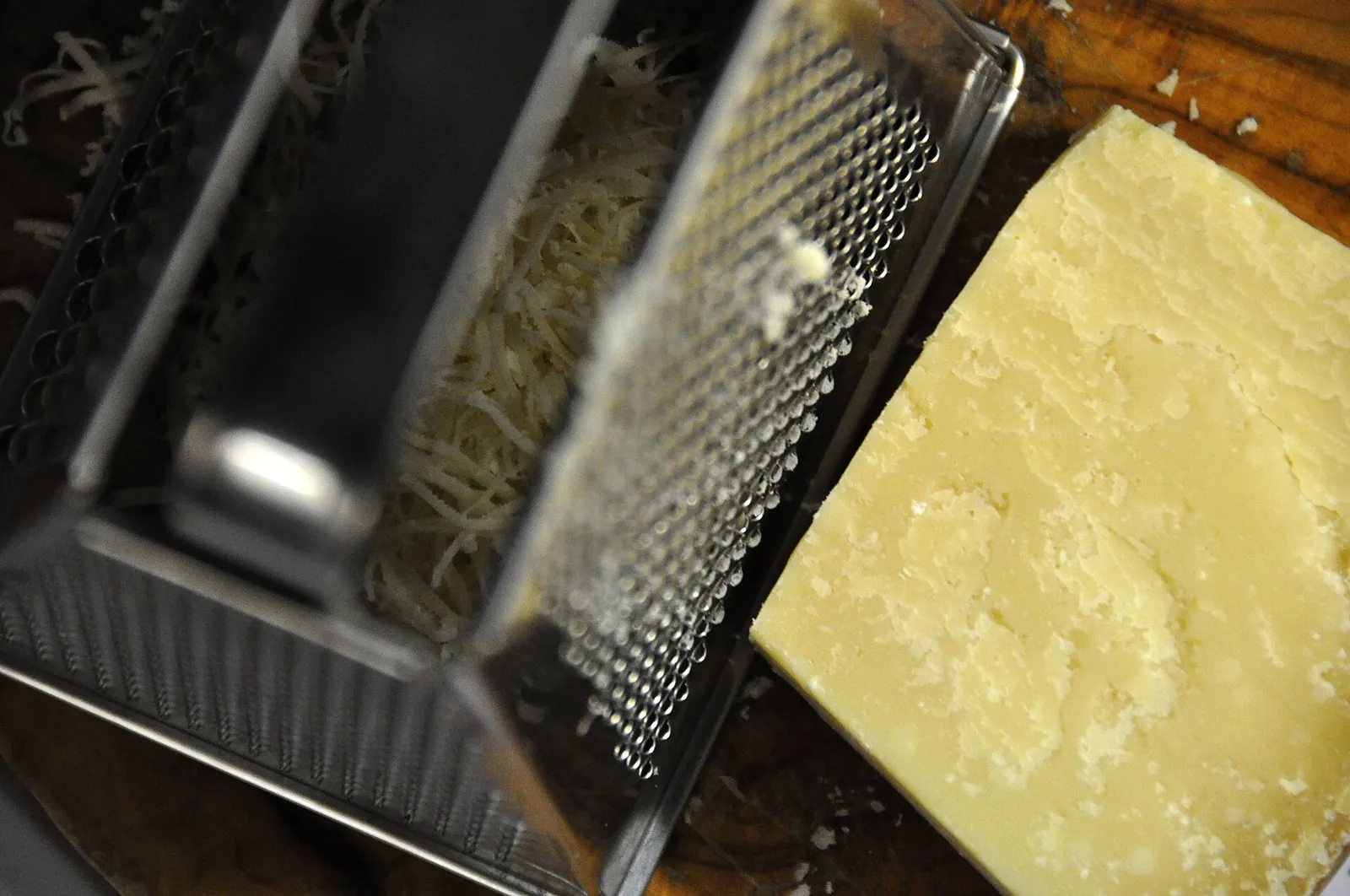
That makes Grana Padano the cheaper cheese, and usually the milder one, and Parmigiano-Reggiano the one with the stricter pedigree. The real surprise is the third player: in the US, "Parmesan" is a legal recipe and not an Italian cheese, and it can differ from both. The Parmigiano-Reggiano guide and the Grana Padano guide cover each Italian cheese in full.
Parmesan vs Grana Padano: the rules side by side
This Parmesan vs Grana Padano table sets the two Italian PDOs next to the US legal standard for Parmesan.
| Parmigiano-Reggiano (PDO) | Grana Padano (PDO) | US "Parmesan" (FDA) | |
|---|---|---|---|
| Where | Parma, Reggio Emilia, Modena, parts of Bologna and Mantua | More than 30 Po Valley provinces | Anywhere |
| Milk | Raw cow's milk, partly skimmed | Raw cow's milk, partly skimmed | Cow's milk; may be pasteurized, fat-adjusted or rebuilt from dry milk |
| Cow feed | Local forage and hay; silage banned | Forage plus silage allowed (not in Trentingrana) | No feed rule |
| Minimum age | 12 months | 9 months | 10 months |
| Fat in the dry matter | At least 32% | At least 32% | At least 32% |
| Additives | None: milk, salt, calf rennet | Egg lysozyme allowed, up to 2.5 g per 100 kg of milk | Coloring, calcium chloride, added enzymes, bleaching, coated rind and surface antimycotics allowed |
| Marks | Dotted rind, casein plate, oval fire-brand | Diamond lettering, four-leaf clover, fire-brand | None required |
| Flavor | Fragrant and savory, nutty with age | Delicate and milky, paler paste | Depends on the maker |
| Likely price drivers | Silage ban, small area, 12-month minimum | Silage allowed, wide area, 9-month minimum, large volume | No origin or feed rules |
Read across the two Italian columns and the pattern is plain: wherever they differ, Grana Padano is the looser one.
Parmesan vs Grana Padano price
The Parmesan vs Grana Padano price gap shows up in wholesale lists, before any store adds its margin.
The Mantua chamber of commerce price list for 27 August 2026 quoted top-grade whole wheels at the dairy or aging warehouse. Parmigiano-Reggiano ran 15.10 to 15.30 euros a kilo at 12 months, 16.40 to 16.80 at 18 months and 18.15 to 18.45 at 24 months. Grana Padano ran 9.80 to 10.00 at 10 months, 11.05 to 11.25 at 14 months and 11.95 to 12.15 for a 20-month Riserva.
Age alone does not explain the difference: the 12-month Parmigiano-Reggiano cost about 26 percent more than the 20-month Riserva. The rules are the likelier drivers, since the silage ban and the small area limit where and how the milk can be produced, while Grana Padano's wide area and looser feed rules let it scale: its consortium counted about 6.05 million wheels in 2025, while the Parmigiano-Reggiano consortium puts its output above 4 million a year.
Grana Padano vs Parmigiano-Reggiano taste
Grana Padano vs Parmigiano-Reggiano taste depends on age as much as on name, and the consortia's own tasting notes show why.
| Stage | Parmigiano-Reggiano | Grana Padano |
|---|---|---|
| Youngest | 12 to 19 months: delicate, with milk, yogurt and fresh fruit | 9 to 12 months: mild, sweet and milky, not yet grainy |
| Middle | 20 to 26 months: balanced between mild and rich, with fruit, nuts and meat stock | Over 16 months: grainy and flaky, savory, never overpowering |
| Oldest | 27 to 45 months: pronounced to spicy, very crumbly | Riserva, over 20 months: very grainy and richer, never aggressive |
Line the notes up by stage and the vocabulary is close, so compare ages before names, and remember that Parmigiano-Reggiano cannot be sold under 12 months while Grana Padano can be sold at 9.
How to tell Parmesan from Grana Padano on the rind
To tell Parmesan from Grana Padano, turn the wedge over and read the rind.
A Parmigiano-Reggiano rind carries dotted letters spelling the name, with the dairy's number and the month and year. A Grana Padano rind carries rows of small diamonds spelling GRANA and PADANO, plus a four-leaf clover with the dairy's number and a province code. Packaged Italian pieces show a wedge-and-wheel logo for Parmigiano-Reggiano and a yellow diamond logo for Grana Padano. A US Parmesan needs neither mark, and a piece cut from the middle of an Italian wheel can lack lettering too, so the name and age on the label settle it.
What Parmesan means in the US
In the US, Parmesan means whatever 21 CFR 133.165 says it means, and that standard describes a recipe, not a place.
The federal standard defines Parmesan, also called reggiano, as a cow's milk cheese with a granular texture and a hard, brittle rind that grates readily. It may hold no more than 32 percent moisture, its solids must carry at least 32 percent milkfat, and it must be cured at least 10 months. The curd is cut to the size of wheat kernels and heated to 115 to 125°F (46 to 52°C).
Nothing in it asks for Italian origin, raw milk or a feed rule. The milk may be pasteurized, adjusted with cream or skim milk, or rebuilt from dry milk, and makers may add calcium chloride, coloring or enzymes, coat the rind and treat the surface with an antimycotic. Grated Parmesan can carry anticaking agents under the grated cheese standard. So a US Parmesan can be a fine aged wedge or a mild shaker cheese, and only the label tells you which; the guides to real vs fake Parmesan and block vs pre-shredded cheese show what to read.
Europe treats the word differently. The consortium says the EU Court of Justice ruled in 2008 that selling other cheese as Parmesan evokes the Parmigiano-Reggiano PDO, and the EU's own Official Journal calls Parmesan a protected name. In the US the Italian cheese is protected as a certification mark instead, and the consortium says those marks bar wording such as "Parmesan Reggiano", even though the federal text treats reggiano as another name for Parmesan.
When to use Grana Padano and when to use Parmesan
Use Grana Padano and Parmesan by job: Parmigiano-Reggiano when the cheese is the dish, Grana Padano when it is an ingredient.
For shaving, snacking and finishing a plate, buy Parmigiano-Reggiano of 20 to 26 months or an Oltre 16 Mesi Grana Padano. For sauces, meatballs, soup and baked pasta, where the cheese blends into other flavors, Grana Padano delivers most of the result for less. If anyone at the table avoids egg, choose Parmigiano-Reggiano or Trentingrana, since lysozyme can appear in Grana Padano. Either works in risotto, and for a saltier, sharper edge than both, read Parmesan vs Pecorino Romano.
What most Parmesan vs Grana Padano advice gets wrong
Most Parmesan vs Grana Padano advice treats one as the real cheese and the other as the copy, which the rules do not support.
Grana Padano is not a fake Parmesan
Grana Padano is not a fake Parmesan: both cheeses have been EU-protected since 1996, and each has its own inspection, hammer test and fire-brand.
A US Parmesan label tells you very little
A US Parmesan label tells you very little, because the word guarantees only a cow's milk cheese cured 10 months or more. The age, the ingredient list and a rind with dotted lettering say far more than the name.
Questions about Parmesan and Grana Padano
These questions about Parmesan and Grana Padano come up most when people stand at the cheese case.
Is Parmigiano-Reggiano the same as Parmesan?
Parmigiano-Reggiano is the protected Italian cheese, and in the EU only it may be sold as Parmesan, while in the US Parmesan is a standard any maker can meet.
Is Grana Padano as good as Parmesan?
Grana Padano is as good as Parmesan for cooking, because a hot dish hides most of the difference; to eat on its own, taste both at the same age and pick the one you like.
Can you substitute Grana Padano for Parmesan?
You can substitute Grana Padano for Parmesan one for one by weight, and choose an Oltre 16 Mesi wedge if you want more savor.
Which has more protein, Parmesan or Grana Padano?
Parmesan and Grana Padano are close on protein: USDA's hard Parmesan has 10.1 grams an ounce, and the Grana Padano consortium's table of 33 grams per 100 grams works out to about 9.4.
Which one contains egg?
Grana Padano can contain egg, because the rules allow lysozyme from hen egg white in the milk, while Parmigiano-Reggiano allows no additives at all.
Parmesan or Grana Padano: the next step
The next step for choosing between Parmesan and Grana Padano is to read the age and the ingredient list first, then taste one wedge of each at about the same age, side by side. The PDO and PGI guide decodes the symbols you will find on the pack.
Sources
- Publication of an amendment application with the single document, 'Parmigiano Reggiano' PDO (OJ C 202, 9 June 2023) and the same for 'Grana Padano' PDO (OJ C 188, 4 June 2019), Official Journal of the European Union
- Disciplinari DOP e IGP, 1.3 Formaggi (Parmigiano Reggiano and Grana Padano product specifications), Italian Ministry of Agriculture (MASAF)
- 21 CFR 133.165, Parmesan and reggiano cheese and 21 CFR 133.146, Grated cheeses, Electronic Code of Federal Regulations
- Consorzio del Formaggio Parmigiano Reggiano: FAQ and Retailers Guidelines, October 2025
- Grana Padano Protection Consortium: Ingredients, Results: production and consumption and Press Folder, August 2024
- Listino dei prezzi all'ingrosso di Mantova, 27 August 2026, Camera di Commercio Cremona-Mantova-Pavia
- Cheese, parmesan, hard (FDC 170848), USDA FoodData Central