
Neither is automatically fraud. A fake Parmesan, strictly, is a product that claims to be pure cheese and is not, which is a different and rarer problem than a shaker of legal grated cheese.
That gives you two questions at the shelf. Is it the Italian cheese, and is it all cheese? This page answers both. For how to pick a good wedge once you know it is real, see the buying guide.
What US law lets Parmesan be
What US law lets Parmesan be is a short recipe in the federal standards. 21 CFR 133.165 says Parmesan, which it also calls reggiano, is made from milk that may be pasteurized, cured for not less than 10 months, with no more than 32 percent moisture and at least 32 percent milkfat in the solids.
The same standard allows added coloring, calcium chloride, added enzymes and antimycotic agents on the surface. It says nothing about Italy, raw milk, what the cows eat or who may use the name. So a domestic Parmesan can be a perfectly good hard cheese, and still be a different cheese from Parmigiano-Reggiano. The full side-by-side is in Parmesan vs. Grana Padano.
Grated cheese has its own standard. 21 CFR 133.146 lists anticaking agents among the optional ingredients and states no percentage limit for them. The label must name the cheese variety and list the ingredients.
What makes Parmigiano-Reggiano the real Parmesan
What makes Parmigiano-Reggiano the real Parmesan is a protected name plus a set of rules the US recipe lacks. The Parmigiano-Reggiano profile covers them: raw cow's milk, salt and calf rennet, made in a defined part of Italy, aged at least 12 months, with no additives.
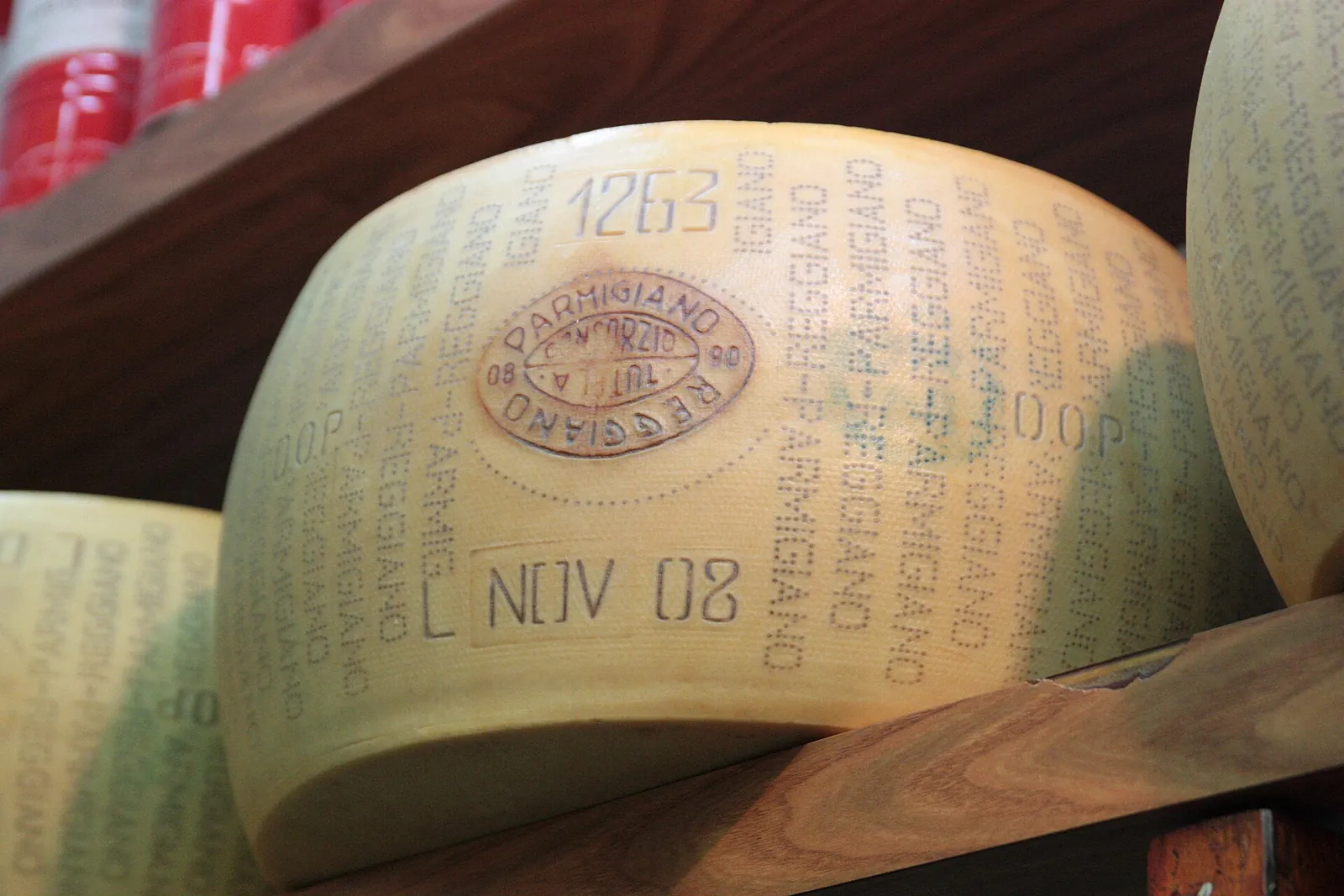
The proof is physical. The consortium says each wheel carries dotted lettering spelling the name, the dairy number, the production month and year, and a plastic casein plate with a traceability code. After 12 months, approved wheels receive an oval hot-iron brand. Wheels with minor defects keep the brand but get parallel grooves cut around the rind, and downgraded wheels lose every origin mark. Packaged pieces must carry the consortium's piece-and-wheel logo and, since April 2018, the minimum maturation time.
The cellulose cases behind fake Parmesan
The cellulose cases behind fake Parmesan are the reason the phrase exists. Castle Cheese Inc. of Slippery Rock, Pennsylvania, sold what it labeled "100 percent Parmesan" between 2010 and 2013, but the product was padded with cellulose, a wood pulp derivative, and cut-rate substitutes, according to IndustryWeek's report. Company president Michelle Myrter pleaded guilty to a federal misdemeanor involving food adulteration and was sentenced to three years of probation, a $5,000 fine and 200 hours of community service at a food bank.
The case spread beyond one company. In 2016 Bloomberg had store-brand grated cheeses tested, and Time reported the cellulose results: Jewel-Osco's Essential Everyday 100% Grated Parmesan at 8.8 percent, Walmart's Great Value at 7.8 percent, Kraft at 3.8 percent and Whole Foods 365 at 0.3 percent. Time also quoted Arthur Schuman's Neil Schuman saying he believed about 20 percent of such cheese is mislabeled.
Cellulose is an anticaking agent and the grated cheese standard permits anticaking agents. The problem in the cases was a "100 percent" claim and a filler level well beyond an anticaking dose, not the mere presence of an additive. Those are 2016 test results and 2010 to 2013 conduct; they say nothing about what is on shelves today, so read the current label.
How to tell real from fake Parmesan at the store
To tell real from fake Parmesan at the store, run four checks in this order, and stop as soon as one fails.
Read the name for real Parmesan
Read the name first. "Parmigiano-Reggiano" is the Italian cheese; "Parmesan," "Parmesan cheese" or "Italian-style hard cheese" is not, which is why the label-reading guide starts with the name.
Look for the rind for real Parmesan
Look for the rind lettering on any wedge. A piece from a real wheel should show part of the dotted name, though one cut from the flat top or bottom may not, so ask which part of the wheel it came from. A wedge with no lettering and no logo, labeled only "Parmesan," is the US kind.
Check the ingredients of grated Parmesan
Check the ingredient list on anything grated. Real grated Parmigiano-Reggiano reads milk, salt, rennet. Cellulose, potato starch or a long list means a legal grated Parmesan or something blended, not the protected cheese.
Compare the price and form
Compare the form: a wedge cut from the wheel is easy to authenticate and a shaker is not. A very low price per ounce on a cheese claiming to be Italian is a reason to read the pack twice, since the real cheese needs at least 12 months of aging.
What most fake Parmesan advice gets wrong
Most fake Parmesan advice gets one thing wrong: it treats everything that is not Parmigiano-Reggiano as fraud, and that is not accurate.
A cheap Parmesan is not always fake
A cheap Parmesan is often just domestic Parmesan following the US recipe, a legal and honest product. The line to watch is the claim: if a pack says 100 percent cheese, the ingredient list should agree.
The burn test and the water test are not reliable
Burn tests, water tests and "does it melt" tricks do not separate real from fake, because legal Parmesan also melts, and no home test is described in the sources for this page. Reading the label and rind is more reliable.
Questions about real vs. fake Parmesan
These are the questions about real vs. fake Parmesan that come up most often.
Is Parmesan the same as Parmigiano-Reggiano?
Parmesan is not the same as Parmigiano-Reggiano: Parmesan is a US recipe with a 10-month cure, while Parmigiano-Reggiano is a protected Italian cheese aged at least 12 months.
Is the Parmesan in a green shaker real cheese?
The Parmesan in a shaker is real cheese if the ingredient list says so, but grated cheese may carry anticaking agents under the grated cheeses standard. It is not Parmigiano-Reggiano unless it says so.
Is there really wood in Parmesan?
Wood in Parmesan means cellulose, a wood pulp derivative used as an anticaking agent; in the Castle Cheese case it was used as filler in a product sold as 100 percent Parmesan.
Is grated Parmesan real if the tub says 100 percent?
Grated Parmesan that says 100 percent is only as honest as its ingredient list: all cheese reads milk, salt and rennet or enzymes, and anything else is added.
Why is real Parmesan expensive?
Real Parmesan is expensive because each wheel needs at least 12 months of aging before it can be sold under the name.
Real vs. fake Parmesan: your next step
Your next step for real vs. fake Parmesan is to buy one wedge with dotted lettering and a stated age, then grate it yourself once to learn what you are paying for. The buying guide shows how, and the Parmigiano-Reggiano page covers the cheese itself.
Sources
- 21 CFR 133.165 Parmesan and Reggiano cheese and 133.146 Grated cheeses, Legal Information Institute, Cornell Law School
- Parmigiano Reggiano marks and seals, Consorzio del Formaggio Parmigiano Reggiano
- Her Cheese Story Full of Holes, Executive Sentenced to Food Bank, IndustryWeek
- FDA Warns The Parmesan You Eat May Be Wood Pulp, Time