
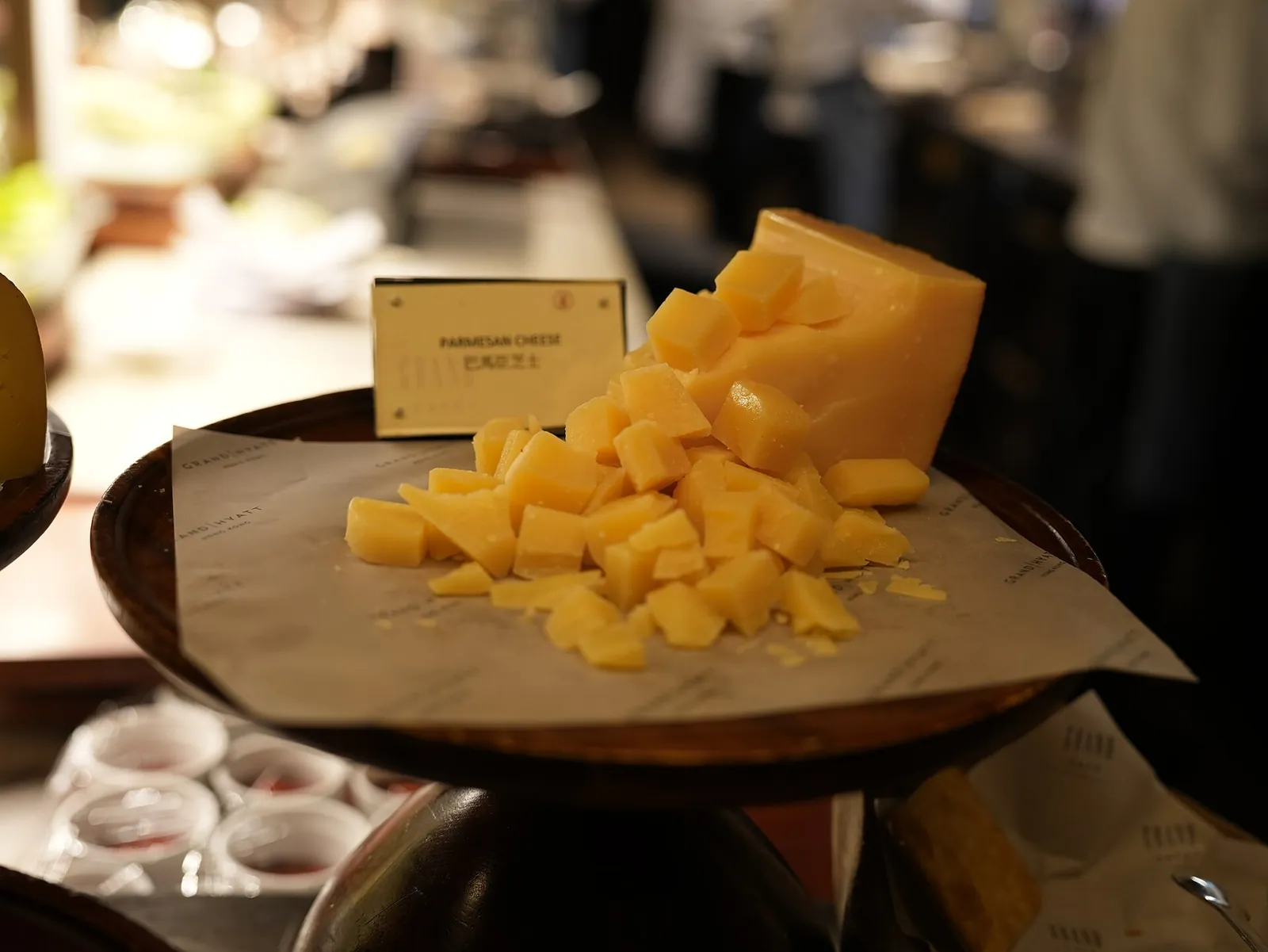
Pick the age for the job, ask where in the wheel the piece came from, and wrap it well at home.
This page is the shopping routine. For what the cheese is and how it is made, see the Parmigiano-Reggiano profile; for telling it from imitations, see the real vs. fake Parmesan guide.
Parmigiano-Reggiano rind markings to look for
Parmigiano-Reggiano rind markings are the quickest check on a wedge at the counter, and the consortium lists every one on its seals and marks page.
| Mark | What it is | What to do with it |
|---|---|---|
| Dotted lettering | The name, PDO inscriptions, dairy number and production month and year, printed around the wheel | Look for a patch on the rind of the wedge |
| Oval hot-iron brand | Applied after 12 months to wheels that pass inspection | Its presence means first grade |
| Parallel grooves around the rind | The brand on a medium-grade wheel | Fine to buy, usually cheaper |
| Casein plate | Plastic plate on a flat face with a traceability code | Seen on whole wheels |
| Wedge-and-wheel logo | Required on pre-packaged pieces since 2012 | Check a packed piece carries it |
A wheel graded down loses all its origin marks, so it can never be sold under the name. Since April 2018, packaged pieces must state the minimum maturation time. A missing patch of lettering is not proof of a fake, because pieces cut from the flat top, bottom or center of a wheel do not carry the side lettering. Ask which part of the wheel the piece came from, and look at the label.
Parmigiano-Reggiano ages and which to buy
Parmigiano-Reggiano ages run from 12 months to several years, and the age you buy should match what you plan to do with it. The wheel must age at least 12 months, which is when the consortium's experts test it and brand it; first-grade wheels can then carry extra marks from 18 months.
| Age | Class | Taste per the consortium | Buy it for |
|---|---|---|---|
| 12 to 19 months | Delicato | Delicate, milk and fresh fruit | Salads, shaving, cold dishes |
| About 20 to 26 months | Armonico | Balanced between mild and rich | Grating, pasta, everyday cooking |
| About 27 to 34 months | Aromatico | Pronounced, crumbly, spice and nuts | Baked pasta, fruit and honey |
| About 35 to 45 months | Intenso | Spice and deep aroma | Tasting alone |
The class names are optional on a label, while a minimum age on a pre-packaged piece is required, so shop by the number, as the profile explains. For an all-purpose wedge, 24 months is a safe default. Older cheese is drier, more crystalline and stronger, and it costs more, so do not pay for an age you will grate into soup.
Where the Parmigiano-Reggiano wedge is cut
Where the Parmigiano-Reggiano wedge is cut matters because a wheel is split and then portioned. The consortium's cutting guide describes tracing a line across the flat face with an almond-shaped knife, pushing it about an inch into the cheese, then driving two almond knives in at opposite ends to split the wheel along its natural grain.
That is why a counter piece should look like it broke rather than sliced: a rough, granular face, not a smooth glossy one. It also means pieces differ. Wedges from the side of the wheel have rind and lettering; blocks from the center are all paste. Choose a piece with some rind if you want to make soup with it later, and ask the counter to cut fresh rather than choosing one that has been sitting in plastic.
Buying Parmigiano-Reggiano at the counter or pre-packed
Buying Parmigiano-Reggiano at the counter lets you see the rind, taste a crumb and pick the amount, while a pre-packed piece gives you a printed age and logo. Either is fine if the marks are there. A vacuum-packed piece lasts several months unopened, per the consortium, and shows a minimum durability date.
At a counter, ask three things: how old the wheel is, when it was cut and whether you can taste. For general counter habits, the cheese counter guide has more.
Buy by the piece, not the grated tub, if you can. Anything grated is a good test of the label: Parmigiano-Reggiano has no additives, while the US grated cheeses standard allows anticaking agents. Grate at home and the question goes away.
How to store Parmigiano-Reggiano after you buy it
To store Parmigiano-Reggiano after you buy it, keep it in the refrigerator between 40 and 48°F, per the consortium, away from other food so it does not absorb odors.
Wrap a cut piece in food-grade plastic film or seal it in an airtight glass or plastic container. The consortium gives a freshly cut piece of 12 to 18 months about 15 days, and a piece of 24 months or older about a month. It says freezing is never recommended and that surface mold can simply be cut off with a knife. The rind is natural protection, so keep it on. For wrapping choices, see cheese paper vs. plastic wrap, and the rind has a second life in soup (see what to do with cheese rinds).
Parmigiano-Reggiano buying mistakes
Parmigiano-Reggiano buying mistakes are mostly small, and each costs flavor or money.
Buying a big wedge you will not finish
Buying a big wedge you will not finish wastes the cheese, since a cut piece of 12 to 18 months lasts only about 15 days. Buy what you will use in a few weeks.
Treating the price as proof
Treating the price as proof of age is a trap. The stated age or minimum age is the proof; price follows age and region of sale.
Skipping the label on a wedge with lettering
Skipping the label on a wedge with lettering misses the age. Lettering shows origin, and age is a separate line on the pack or the counter card.
Questions about buying Parmigiano-Reggiano
These are the questions about buying Parmigiano-Reggiano that come up most often.
What age of Parmigiano-Reggiano is best for grating?
The best age of Parmigiano-Reggiano for grating is about 24 months, which suits general use: it grates, shaves and snacks well. Choose 12 to 19 months for salads and 27 months or more for tasting.
Is a wedge real Parmigiano-Reggiano without dotted lettering?
Real Parmigiano-Reggiano usually shows dotted lettering, but cuts from the flat faces may not, so check the logo and minimum age on a pre-packaged piece and an ingredient list with no additives.
How long does Parmigiano-Reggiano last in the fridge?
Parmigiano-Reggiano lasts about 15 days once cut at 12 to 18 months and about a month at 24 months or older, per the consortium, stored airtight at 40 to 48°F.
Can you freeze Parmigiano-Reggiano?
Freezing Parmigiano-Reggiano is never recommended by the consortium, so buy smaller pieces more often.
Can you eat the Parmigiano-Reggiano rind?
The Parmigiano-Reggiano rind is natural protection for the cheese, and the consortium says it can be used in cooking once cleaned. Simmer it in soup and remove it before serving.
Your Parmigiano-Reggiano shopping list
Your Parmigiano-Reggiano shopping list is short: a wedge of about 24 months with a patch of dotted rind, an airtight wrap, and a fridge spot at 40 to 48°F. Taste a 12 to 19 month piece beside it once to hear what age does.
Sources
- Parmigiano Reggiano marks and seals, Consorzio del Formaggio Parmigiano Reggiano
- Parmigiano Reggiano cutting and storage, Consorzio del Formaggio Parmigiano Reggiano
- 21 CFR 133.146 Grated cheeses, Legal Information Institute, Cornell Law School
- 21 CFR 133.165 Parmesan and Reggiano cheese, Legal Information Institute, Cornell Law School