
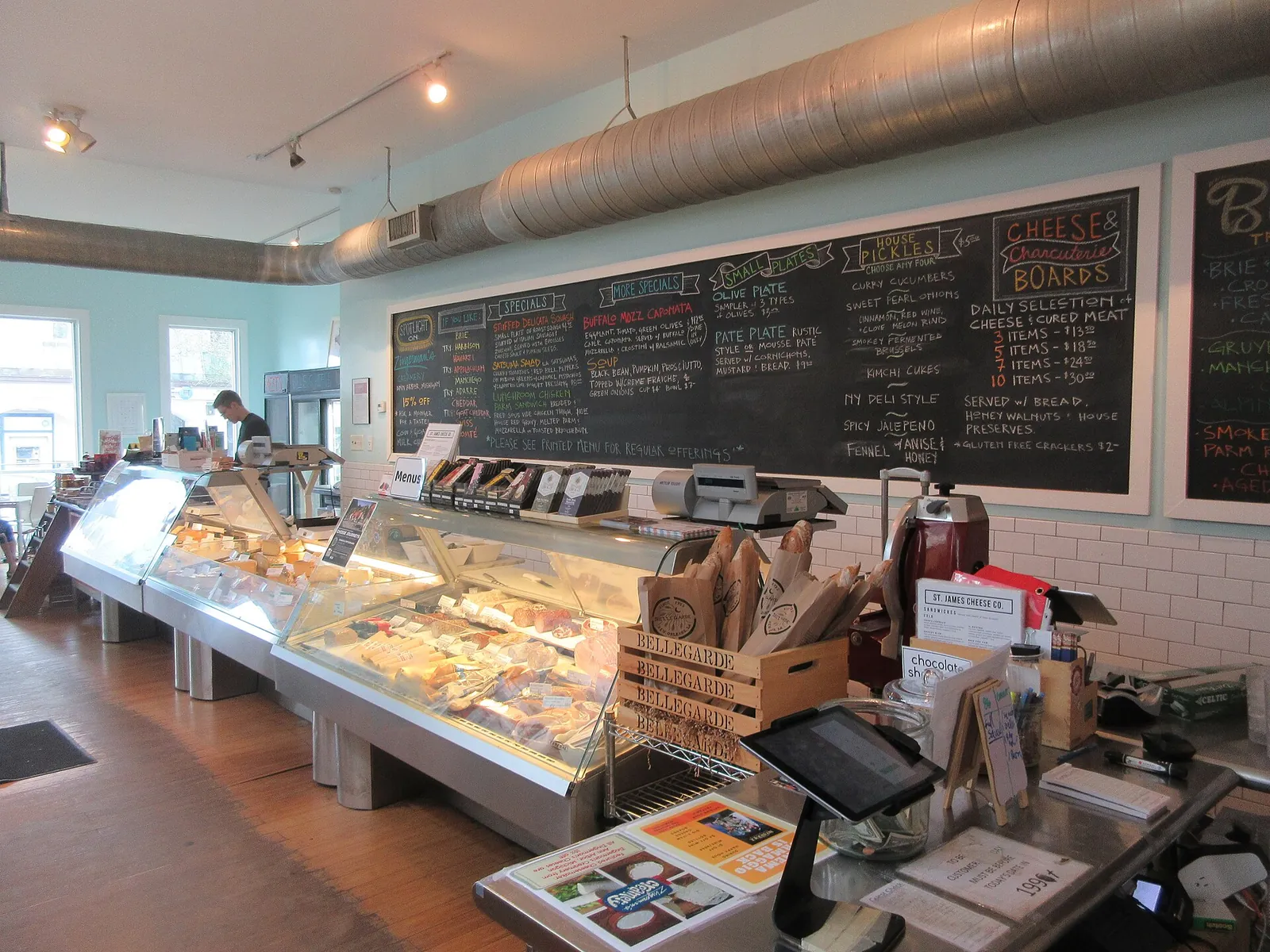
The staff cut the cheese fresh, weigh it in front of you and wrap it, so you pay for the amount you will actually eat.
The counter has one big advantage over the shelf of sealed wedges: you can ask. Almost every decision below, from amount to wrap, is easier when you say what you are planning. For the questions themselves, see questions to ask your cheesemonger; this page covers the mechanics of the purchase.
Before you get to the cheese counter
Before you get to the cheese counter, settle three things: the occasion, the headcount and a rough budget. A board for six, a sandwich for lunch and a gift each lead to different cheeses. Going when the counter is quiet, such as a weekday afternoon, gives the staff time to cut samples and talk rather than rush you.
Look at the case before you speak. Cheeses are usually grouped by milk, by country or by style, and handwritten tags often give the name, the origin and the price per pound. Reading the case first tells you which cheeses are in the same family and where the bargains are.
How to taste cheese at the counter
Tasting cheese at the counter is normal, and most shops expect it, so ask for "a little taste of this one." A sliver is plenty. Taste something new, something expensive or anything you are unsure about, and skip the taste for a cheese you already buy every week.
Taste in a sensible order: fresh and mild first, then bloomy and washed-rind cheeses, then blues last, since a strong blue will flatten everything after it. Notice the rind too. Whether to eat it depends on the cheese, and the counter staff will say; the rind types guide explains the categories.
Tasting is a courtesy, not a buffet. Two or three tastes, then a decision, is a fair rhythm; if a cheese is not for you, say so plainly and move on.
How much cheese to buy at the counter
How much cheese to buy at the counter depends on what the cheese is doing in the meal, and you buy by weight, so it helps to think in ounces. A standard guideline is 1 to 2 ounces per person as an appetizer and 4 to 6 ounces per person when cheese is the meal; the cheese per person guide works through boards and parties. A quarter pound is 4 ounces, so a quarter pound of each of three cheeses feeds four or five people at a drinks gathering.
Buy less of strong cheeses and more of mild ones. Two ounces of a pungent blue goes a long way; two ounces of a mild cheddar disappears. And buy only what you will finish: the same Clemson Extension guide that gives a keeping time of one to three weeks for opened soft natural cheeses says hard natural cheeses keep for several months, so a soft wedge is the one to buy small.
Ask for "about a quarter pound" and let the cutter come close. A wire or knife cut is by eye, so it will land a little over or under; most counters will cut a bit off or add a sliver if you ask. Wheels with a set shape, such as a small round of goat cheese, may be sold whole instead.
How the counter cuts, weighs and wraps cheese
At a cheese counter, the cheese is cut from a wheel or block, weighed, wrapped and labeled with the name and price. Some counters also wrap pieces ahead of time and keep them in the case, so ask when something was cut if freshness matters to you.
You pay by the pound, but weigh the piece in ounces in your head. If a cheese is $24 a pound, a quarter pound costs $6. Check that the scale shows the weight before the wrap goes on, and that the label matches the tag on the case.
Paper is the better wrap. Wisconsin Cheese's storage guide recommends cheese paper, which is coated in wax with a porous plastic layer so the cheese can breathe, and says wrapping cheese tightly in plastic wrap can suffocate it. If the counter wraps in plastic, take it home and rewrap in paper. The cheese paper vs. plastic wrap comparison covers it, and how to store cheese you just bought covers the fridge.
Cold matters on the way home. Clemson Extension says cheese should be stored at 35 to 40 degrees Fahrenheit, and that soft cheeses left at room temperature more than four hours should be thrown out. Do the cheese shop last on an errand run.
Mistakes people make at the cheese counter
The mistakes people make at the cheese counter are mostly about holding back. People hide what they do not know, so they get the cheese they already know. Say "this is new to me" and the cutter will likely hand you a sample.
Another is buying a big piece of an unfamiliar cheese because the price per pound looks reasonable. A pound is a lot of blue cheese. Buy 4 ounces, try it at home, and come back. A third is judging by the rind and label alone; counters give you the chance to smell and taste, which a sealed wedge never does (see pre-cut vs. cut-to-order cheese for when a prewrapped piece is still fine).
Last, many shoppers think a counter is only for expensive cheese. Most counters sell a sharp cheddar or a good Swiss alongside the splurges, and buying 6 ounces of one costs less than a sealed 8-ounce block of the same style.
Questions about shopping at a cheese counter
These are common questions about shopping at a cheese counter.
Is it rude to ask for a taste at the cheese counter?
Asking for a taste at the cheese counter is not rude; it is the normal way to shop, and most staff are glad to do it. Keep it to a few small samples and buy something.
How much cheese should you buy at a cheese counter for a party?
How much cheese to buy at a cheese counter for a party comes to about 1 to 2 ounces per person as an appetizer, or 4 to 6 ounces per person if cheese is the main event. Buy more of the mild cheeses and less of the strong ones.
Do you have to buy a whole wheel at the cheese counter?
You do not have to buy a whole wheel at a cheese counter; most cheeses are cut to the weight you ask for. Small rounds, logs and some soft cheeses may be sold whole.
Should you tip or thank a cheesemonger?
Thanking a cheesemonger is welcome, and tipping is not expected at a retail counter. Coming back and saying what you liked is the better thank you, because they will remember it.
How long does cheese from the counter last?
Cheese from the counter lasts longest when it is hard: Clemson Extension puts hard natural cheeses at several months after opening and soft ones at one to three weeks. Buy soft cheese in smaller amounts.
Is cut-to-order cheese more expensive?
Cut-to-order cheese often costs more per pound than a sealed wedge, but you pay for only the amount you want. In USDA's October 2, 2026 ad survey, sealed 2-pound blocks of natural cheese averaged $7.07, about $3.54 a pound; the pre-cut vs. cut-to-order page has the full comparison.
Your next trip to the cheese counter
On your next trip to the cheese counter, take a quarter pound of two cheeses you know and one you do not, taste before you buy, and ask for paper. Then the guide to what to ask the person behind the case covers what to say when the cutter asks what you are looking for.
Sources
- Handling of Cheese for Safety and Quality (HGIC 3506), Clemson Cooperative Extension
- Weekly Grocery Store Dairy Feature Activity, October 2, 2026, USDA Agricultural Marketing Service
- How to Store Cheese the Right Way, Dairy Farmers of Wisconsin