
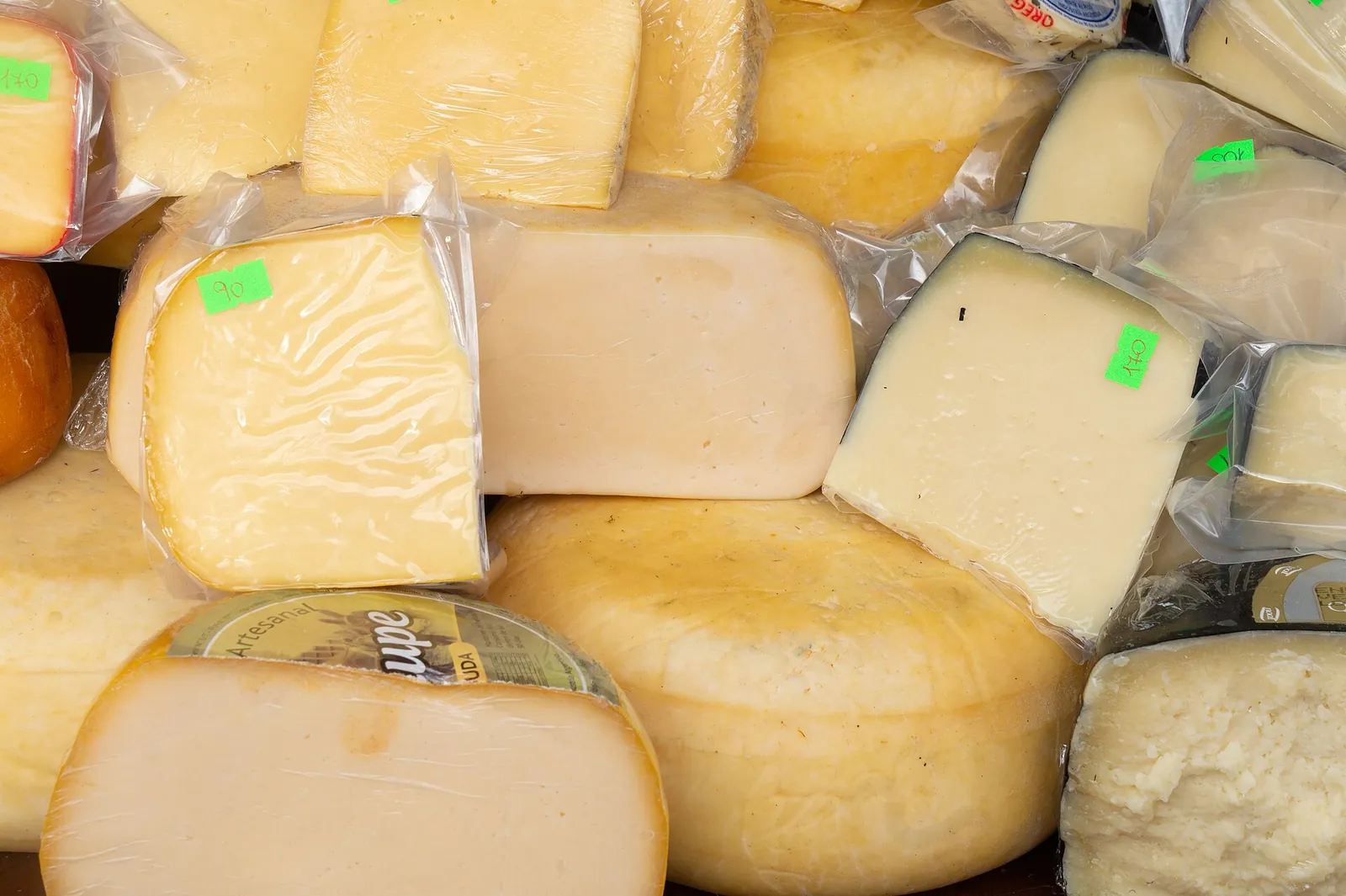
A sealed wedge of hard cheddar for the week is fine; a ripe soft cheese or an expensive wedge you cannot taste first is better cut to order.
Pre-cut means a piece cut and wrapped before you arrive, usually in plastic and often by weight set at the factory. Cut-to-order means the counter cuts it from a wheel or block while you wait. Both can be good, and the differences are freshness, wrap, price per pound and what you get to find out before you pay.
Freshness: pre-cut vs cut-to-order cheese
On freshness, pre-cut vs. cut-to-order cheese differs in how long a cut face has been sitting. Cheese begins to dry and pick up flavors once it is cut. A piece cut at the counter while you wait has a fresh surface; a sealed wedge may have been cut days or weeks earlier, though sealing slows the drying.
How much this matters depends on the cheese. Clemson Extension says hard natural cheeses keep for several months after opening and soft ones one to three weeks, so hard cheese is forgiving and soft cheese is not. Large pieces keep longer than shredded cheese, so a sealed block beats a bag of shreds on keeping time. A prewrapped piece also carries a date, and counter cuts often do not, so ask when a counter piece was cut (more in questions to ask your cheesemonger).
For ripe cheeses such as Brie and Camembert, a counter cut lets you see and smell the cut face; see choosing a ripe Brie.
Plastic: pre-cut cheese wrap and what it does
Pre-cut cheese is wrapped in plastic, and plastic is both a help and a problem. Sealed film keeps air and moisture out of a wedge, which is why prewrapped cheese lasts on the shelf. Wisconsin Cheese's storage guide, though, says tight plastic wrap can suffocate cheese, which is why it recommends cheese paper, and a plastic-wrapped soft or washed-rind cheese can taste flat or sour after days.
So the sealed wedge is good in the cooler and less good in your fridge for weeks. When you open a wedge you plan to keep, rewrap it in paper, then loosely in a bag. The cheese paper vs. plastic wrap page compares them, and how to store cheese you just bought shows the steps. Clemson Extension adds the safety basics: keep cheese at 35 to 40 degrees Fahrenheit and throw out soft cheese left at room temperature more than four hours.
Cut-to-order cheese is usually wrapped in paper or thin film at the counter. If it comes in plastic, repack it at home.
Price per pound: pre-cut vs cut-to-order cheese
On price per pound, pre-cut vs. cut-to-order cheese depends on size more than on method. USDA's weekly survey of grocery ads for October 2, 2026 gives natural cheese averages by pack: a 6 to 8 ounce block $3.26, a 1-pound block $4.60 and a 2-pound block $7.07.
| Pack (USDA ads, Oct 2, 2026) | Average price | Per pound |
|---|---|---|
| 6 to 8 oz block | $3.26 | about $6.52 to $8.69 |
| 1 lb block | $4.60 | $4.60 |
| 2 lb block | $7.07 | about $3.54 |
The per pound column is arithmetic on USDA's prices. The small pack costs about twice as much per pound as the big one. Counter cheese has no USDA average, and shops set their own prices, so check the tag. It is often higher per pound than a sealed block of a similar style, but you can buy 5 ounces instead of 8, so what you actually pay can be less. Most of the savings come from not throwing out the last third of a block.
When pre-cut cheese is fine
Pre-cut cheese is fine when the cheese is hard, plain or going into a dish. Sealed cheddar, Swiss, Colby, Jack and block mozzarella do well, and cooking hides small differences in ripeness. A 2-pound block in the grocery or a warehouse store is often the cheapest way to buy for the week.
Pre-cut is also the answer when there is no counter, when you are shopping late or when you want a piece with a printed date and ingredient list. Read the label to see what you are buying (see how to read a cheese label).
When to buy cut-to-order cheese
Buy cut-to-order cheese when you cannot judge the cheese from the package. That means ripe soft cheeses, blues, washed-rinds, unfamiliar imports and anything over about $20 a pound. At the counter you can taste first, ask for a certain amount and see the cut face. The cheese counter guide covers how to do it.
Cut-to-order also fits small amounts: 3 ounces of an expensive cheese for a board, not a sealed 8-ounce piece. For board amounts see how much cheese per person.
What most advice on pre-cut and cut-to-order cheese misses
What most advice on pre-cut and cut-to-order cheese misses is that the method is not the variable. A cut-to-order piece wrapped in plastic that sits for a week is no fresher than a sealed wedge. A prewrapped wedge from a busy cooler with a far-off date may be fresher than a slow counter's piece.
Look at the cut face. It should look moist but not wet, with no cracks, gray patches or dried edges. Smell the wrap for ammonia. Check the date on a sealed wedge. And a sealed piece has one more advantage: nobody has handled it since it was packed.
Questions about pre-cut vs cut-to-order cheese
These are the usual questions about pre-cut vs. cut-to-order cheese.
Is cut-to-order cheese better than pre-cut?
Cut-to-order cheese is better for soft, ripe or expensive cheese because you can taste it and see the cut face. For hard everyday cheeses, pre-cut is just as good.
Is pre-cut cheese cheaper?
Pre-cut cheese is often cheaper per pound in big packs: USDA ads averaged about $3.54 a pound for 2-pound blocks and $4.60 for 1-pound blocks on October 2, 2026. Small 6 to 8 ounce packs cost more per pound.
Does pre-cut cheese go bad faster?
Pre-cut cheese does not necessarily go bad faster, because sealing slows drying. Hard cheese keeps for months after opening, per Clemson Extension; soft cheese keeps one to three weeks.
Is plastic bad for cheese?
Plastic wrap is not bad for short storage, but Wisconsin Cheese recommends cheese paper for keeping cheese because tight plastic can suffocate it.
Is it better to buy cheese in a block or sliced?
Buying cheese in a block is generally better for keeping, since Clemson Extension says large pieces keep longer than shredded cheese. Slices are for convenience; see block vs. pre-shredded cheese.
Choosing between pre-cut and cut-to-order cheese
Choosing between pre-cut and cut-to-order cheese comes down to this: buy the sealed block for cheese you know and will use up, and have the counter cut cheese you cannot judge. Try both for one cheese and compare. Use paper when you get home.
Sources
- Weekly Grocery Store Dairy Feature Activity, October 2, 2026 (Vol. 93, No. 40), USDA Agricultural Marketing Service
- Handling of Cheese for Safety and Quality (HGIC 3506), Clemson Cooperative Extension
- How to Store Cheese the Right Way, Dairy Farmers of Wisconsin