
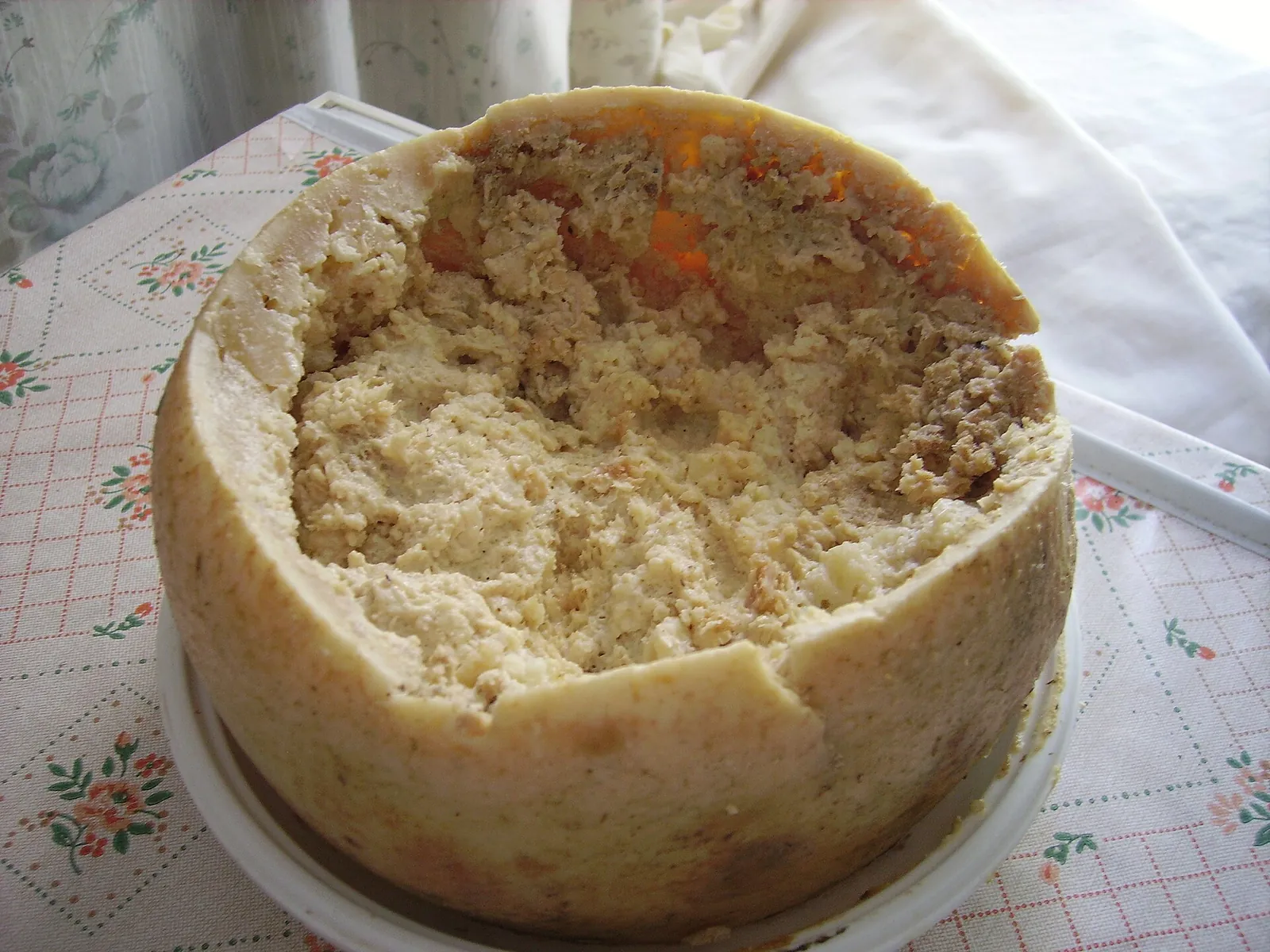
The name means "rotten cheese" in Sardinian. This page explains what it is and where the law stands, and it is not a recommendation to seek it out.
The larvae belong to the cheese fly, Piophila casei, and they eat their way through the paste. People who grew up with the cheese treat it as a food for celebrations, while regulators treat it as a food that cannot be proven safe.
Casu marzu at a glance
Here is casu marzu at a glance, drawn from a Wageningen University master's thesis that studied its safety and law.
| Detail | Casu marzu |
|---|---|
| Milk | Sheep's milk, from an ordinary Sardinian sheep cheese |
| Made in | Sardinia, Italy |
| Special feature | Live larvae of the cheese fly Piophila casei in the paste |
| Other names | Casu frazigu, casu becciu, casu fattittu and more, all meaning "rotten cheese" |
| Sale in Italy | Forbidden under Article 5 of the 1962 food hygiene law |
| Listed as | A Sardinian traditional food product in the national list (15th revision, 2015) |
| Eaten | At gatherings, as a gift, often with Cannonau red wine |
How casu marzu is made
Casu marzu starts as a normal sheep cheese that is deliberately left open so flies can reach it. The thesis notes that it does not have to be one particular cheese, and it can even be a cheese left over from regular production that has left the dairy's control.
Because the cheese is illegal to sell, nobody monitors the process, and methods and raw materials vary from maker to maker. That variation is part of the safety problem: an ordinary dairy runs under inspection and testing, and this cheese does not. The sheep also set the season, since the milk supply stops in September, October and November.
For a related Sardinian cheese made in the open with no flies involved, see Fiore Sardo.
Is casu marzu legal in Italy and the EU?
Casu marzu is not legal to sell in Italy, and that rule carries into the EU. Article 5 of Italian law no. 283 of April 30, 1962 forbids marketing food that is infested, and the thesis says casu marzu falls under it because of the fly.
The legal picture has a twist. The cheese appears on Italy's national list of traditional agri-food products, in the Sardinian cheese category, but the thesis points out that being "traditional" is not the same as complying with food law. EU general food law (Article 14 of Regulation (EC) No 178/2002) bars unsafe food from the market, and a product that is unsafe in one member state is treated as unsafe in all of them. Rules since 2005 let a member state grant hygiene exceptions for traditional foods, but the thesis found real uncertainty about whether casu marzu qualifies.
Enforcement has reached beyond Italy: in 2013 Dutch food safety inspectors confiscated casu marzu from a food fair. One law professor at the University of Sassari, quoted in the thesis, argues that Article 5 covers selling and does not prohibit making or eating it at home.
Is casu marzu legal in the US?
Casu marzu is not legal to sell in the US either, though the federal rule that applies is a general one, not a ruling on this cheese. The University of Wisconsin entomology department's blog says it cannot legally be sold in the US.
The relevant federal rule is the adulteration section of the Food, Drug, and Cosmetic Act, 21 U.S.C. 342. It calls food adulterated if it "consists in whole or in part of any filthy, putrid, or decomposed substance, or if it is otherwise unfit for food." A cheese that is deliberately infested falls within the spirit of that language, and nothing here suggests an exception. Nothing on this page is a reason to try to bring it home, and a shop that offers it is not a safe supplier.
Casu marzu food safety and health risks
Casu marzu food safety is a real concern because the larvae are alive when the cheese is eaten. The thesis reports that Piophila casei larvae can survive acid, including stomach acid, for 120 hours. That raises the possibility of intestinal myiasis, which the thesis describes as tiny perforations of the intestine wall.
The same thesis notes that no case of myiasis has been reported in connection with eating casu marzu. It also lists other hazards, such as histamine and bacteria, for a product made without a monitored process. The author argues the risk to any one eater may be small because exposure is low, but that is an argument for regulating the cheese, not a clearance. Anyone who is pregnant, immunocompromised or very young has more reason to avoid raw-milk and unregulated foods; see the raw-milk cheese guide.
What most casu marzu coverage gets wrong
Most casu marzu coverage is a shock story, and it misses how the cheese actually sits in Sardinian life.
Casu marzu is not a spoiled cheese
Casu marzu is not simply a cheese that went bad. The larvae are part of the traditional process, and locals who have eaten it since childhood do not see it as odd. They save it for special occasions and share it as a gift.
Casu marzu is not an ordinary banned cheese
Casu marzu is not like a banned raw-milk cheese, because the problem is the live insects, not the milk. A raw-milk Sardinian cheese such as Fiore Sardo is sold legally; the Sardinia and Sicily cheese guide and the Pecorino Romano page cover the legal ones.
Casu marzu has no safe store-bought version
Casu marzu has no safe store-bought version in the US, and "traditional" is not a safety certificate. If you find larvae in a cheese you bought, that is spoilage, not casu marzu, and the cheese goes in the trash. For intentionally pungent cheeses that are legal, see the best stinky cheeses.
Questions about casu marzu
These are the questions about casu marzu that come up most.
Is casu marzu really made with live maggots?
Casu marzu is made with live fly larvae: Piophila casei lays eggs in an open sheep cheese, and the larvae are alive when the cheese is eaten.
Is casu marzu legal?
Casu marzu is illegal to sell in Italy under a 1962 hygiene law, and EU rules on unsafe food stand against it, although it is listed as a Sardinian traditional product.
Is casu marzu safe to eat?
Casu marzu is not recognized as safe: the larvae can survive stomach acid for a long time, and no regulator monitors how it is made.
What does casu marzu mean?
Casu marzu means "rotten cheese" in Sardinian, and the same cheese goes by names such as casu frazigu.
Can you buy casu marzu in the US?
Casu marzu cannot legally be sold in the US, so a US seller offering it should be treated as a warning sign.
Casu marzu in short
For casu marzu, the lesson is cultural and legal rather than culinary: it is a Sardinian tradition that sits outside food law. If you want the island's cheese, buy the legal ones, starting with Fiore Sardo.
Sources
- Can Casu Marzu be deemed safe according to article 14 of Regulation (EC) No 178/2002?, master thesis, Wageningen University
- Dairy, Insects, and Illegal Cheese, University of Wisconsin-Madison, Department of Entomology
- 21 U.S.C. 342, Adulterated food, Legal Information Institute, Cornell Law School