
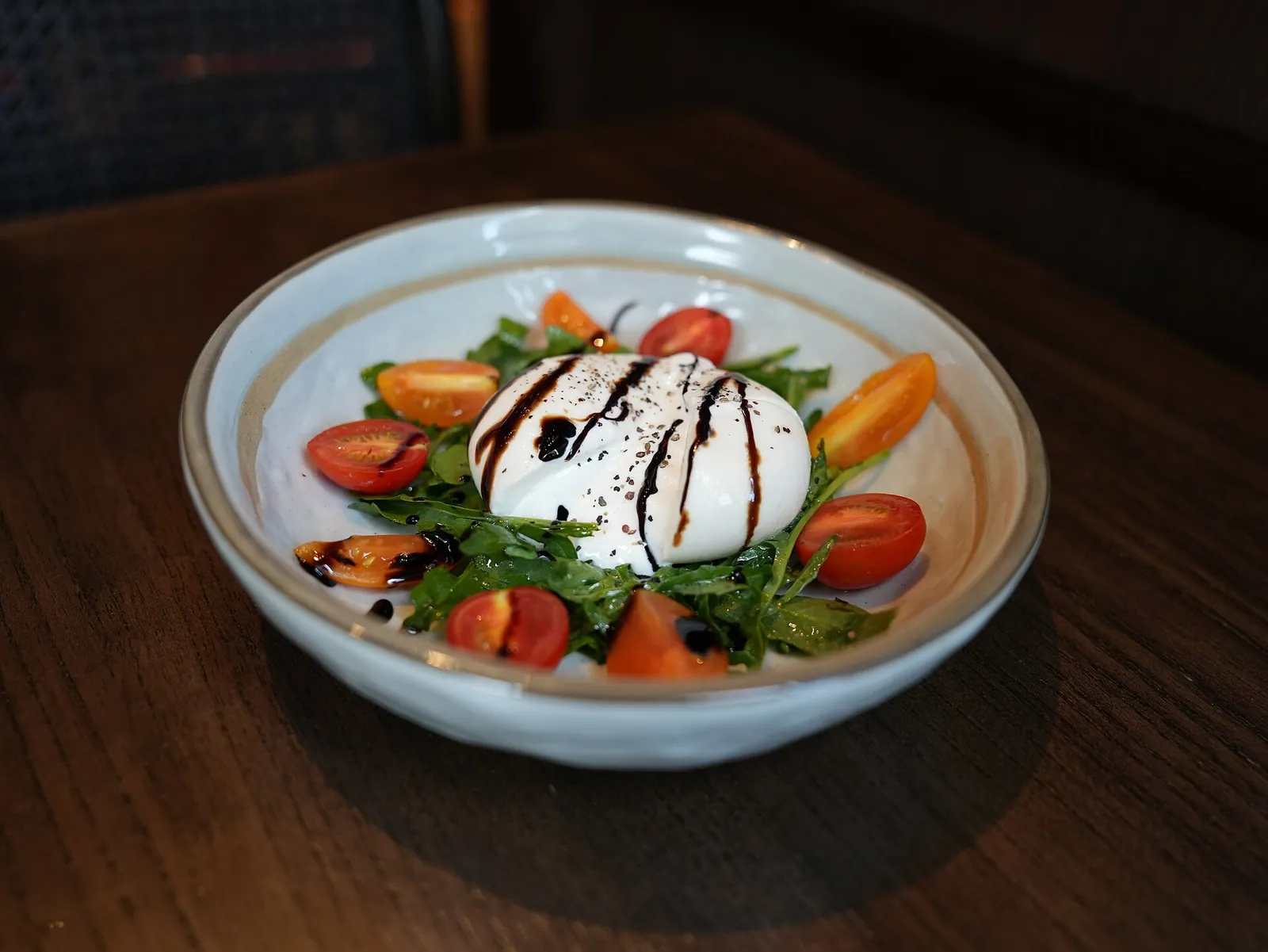
Mozzarella leaves it whole, stracciatella shreds it and adds cream, and burrata wraps stracciatella inside a pouch of mozzarella.
That shared start explains almost every difference you can taste. Where there is cream, the cheese is softer and wetter and goes off sooner. Where there is only curd, it holds its shape and survives heat.
Burrata vs mozzarella vs stracciatella at a glance
This burrata vs mozzarella vs stracciatella table shows how the same curd changes with its form.
| Mozzarella | Stracciatella | Burrata | |
|---|---|---|---|
| Build | Solid ball, braid or log of stretched curd | Hand-torn shreds of curd mixed with cream | Mozzarella pouch filled with stracciatella |
| Texture | Springy and layered | Loose, creamy, stringy | Springy shell, soft center |
| Added cream | None | Yes, a large share | Yes, inside |
| Holds a shape | Yes | No, it is spooned | Yes until cut |
| Cooking | Melts, bakes, shreds | Added after cooking | Added after cooking |
| Best for | Pizza, baking, caprese, sandwiches | Toast, pasta, vegetables, pizza after baking | Showpiece plates, served raw |
| Shelf life | Days in its liquid | A day or two | Days; handmade burrata 3 to 5 |
How burrata, mozzarella and stracciatella are related
Burrata, mozzarella and stracciatella are related through pasta filata, the stretched-curd method: the curd is heated in hot water and pulled until it turns smooth and elastic. Mozzarella is the result. If you stop there and shape it, you have mozzarella; if you tear part of it into ribbons and add cream, you have stracciatella.
Burrata uses both. A dairy forms a sack from the stretched curd, fills it with stracciatella and closes it. In a 2023 University of Bari trial, the curd was stretched in 83°C (181°F) water into a ball and then inflated with a blowing machine into a pouch, which was filled with stracciatella made from equal weights of UHT cream and fresh mozzarella strands. That is the whole recipe in one sentence: the shell and the filling start as the same curd.
So the three are not rivals on a ladder. They are stages of one process, and the guide to types of mozzarella covers the stretched curd they all share.
Mozzarella vs burrata: solid or filled
Mozzarella vs burrata comes down to what is inside. Fresh mozzarella is curd all the way through, so it slices cleanly, tears in layers and carries its own water. Burrata is mostly cream and shreds held by a thin shell, so it spills.
The lab numbers show it. A study of 21 Burrata di Andria cheeses averaged about 18 grams of fat and 10 grams of protein per 100 grams, with 70 percent water. Fresh mozzarella has far more protein for its weight, because it has less cream in it; the burrata vs mozzarella comparison puts the figures side by side.
For a cook that means mozzarella is the structural cheese. It can be sliced for a sandwich, layered into a pan or put on a pizza. Burrata is a finishing cheese: its shell is thin and its center is liquid, so it does not have the strength to bake.
Stracciatella vs burrata: filling or the whole thing
Stracciatella vs burrata is the filling against the filled pouch. Burrata is built to look like a plain white ball, then reveal the stracciatella when it is cut. Stracciatella has no shell, so the reveal is gone, and in exchange you get more of the filling per spoonful and a cheaper, easier thing to spread.
A shell does one useful job: it keeps the cream sealed and protects the filling from air. That is why a burrata in its liquid usually looks fresher than an open tub of filling at the end of the week. It also means a burrata is more of an occasion. Buy it for a plate where you will cut it in front of people; buy stracciatella for toast, pasta and anything you want to spread across.
Mozzarella vs stracciatella: the cream makes the difference
Mozzarella vs stracciatella is mostly cream. Both are the same curd, but mozzarella is pulled tight and left in a ball, while stracciatella is torn loose and bathed in dairy, so it behaves like a sauce. Mozzarella tastes milky and a little tangy; stracciatella tastes sweeter and richer because cream carries most of the flavor.
If a recipe calls for one and you only have the other, the swap runs one way. Torn fresh mozzarella mixed with a spoonful of cream stands in for stracciatella. Stracciatella cannot replace mozzarella where you need strings, slices or melt, because it has no body to hold.
Which to use: burrata, mozzarella or stracciatella
Pick burrata, mozzarella or stracciatella by what the dish needs the cheese to do.
- Pizza from a very hot oven: fresh mozzarella, then stracciatella dolloped on after baking. For a home oven, low-moisture mozzarella bakes without flooding.
- Caprese and salads: fresh mozzarella for clean slices; burrata for a showpiece plate with the same tomatoes.
- Baked pasta and lasagna: mozzarella only. Neither of the other two survives the oven.
- Toast and bruschetta: stracciatella spreads; burrata makes you tear and scoop.
- Warm pasta: stracciatella stirred in off the heat becomes a light cream sauce.
- Sandwiches: mozzarella; the other two make bread soggy.
Buffalo versions exist in the mozzarella family, and fior di latte vs bufala explains the milk difference.
What most burrata mozzarella stracciatella advice gets wrong
Most burrata mozzarella stracciatella advice treats the three as interchangeable, and they are not. The most common mistake is putting burrata on pizza before it goes in the oven. Heat splits the cream and leaves a dry shell; add it after baking.
A second mistake is assuming "burrata" always means the same thing. Plain burrata can be made anywhere, while the protected Burrata di Andria PGI is a specific product; the burrata guide explains the label. A third is treating all three as long-lasting because mozzarella is. Mozzarella has some tolerance, but burrata and stracciatella are made to be eaten within days; the storing cheese guide covers how to hold soft cheese.
Questions about burrata, mozzarella and stracciatella
These are the questions about burrata, mozzarella and stracciatella that come up most.
Is burrata just mozzarella with cream?
Burrata is a mozzarella pouch with a creamy filling, so it is mozzarella on the outside and stracciatella on the inside. The curd is the same; the form and the cream are what change.
Is stracciatella the same as the inside of burrata?
Stracciatella is the inside of burrata: curd shreds in cream, sold on its own.
Which is healthier, burrata, mozzarella or stracciatella?
Burrata, mozzarella and stracciatella all differ mostly in cream. Burrata averaged about 18 grams of fat per 100 grams in the lab study, and the creamier the cheese, the more fat per ounce.
Can you use burrata instead of mozzarella?
Burrata can replace mozzarella in anything served raw, such as caprese, but not in anything baked, where the filling runs and the shell dries.
Which is best on pizza, mozzarella, burrata or stracciatella?
Mozzarella is best on pizza before baking, and stracciatella or burrata is best added after it comes out of the oven.
Choosing between burrata, mozzarella and stracciatella
When choosing between burrata, mozzarella and stracciatella, start with the heat. If it goes in the oven, buy mozzarella. If it goes on after, buy stracciatella to spoon or burrata to cut open, and eat it the day you buy it.