
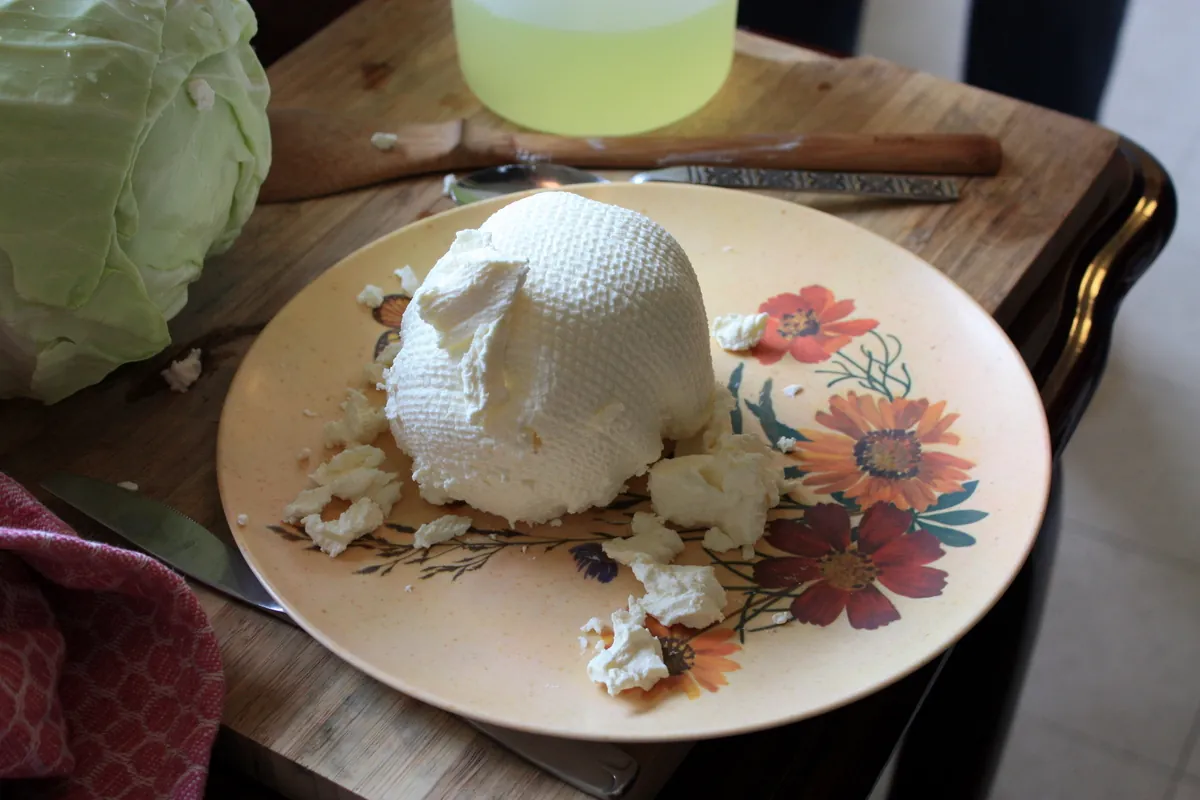
Draining off the whey concentrates everything that stays behind: fresh labneh is about 72 percent water, while plain whole-milk yogurt is about 88 percent, so labneh tastes richer, tangier and a little salty.
It is the everyday yogurt cheese of the Levant, eaten at breakfast and on mezze tables with olive oil and herbs, and it takes nothing more than yogurt, salt, a cloth and time. How long it hangs decides what you get, from a soft spread to firm balls that keep for months under olive oil.
Labneh at a glance
Here is labneh at a glance, with figures for fresh, full-fat labneh.
| Labneh | |
|---|---|
| Also called | Labaneh, strained yogurt, concentrated yogurt |
| Made from | Salted yogurt, strained of its whey |
| Milk | Usually cow's milk; goat's and sheep's milk too |
| Home region | The Middle East, especially Lebanon and the Levant |
| Texture | Thick and spreadable; firm enough to roll when strained longer |
| Flavor | Tangy, lactic, lightly salty |
| Per 100 g (3.5 oz) | About 72.5 g water, 9.4 g fat, 7.7 g protein |
| Fridge life | About 10 to 15 days at 39°F (4°C) |
What labneh is, and where it comes from
Labneh is a strained yogurt that comes from the Middle East and holds a central place in the Lebanese diet, where it is eaten fresh at breakfast and on mezze platters, according to a 2025 review of Lebanon's traditional dairy foods. The traditional recipe ferments milk with the two classic yogurt bacteria, Lactobacillus bulgaricus and Streptococcus thermophilus, salts the yogurt to about 1.5 percent and hangs it overnight in cheesecloth bags, as described in a 2024 study of labneh sold at retail.
It belongs to a wide family of Middle Eastern cheeses, and Lebanon's mountain villages still make an aged cousin, labneh anbaris, fermented for months in sealed clay jars until it turns sharp, dense and slightly crumbly.
How labneh is made
Labneh is made by salting plain yogurt and letting it drain in cloth until it is as thick as you want it. In a study at the American University of Beirut, salted yogurt hung for 18 to 50 hours, depending on the milk and its fat level, before reaching about 26 percent solids. Factories often skip the cloth: they spin out the whey in centrifuges or concentrate the milk by ultrafiltration before fermenting it, and the shorter fermentation gives a milder, less acidic labneh. Traditional production takes about 2.6 kg of whole cow's milk for each kilogram of labneh, so a 32-ounce tub of yogurt strains down to roughly 12 ounces.
At home, stir 1/2 to 1 teaspoon of salt into 32 ounces of plain whole-milk yogurt, spoon it into a strainer lined with cheesecloth set over a bowl, and refrigerate it for 12 to 24 hours, longer for a firmer cheese. The step-by-step labneh method covers yogurt choice, timing and fixes.
Labneh vs Greek yogurt vs cream cheese
Labneh sits between Greek yogurt and cream cheese: drier and richer than Greek yogurt, with roughly a quarter of the fat of cream cheese. This comparison uses USDA figures for whole-milk Greek yogurt, cream cheese and sour cream, and the Lebanese review's figures for fresh labneh.
| Per 100 g (3.5 oz) | Labneh, fresh | Greek yogurt, whole milk | Cream cheese | Sour cream |
|---|---|---|---|---|
| Water | 72.5 g | 81.3 g | 52.6 g | 73.1 g |
| Fat | 9.4 g | 5.0 g | 34.4 g | 19.4 g |
| Protein | 7.7 g | 9.0 g | 6.2 g | 2.4 g |
| Made from | Salted yogurt, strained | Yogurt, strained | Cultured milk and cream, drained | Cultured cream |
| US standard | None | No separate standard | At least 33% fat, at most 55% water | At least 18% milkfat |
| Texture | Spreadable | Spoonable | Firm, smooth | Spoonable |
Greek yogurt is the closest relative. Both are strained yogurt, but labneh is salted, usually made from full-fat yogurt and strained further, so it spreads rather than spoons. Cream cheese is built differently: milk and cream are set with cultures and clotting enzymes, and the FDA standard for cream cheese requires at least 33 percent milkfat, which is why it tastes so much richer. Sour cream is cultured cream, with about twice labneh's fat and a third of its protein.
Labneh balls in olive oil (labneh makbouseh)
Labneh balls, or labneh makbouseh, are labneh strained until firm, salted, rolled into balls and preserved in olive oil. In the Chouf and the Bekaa Valley, families traditionally made them at the end of the spring milking season, a way to store the season's milk before refrigeration. The longer straining shows in the numbers: the Lebanese review puts labneh balls at about 60 percent water, 17 percent fat and 17 percent protein. The oil seal, low moisture and acidity let them keep for months, traditionally at room temperature.
At home, keep the jar in the fridge with the balls fully covered by oil, and lift them out with a clean spoon. Cold olive oil turns cloudy and thick, so let the jar sit out for 20 to 30 minutes before serving. For variations, roll the balls in za'atar, Aleppo pepper or dried mint before they go into the jar.
How to eat labneh
The classic way to eat labneh is spread in a shallow bowl, swirled with the back of a spoon, pooled with olive oil and sprinkled with za'atar, then scooped up with warm pita. Za'atar is a Levantine mix of dried herbs such as thyme, oregano or marjoram with sumac, toasted sesame seeds and salt; Britannica notes it is commonly served at breakfast with bread and olive oil and regularly sprinkled on labneh. Add cucumbers, tomatoes, olives and fresh mint for a full breakfast plate.
Beyond the bowl, spread labneh in a wrap with cucumber and mint, dollop it on roasted vegetables, grilled lamb or lentil soup, beat in garlic and herbs for a dip, or go sweet with honey, figs and pistachios.
Labneh nutrition
Labneh nutrition depends on the tub, because the name covers a wide range of products. Fresh full-fat labneh runs about 9.4 g of fat and 7.7 g of protein per 100 g, or about 2.7 g of fat and 2.2 g of protein per ounce. In the 2024 survey of 116 labneh products in the United Arab Emirates, labels claimed anywhere from 4.5 to 23 percent protein. Among the brands the researchers selected for testing, the labels showed fat and protein moving in opposite directions: high-fat labneh (17 to 18 percent fat) had 4.9 to 7.5 percent protein, while lite labneh (3.5 to 4.5 percent fat) had about 15 percent. USDA's FoodData Central lists labneh only as brand label data, with no reference entry, so read the panel on the tub you buy.
Buying labneh in the US
To buy labneh in the US, start at Middle Eastern, Armenian, Turkish or Mediterranean grocers, then check the specialty dairy case at large supermarkets. Brands with labneh in USDA's database include Tazah, which sells goat's milk labneh in oil, Le Bedouin, Yaza and Içim's Turkish-style labneh, while Cava sells flavored labneh dips. Read the ingredients: the simplest labneh is cultured milk (or milk and cream) and salt, while others add whey protein concentrate, pectin or gums for body and potassium sorbate as a preservative. Jarred labneh in oil may be shelved with the olives rather than the yogurt.
How to store labneh
Store labneh in the refrigerator in a covered container and use a clean spoon each time. Fresh labneh keeps about 10 to 15 days at 39°F (4°C), and it spoils mainly through continued souring and the growth of yeasts and molds. A thin film of olive oil over the top keeps the surface from drying out. A little whey pooling on top is normal; pour it off or stir it back in. Fizzing, a yeasty or bitter smell, or fuzzy spots mean it is time to throw it out.
Labneh substitutes
The best labneh substitute is full-fat Greek yogurt with a pinch of salt, strained in a cloth-lined sieve in the refrigerator for a few hours until it spreads. For a quick fix with no straining, beat equal parts cream cheese and Greek yogurt until smooth. Quark, the German fresh cheese, is another close match for spreading and baking. Sour cream works only for dolloping, since it is thinner and fattier.
What most labneh advice gets wrong
Most labneh advice treats it as one food with one recipe, and three details change the result.
Straining it on the counter. Traditional labneh hangs overnight at room temperature, but warmth cuts its life short. In a Journal of Dairy Science shelf-life study, bag-strained labneh lasted 8.5 to 10.5 days at 41°F (5°C), about 5 days at 59°F (15°C) and under 3 days at 77°F (25°C). Strain it in the refrigerator.
Assuming every tub has live cultures. Fresh labneh keeps its cultures, but heat treatment after fermentation kills them. In the UAE survey, every labneh from a multinational company had been heat-treated after fermentation, against 7 percent of small producers' labneh, and the US yogurt standard allows the same step for yogurt. If live cultures matter to you, look for "live and active cultures" on the label.
Judging it by thickness alone. Many commercial brands reach their body with gums, starch or pectin rather than long straining; about two-thirds of the brands in the UAE survey contained additives. A short ingredient list is the better sign of traditional labneh.
Questions about labneh
These questions about labneh come up most from people meeting it for the first time.
Is labneh a cheese or a yogurt?
Labneh is both a yogurt and a cheese: it is made from yogurt, and dairy scientists classify the strained result as an unripened fresh cheese, eaten without any aging. Yogurt vs cheese explains where the line usually falls.
What is the English name for labneh?
The English name for labneh is usually strained yogurt or concentrated yogurt. US packages also call it a spreadable cheese or a yogurt dip.
What does labneh taste like?
Labneh tastes tangy and lactic, like a cross between Greek yogurt and cream cheese, with a light saltiness. Labneh balls kept in oil taste tangier and more concentrated.
Is labneh like sour cream?
Labneh is like sour cream in its tang and can stand in for it on a baked potato, but it is thicker, less fatty and much higher in protein, because it is strained yogurt rather than cultured cream.
Can you make labneh from goat's or sheep's milk yogurt?
Yes, you can make labneh from goat's or sheep's milk yogurt. In the Beirut study that made all three, the type of milk changed texture and flavor more than the fat level did, with goaty aroma and flavor among the traits that shifted.
Trying labneh for the first time
For your first labneh, buy a plain, full-fat tub with a short ingredient list, spread it in a bowl, add olive oil and za'atar, and eat it with warm pita and cucumbers. Then strain a batch of whole-milk yogurt at home and taste how much an extra day of hanging changes it.
Sources
- Milk Supply in Lebanon: Economic Challenges and the Role of Traditional Dairy Products (2025), Foods, via PubMed Central
- Labneh: A Retail Market Analysis and Selected Product Characterization (2024), Foods, via PubMed Central
- The characterization of the physicochemical and sensory properties of full-fat, reduced-fat and low-fat bovine, caprine, and ovine Greek yogurt (Labneh) (2014), Food Science and Nutrition, via PubMed Central
- Determination of shelf life of concentrated yogurt (labneh) produced by in-bag straining of set yogurt using hazard analysis (2002), Journal of Dairy Science, via PubMed
- Zaatar, Encyclopaedia Britannica
- 21 CFR 133.133, Cream cheese, Electronic Code of Federal Regulations
- 21 CFR 131.200, Yogurt, Electronic Code of Federal Regulations
- Yogurt, Greek, plain, whole milk (FDC 171304), USDA FoodData Central