
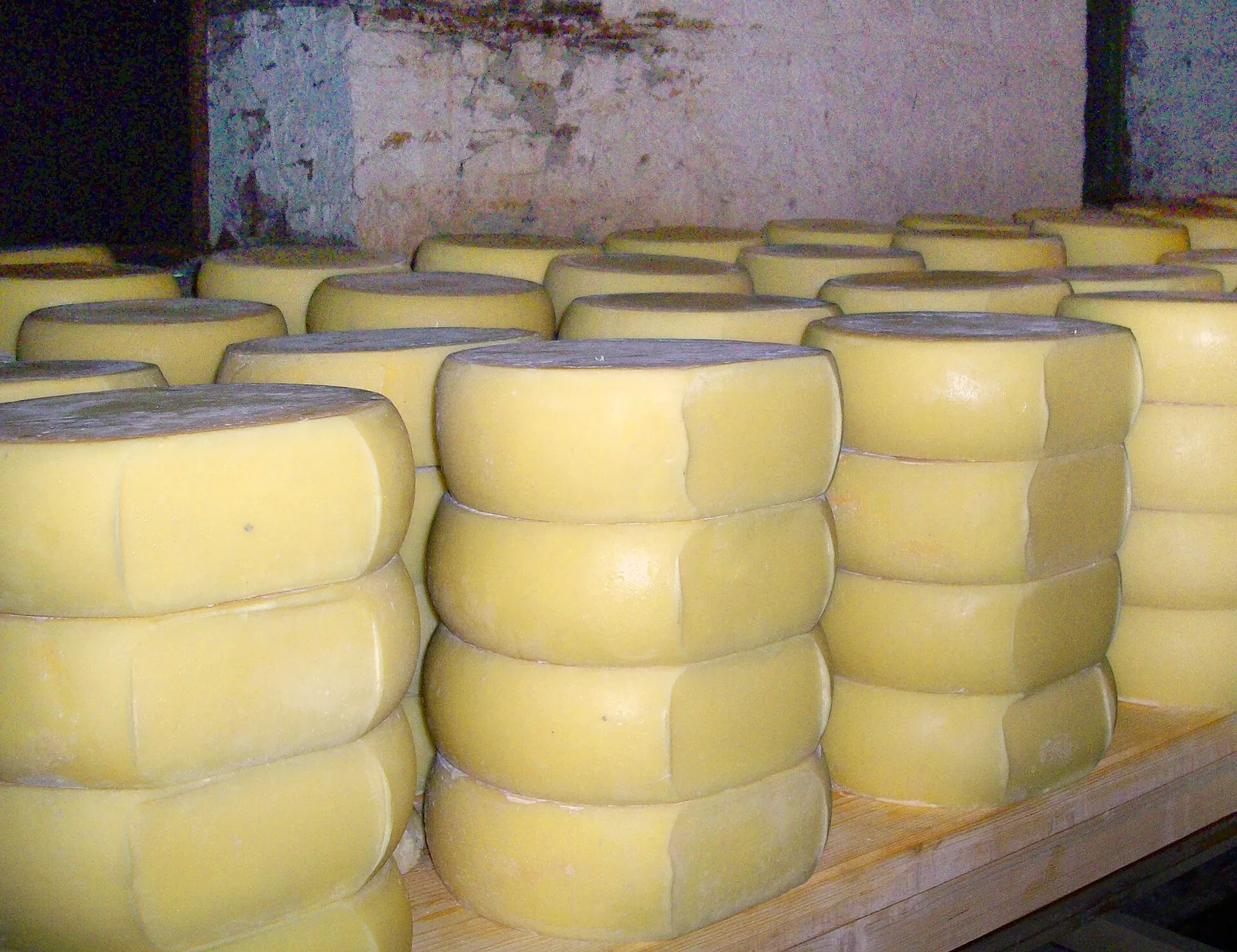
Bulgaria, Romania, North Macedonia, Serbia, Greece and Turkey all make it, under a handful of names.
The idea that explains it is the stretch. The curd sours until it turns elastic, then is sliced and kneaded in very hot water, the pasta filata method behind provolone, and aged for two months or longer. The kneading gives kashkaval its close, springy texture and a melt that needs real heat.
Kashkaval cheese at a glance
Here is kashkaval cheese at a glance, from Bulgaria's national standard and EU rules.
| Kashkaval | |
|---|---|
| Also called | Cașcaval (Romania), kaşar (Turkey), kačkavalj (Serbia), kashkavali (Greece) |
| Milk | Sheep's, cow's or mixed; goat's milk only in small shares |
| Type | Semi-hard, stretched curd (pasta filata) |
| Rind | Thin or none; often waxed or sealed in film |
| Texture | Firm, smooth and springy, with few or no holes |
| Ripening | About 2 months minimum; 2 to 6 months for full aroma |
| Flavor | Buttery, salty and slightly tangy; nuttier with age |
| Water | 45% or less |
| Fat and protein | 27 to 30% fat and 25 to 28% protein (Greek PGI rules) |
| Salt | 1.4 to 3%, depending on the standard |
| Calories | 335 (cow's milk) to 363 (sheep's milk) kcal per 100 g, about 95 to 103 per ounce |
| Protected names | Kasseri PDO and Kashkaval Pindou PGI (Greece); Caşcaval de Săveni PGI (Romania) |
What kashkaval is, from Bulgaria to Turkey
Kashkaval is one cheese with a name in nearly every language between Bulgaria and Turkey, and the details shift at each border.
| Country | Local name | Usual milk | EU-protected version |
|---|---|---|---|
| Bulgaria | Kashkaval (кашкавал) | Sheep's ("Balkan"), cow's ("Vitosha") or mixed ("Preslav") | None |
| Romania | Cașcaval | Sheep's or cow's | Caşcaval de Săveni, raw cow's milk |
| Greece | Kashkavali; kasseri | Sheep's, with some goat's | Kashkaval Pindou; Kasseri |
| Turkey | Kaşar | Cow's, traditionally raw | None |
Bulgaria's national standard, BDS 14:2010, names its kashkaval by milk, according to a 2021 review of traditional Bulgarian dairy foods. Turkey's kaşar is the same kind of stretched cheese, traditionally made from raw cow's milk.
Cașcaval in English
Cașcaval in English is simply kashkaval, the Romanian spelling of the same cheese, often glossed as yellow cheese. Romanian dictionaries on dexonline define it as a fine, hard cheese in flat rounds or wheels made from sheep's milk curd, more rarely cow's, and trace the word to the Italian cacio cavallo by way of Greek and Turkish, which makes caciocavallo a cousin. Greek rules for Kashkaval Pindou offer a herders' version: in Aromanian, the name roughly means "cheese transported by horses."
How kashkaval is made: the pasta filata method
Kashkaval is made by the pasta filata method, shown here in the Bulgarian version, with scalding temperatures from Romania and Turkey.
- Set and cook the curd. Rennet sets the milk in 30 to 40 minutes. The curd is cut to about 1/4 inch (0.5 cm), then stirred and warmed to 100 to 102°F (38 to 39°C).
- Let it sour. The drained curd rests as one mass for 2 to 3 hours at 95 to 99°F (35 to 37°C) while lactic bacteria drop the pH to 5.2 to 5.4. The acid pulls calcium out of the protein network and leaves the curd soft and stretchy; it is ready when a tapped slab sounds like a drum.
- Scald and knead. Thin slices of curd are worked in hot water or brine into a smooth dough: about 176°F (80°C) for Romania's Săveni cașcaval, 167°F (75°C) for 5 minutes for Turkish kaşar.
- Mold, salt and ripen. The dough is molded, salted and ripened about 55 days at 46 to 54°F (8 to 12°C), then often sealed in paraffin or wax.
The EU single document for Kashkaval Pindou explains the payoff: hot water makes the curd as pliable as dough, so it fills the mold as one firm, springy mass. It also suited mountain herding. Aromanian-speaking (Vlach) shepherds in Greece's Pindos range made curd at summer pastures, carried it down on horseback and finished it in the valleys, where the hot water partly sterilized curd made from raw or even soured milk.
Sheep vs cow kashkaval
Sheep vs cow kashkaval is the first choice on any label, and the milk explains most of the difference. Greek rules for kasseri and Kashkaval Pindou require milk with at least 6 percent fat, against 3.2 percent for Romania's cow's milk Săveni cașcaval. Bulgaria's standard carries that into the cheese: sheep's milk kashkaval needs at least 50 percent fat in its dry matter, cow's 45.
Sheep's kashkaval tastes fuller, buttery with a ripe aroma that the Greek rules credit to fatty milk from animals grazing aromatic mountain plants. Cow's milk kashkaval is milder. Goat's milk works only in small shares: in Greek trials of kashkaval of Pindos, 10 percent goat's milk was fine, while 30 percent made a tough curd that fractured during stretching.
Kashkaval taste and texture by age
Kashkaval taste and texture change most with age, which labels rarely state.
- Young, about 2 months: pale, springy and moist, milky and buttery with a little tang. A slow, cold start adds depth: Caşcaval de Săveni, aged at least 60 days at 36 to 46°F (2 to 8°C), has a sweet and salty taste with a slight walnut bitterness from protein breakdown.
- Older, 3 to 6 months and beyond: firmer, drier and deeper yellow, sharper and saltier, with an aroma the Săveni rules liken to damp earth.
Protected kashkaval names
Protected kashkaval names exist in the EU, but none of them is Bulgarian. Three cheeses in the family have registered names:
- Kasseri (PDO, Greece): sheep's milk with at most 20 percent goat's, from parts of Thessaly, Macedonia and Thrace and from Lesvos, ripened at least three months, per its 2026 single document; more in the kasseri guide.
- Caşcaval de Săveni (PGI, Romania): raw cow's milk from the northern half of Botoșani County, aged at least 60 days.
- Kashkaval Pindou (PGI, Greece): rindless, from sheep's milk with under 35 percent goat's, made in Epirus and neighboring districts of Western Macedonia and Thessaly, and now registered in the EU's eAmbrosia database.
Bulgaria's protected cheese is its white brined sirene, covered in the guide to Balkan white cheeses. Plain "kashkaval" is not registered, so a US label can use it for any milk, age or country; the guide to PDO and PGI labels explains each mark.
How to eat kashkaval
The classic way to eat kashkaval hot is kashkaval pane, and the name is the recipe: Romania's dictionary defines pané as fried after a coat of flour, egg and breadcrumbs, with cașcaval among its examples.
Kashkaval pane
Kashkaval pane works because the cheese melts only at high heat, so the crust browns before the center runs. In a Journal of Dairy Science study, Serbian kačkavalj melted at about 158 to 194°F (70 to 90°C) and set again at 136 to 145°F (58 to 63°C) as it cooled. Chill slabs cut 1/2 inch (1.25 cm) thick, dredge them in flour, then egg, then fine breadcrumbs, then repeat egg and crumbs for a sealed coat. Fry in 1/2 inch of oil at 350°F (175°C) for 1 to 2 minutes a side and eat it before it sets.
Kashkaval Mornay sauce
Kashkaval Mornay sauce is béchamel with grated kashkaval whisked in where a French cook would use Gruyère. Start with 4 ounces (about 1 cup grated) per 2 cups of lightly salted béchamel, added off the heat a handful at a time, and serve it hot, since it thickens as it cools; the cheese sauce method covers rescues. Kashkaval also suits toasted sandwiches, baked pasta and a meze plate with tomatoes, olives and bread, plus a dry white or cold lager.
Buying and storing kashkaval in the US
Buying kashkaval in the US is easiest at Balkan, Russian, Turkish, Greek and Middle Eastern grocers, and the label tells you more than the name. Look for the milk first and the country second; a wheel sold as Bulgarian may be sheep's, cow's or mixed, and kaşar is the Turkish version. Check for pasteurized milk if you are pregnant or at higher risk; the CDC advises avoiding raw-milk cheese unless it is heated until steaming hot.
At home, wrap it in cheese paper or parchment inside a loose zip-top bag in the refrigerator, rewrap it after each use, and trim away a dried face or a small spot of mold.
Kashkaval substitutes
The best kashkaval substitute is provolone, a stretched-curd cheese by US definition with almost the same moisture: about 41 percent water in USDA data.
- **Provolone** works for frying, sandwiches and sauces; sharp provolone stands in for aged kashkaval.
- Caciocavallo, the Italian relative, is made the same way.
- Kasseri is the pick when you want sheep's milk flavor, including for fried cheese.
- Low-moisture mozzarella with a little grated pecorino covers melting jobs, the pecorino adding salt and tang.
What most kashkaval advice gets wrong
Most kashkaval advice repeats a few lines from shop listings, and several are wrong in ways that matter.
It is not the "cheddar of the Balkans." The nickname is half right: the curd is cheddared, left warm for hours to sour, but then it is stretched in hot water, which puts kashkaval in the provolone family. That is why it peels in strips instead of crumbling; the Săveni rules even require slices that come away in strips.
Older is not better for frying. In North Macedonia, where kashkaval is the most popular hard cheese, a Food Chemistry study found its meltability fell significantly as it ripened. Fry and melt young kashkaval; grate and nibble the aged one.
Hot water is not pasteurization. In a 2026 study of Turkish kaşar, the 5-minute scald at 167°F (75°C) cut an added pathogen at least 100,000-fold but did not eliminate it, and survivors lasted through 30 days of storage.
Freezing works better than its reputation. Bulgarian trials summarized in the 2021 review kept cow's milk kashkaval for 12 months at 39, 34, 18 and 0°F (4, 1, -7.5 and -18°C) with no significant change in water, protein, fat or salt, and colder storage slowed ripening. Freeze cooking portions and thaw them in the refrigerator; freezing cheese has more.
Questions about kashkaval cheese
These questions about kashkaval cheese come up most from first-time buyers.
What is kashkaval cheese similar to in the USA?
Kashkaval cheese is most similar to provolone in the USA: both are stretched in hot water and aged. Greek kasseri comes closer to sheep's milk kashkaval.
What does kashkaval taste like?
Kashkaval tastes buttery, salty and slightly tangy when young. Sheep's milk versions smell riper, and age adds a nutty, faintly bitter edge.
Is kashkaval cheese like mozzarella?
Kashkaval cheese is like mozzarella in method, but aging makes it firmer, saltier and drier: 45 percent water or less, against about 50 percent for whole-milk mozzarella in USDA data, and it needs more heat to melt.
What is Bulgarian kashkaval?
Bulgarian kashkaval is made to the national standard BDS 14:2010, which bans preservatives, emulsifiers and stabilizers and sets salt at 1.8 to 3 percent.
Is kashkaval healthy?
Kashkaval is a rich, salty cheese at about 95 to 103 calories per ounce by Bulgaria's standard, close to provolone's 100, so keep portions modest and count its sodium.
Where to start with kashkaval cheese
For a first taste of kashkaval cheese, buy a young sheep's milk kashkaval and a cow's milk one, let slices warm to room temperature, and taste the difference. Then fry a slab as kashkaval pane and eat it straight from the pan.
Sources
- Traditional Bulgarian Dairy Products: Ethnic Foods with Health Benefits (Petrova et al., 2021), Microorganisms, via PubMed Central
- Single document: Kashkavali Pindou / Kashkaval Pindou, PGI-GR-02821 (OJ C 175, 17.5.2023), Official Journal of the European Union
- Single document: Caşcaval de Săveni, PGI-RO-02361 (OJ C 15, 16.1.2020), Official Journal of the European Union
- Approved standard amendment and single document: Kasseri, PDO-GR-0440 (C/2026/192), Official Journal of the European Union
- Semi-Industrial Production of Kashkaval of Pindos Cheese Using Sheep or a Mixture of Sheep-Goat Milk (Pappa et al., 2020), Foods, via PubMed Central
- Textural and cooking properties and viscoelastic changes on heating and cooling of Balkan cheeses (Guinee et al., 2015), Journal of Dairy Science, via PubMed
- Survival and Behavior of Streptococcus gallolyticus subsp. gallolyticus During Manufacturing and Shelf Life of Kashar Cheese (2026), Food Science and Nutrition, via PubMed Central
- Cheese, provolone (FDC 170850), USDA FoodData Central