
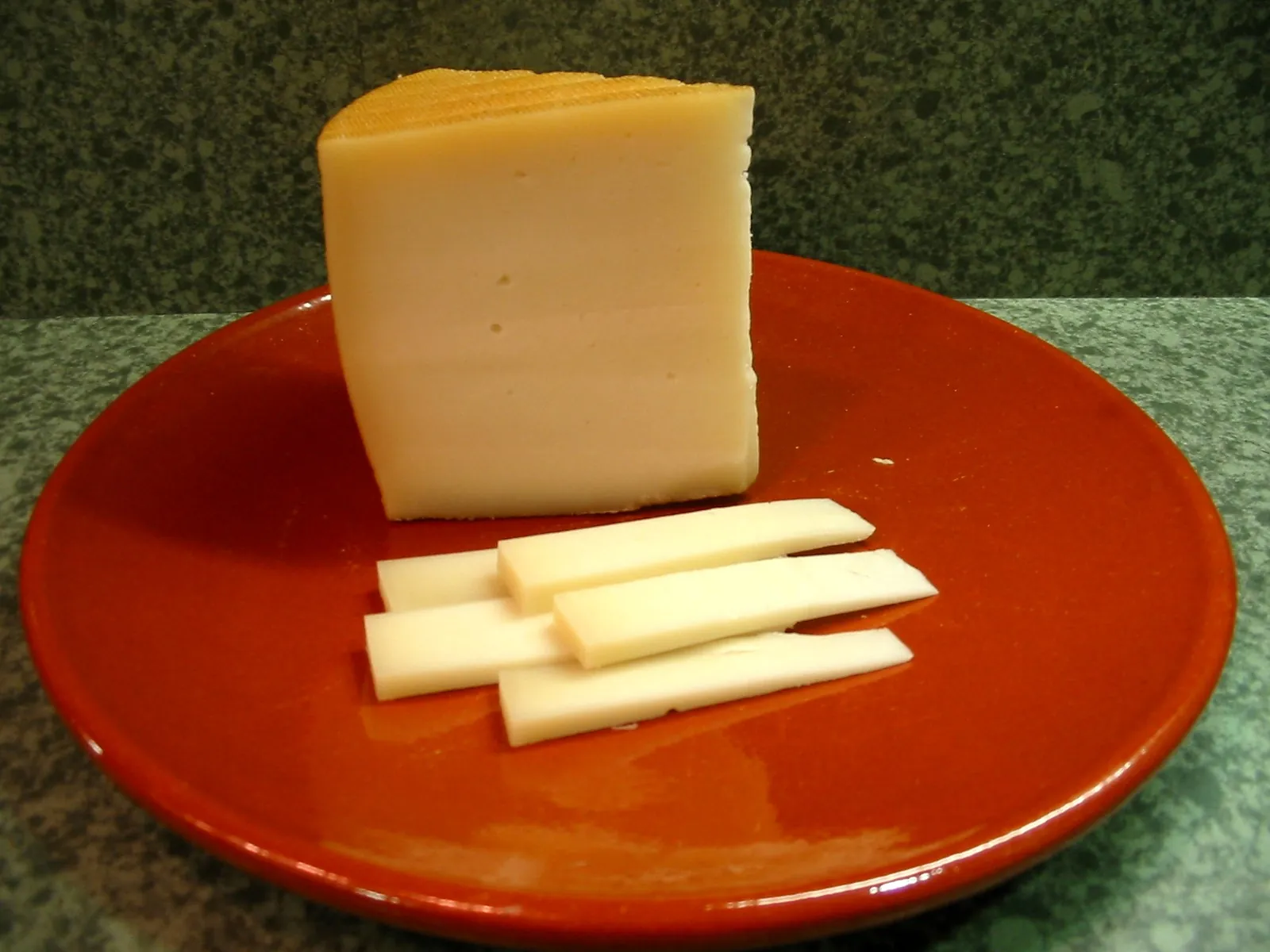
The label is the only reliable way to tell which kind you are buying.
Smoke is optional here, which surprises people who think of Idiazabal as "the smoked one." The protected name is about the sheep, the place and the minimum aging; smoking is a choice the maker adds at the end.
Idiazabal cheese at a glance
Here is Idiazabal cheese at a glance, taken from the EU application for the name and the Foods and Wines from Spain product profile.
| Detail | Idiazabal |
|---|---|
| Milk | Whole raw sheep's milk from Latxa and Carranzana ewes |
| Made in | The Basque Country and part of Navarre, Spain |
| Protected name | PDO, registered in the EU on June 21, 1996 |
| Shape and size | Cylinder with flat faces, 8 to 12 cm high, 10 to 30 cm across, 1 to 3 kg |
| Aging | At least 60 days; 4 to 8 months is typical |
| Rind and paste | Hard rind, compact paste |
| Smoke | Optional, over beech or alder wood |
| Fat | At least 45 percent of the dry matter |
What the Idiazabal cheese name protects
The Idiazabal cheese name protects a specific place, breed and method, and the EU register holds the original application. Milk must come from Latxa and Carranzana ewes on registered farms, and the dairies and the cheese must be inside the Basque Country or the Navarre part of the zone. The ewes graze high pasture in spring and summer and the cold, humid valleys in autumn and winter, which the application names as the reason the cheese tastes the way it does.
The curd is set with rennet at 28 to 32°C (82 to 90°F), salted in brine or dry, and ripened for at least 60 days. The Regulating Body numbers the labels, and the words "Denominación de Origen Idiazábal" must appear on them. A wheel without that numbered label may be Idiazabal-style, not Idiazabal. The guide to PDO and PGI labels explains what the seal promises.
How smoked Idiazabal cheese differs from unsmoked
Smoked Idiazabal cheese is the same cheese with a few days of wood smoke on the outside, so the difference sits mostly at the rind. Foods and Wines from Spain says the smoking uses beech or alder wood and is optional, which is why both kinds are sold. The smoke adds a woody, campfire note to the first bite and fades into the sheep's milk flavor underneath.
Unsmoked Idiazabal lets that milk flavor stand alone, and many Basque cooks prefer it for that reason. If you have never tried it, buy a small piece of each and taste them side by side. The smoked wheel tends to have a darker, amber-brown rind; the unsmoked one is paler. The label ("ahumado" means smoked) is more reliable than color, so ask.
Flavor and texture of Idiazabal cheese by age
The flavor of Idiazabal cheese is described in the product profile as intense, full and balanced, with the marked taste of ripened sheep's milk, a slight piquancy, a trace of sweetness and acidity, and a long aftertaste. The paste is compact and firm.
Age moves it along a predictable line. At the 60-day minimum it is firmer than fresh sheep's milk cheese but still fairly mild and buttery. Past four months it tightens, dries a little and gets sharper and nuttier, with more of that lingering finish. The profile calls 4 to 8 months typical, so most wedges you meet in the US fall in that band. Age is rarely printed on the wedge, so a taste or a question to the cheesemonger is the practical test.
How to buy Idiazabal cheese in the US
Buying Idiazabal cheese in the US usually means a wedge from a specialty shop or an importer's online store, because the wheels are imported. Look for the numbered Idiazabal label or the name stamped on the rind, and for the word "ahumado" if you want smoke. Ask for a cut from a whole wheel; a wedge that has sat sweating in plastic will taste flat.
Because it is a raw milk cheese, it reaches the US only after at least 60 days of aging, which the PDO already requires. People who are pregnant or immunocompromised should follow FDA guidance on raw-milk cheeses; the raw-milk cheese page covers the rules.
How to serve and cook with Idiazabal cheese
Serve Idiazabal cheese at room temperature, in thin wedges, with membrillo (quince paste), Marcona almonds, walnuts and cured ham. Take it out of the fridge an hour ahead; cold dulls sheep's milk fat. The cheese board guide covers quantities and layout.
It is also a cooking cheese. Grate it over scrambled eggs, fried potatoes, pasta or beans, where sharpness and salt do the work of a Parmigiano. The smoked version lends a savory depth to a pot of white beans or a plain omelet; add it near the end so the smoke stays noticeable. For drinks, Spain's Basque and Rioja reds, the Basque white Txakoli and dry cider all cut through its richness. The cider and cheese guide explains why cider suits it.
What most Idiazabal advice gets wrong
Most advice on Idiazabal repeats a few habits that hide what the cheese is.
Idiazabal cheese is not always smoked
Idiazabal cheese is not always smoked, and the unsmoked wheel is just as authentic as the smoked one. The EU application and the Foods and Wines from Spain profile both treat smoking as optional.
Idiazabal cheese is not a Manchego copy
Idiazabal cheese is not a Manchego copy, even though both are Spanish sheep's milk wheels. Manchego comes from La Mancha and Manchega sheep, while Idiazabal comes from Basque pasture and Latxa and Carranzana sheep, so the milk flavor and the aging profile differ. They can stand in for each other in a pinch, though.
Idiazabal cheese does not need smoky partners
Idiazabal cheese does not need smoky partners stacked on top of it. A smoked wedge with smoked ham and smoked almonds buries the cheese. Pair smoked Idiazabal with something sweet or fresh, like quince or an apple.
Questions about Idiazabal cheese
These are the questions about Idiazabal cheese that come up most.
What milk is Idiazabal made from?
Idiazabal is made from whole raw sheep's milk, from Latxa and Carranzana ewes in the Basque Country and part of Navarre.
How long is Idiazabal aged?
Idiazabal is aged at least 60 days, and Foods and Wines from Spain lists 4 to 8 months as typical.
Is all Idiazabal smoked?
Not all Idiazabal is smoked: smoking over beech or alder is optional, so smoked and unsmoked wheels are both sold under the same protected name.
What is a good substitute for Idiazabal?
A good substitute for Idiazabal is aged Manchego for the sheep's milk character, or Ossau-Iraty, the French Basque sheep cheese, for a milder match. For smoke, a smoked cheese such as Fiore Sardo is the nearest relative. The substitute finder has more options.
Your first Idiazabal cheese
For your first Idiazabal cheese, buy two small wedges, one smoked and one not, and taste them with quince paste and a glass of dry cider. Keep the leftovers wrapped in wax paper in the fridge, as the storing cheese guide describes.
Sources
- Idiazabal PDO application summary, Regulation (EEC) No 2081/92, eAmbrosia, European Commission
- Idiazabal PDO, Foods and Wines from Spain, ICEX
- Idiazabal protected food name, GOV.UK