
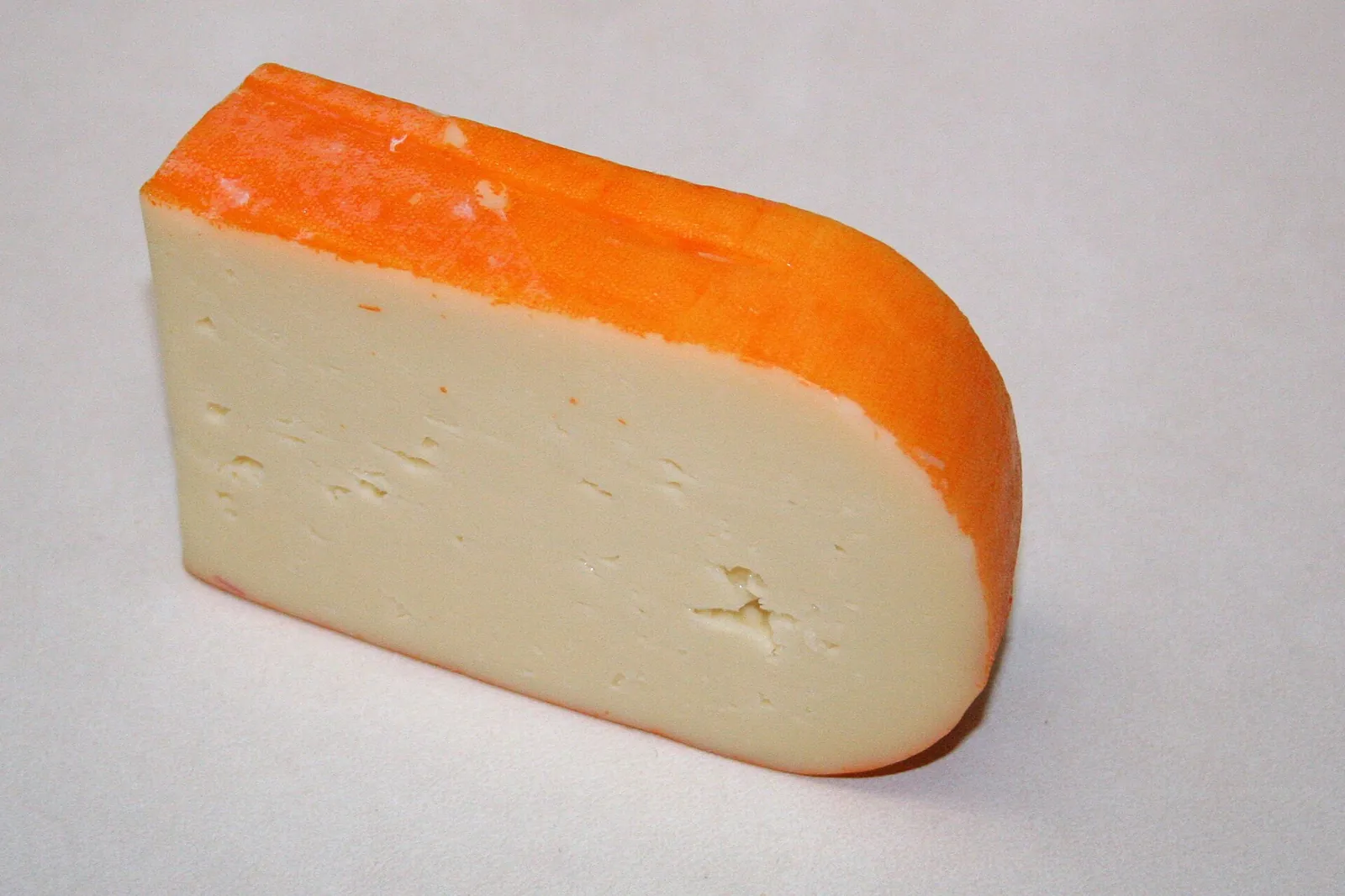
It ranges from mild and buttery when young to sharp and nutty when cured, and the young kind slices and melts, while the cured kind grates.
Its shape explains the cheese. Curd is wrapped in a square cotton cloth and the corners are knotted, so the finished block carries the cloth's folds on its top face.
Mahon cheese at a glance
This Mahon cheese at a glance table draws on the original EU application for the name and the Foods and Wines from Spain profile.
| Detail | Mahón-Menorca |
|---|---|
| Milk | Whole cow's milk (Friesian, Menorcan, Brown Swiss), up to 5 percent Menorcan sheep's milk |
| Made in | The island of Menorca, Balearic Islands, Spain |
| Protected name | PDO, registered in the EU on June 21, 1996 |
| Shape and size | Square base, rounded edges, 5 to 9 cm high, 1 to 4 kg |
| Aging | Young 21 to 60 days; semi-cured 60 to 150 days; cured over 150 days |
| Rind | Rubbed with olive oil, cow's butter or olive oil with paprika |
| Paste | Firm, ivory-yellow, a few pea-sized holes |
| Fat | At least 38 percent of the dry matter |
What the Mahon cheese name protects
The Mahon cheese name protects both the place and the maker: milk, making and ripening must all happen on Menorca. The original EU application allows whole cow's milk from Friesian, Menorcan and Brown Swiss cattle, with up to 5 percent sheep's milk from the Menorcan breed. It sets two types: Mahón Artesano, made by hand from raw milk and aged at least 60 days, and Mahón from dairies that treat the milk.
The EU register lists the name as a PDO from June 21, 1996, according to the GOV.UK record. If you want to know what that seal promises across Europe, the PDO and PGI guide has it.
How Mahon cheese is made
Mahon cheese is made by setting the milk with rennet at 30 to 34°C (86 to 93°F), cutting the curd to grains of about 1 cm and pressing it for about 10 hours. For Artesano, the curd is shaped by hand in the "fogasser," a square cotton cloth, which leaves fold marks on the top face. Wheels are then salted in saturated brine for up to 48 hours and dried for 3 to 4 days before ripening.
During ripening the cheeses are turned and cleaned, and the rind is rubbed repeatedly with cow's butter, olive oil or olive oil with paprika. The application says the rubbing keeps the rind from drying out too fast, repels insects and gives the typical color. That is where the orange comes from, not from sea air or an added dye.
Mahon cheese flavor by age
The flavor of Mahon cheese changes by age enough that three different cheeses sit under one name. Foods and Wines from Spain lists the bands as young (21 to 60 days), semi-cured (60 to 150 days) and cured (over 150 days).
Young Mahon has a yellowish-white rind and a mild, milky taste. Semi-cured develops what that profile calls a slight flavor of butter and nuts, especially hazelnuts, and the rind turns orange or light brown. Cured Mahon has a brown rind, a drier paste, and notes of wood and leather with growing piquancy. The application describes the paste as firm and ivory-yellow with few, irregular holes no bigger than a pea, and says the sharpness grows with age.
How to buy Mahon cheese in the US
Buying Mahon cheese in the US is easiest at a specialty cheese shop, where it is usually sold as a wedge cut from a square block. Ask which age band you are getting. If the label says only "Mahón," ask whether it is young, semi-cured or cured, since a young and a cured wedge are almost different cheeses.
Check the rind: it should be dry and evenly colored. Mahon sold without a Menorca origin and a PDO label may be a "Mahon-style" cheese from elsewhere, so the protected name on the label matters.
How to use Mahon cheese
Use young or semi-cured Mahon cheese where you would use a good table cheese: sliced for a sandwich, cubed on a board, or melted onto toast. It melts smoothly, so it works in a grilled cheese. Cured Mahon works like a grating cheese, shaved over pasta, eggs or roasted vegetables.
A simple way to taste it is thin slices with olive oil and black pepper. Reds like Tempranillo and Garnacha, and cava, go with it. The cheese board guide shows how to place a firm wedge alongside soft cheeses.
What most Mahon cheese advice gets wrong
Most Mahon advice skips the details that change what you buy.
Mahon cheese is not a sheep's milk cheese
Mahon cheese is not a sheep's milk cheese, though it comes from a country known for them. The base is cow's milk, with at most 5 percent sheep's milk allowed.
Mahon cheese is not square by accident
Mahon cheese is not square by accident, and the shape is not decoration. It comes from the cloth the curd is wrapped in; in artisan production the folds of that cloth are visible on the top face.
Mahon cheese rind color is not a quality grade
Mahon cheese rind color is not a quality grade, because it comes from the rub of oil, butter and paprika. Judge age by the label and by taste, not by how orange the rind looks.
Questions about Mahon cheese
These are the questions about Mahon cheese that come up most.
What milk is Mahon cheese made from?
Mahon cheese is made from cow's milk, mainly Friesian, Menorcan and Brown Swiss cattle, with up to 5 percent Menorcan sheep's milk.
What does Mahon cheese taste like?
Mahon cheese tastes mild and milky when young, buttery and nutty when semi-cured, and sharp with notes of wood and leather when cured.
Why is Mahon cheese square?
Mahon cheese is square because the curd is pressed in a square cotton cloth called a fogasser, and the folds mark the top of artisan wheels.
Is Mahon cheese a good melting cheese?
Mahon cheese melts well when it is young or semi-cured, since it keeps more moisture. Cured wheels are drier and better grated. For other options, see the best melting cheeses.
What is a good Mahon cheese substitute?
For Mahon cheese, young Gouda stands in for a young wedge, and aged Manchego or aged Gouda can stand in for a cured one. The substitute finder lists more.
Your first Mahon cheese
For your first Mahon cheese, buy a small semi-cured wedge, slice it thin and drizzle it with olive oil and black pepper. If you like it, try a young one next to a cured one to taste how age changes the same block. Store it wrapped in wax paper, as the storing cheese guide explains. For another Spanish cheese with a protected name, see Manchego.
Sources
- Denominación de Origen "Mahón": application file for registration, eAmbrosia, European Commission
- Mahón-Menorca PDO, Foods and Wines from Spain, ICEX
- Mahón-Menorca protected food name, GOV.UK