
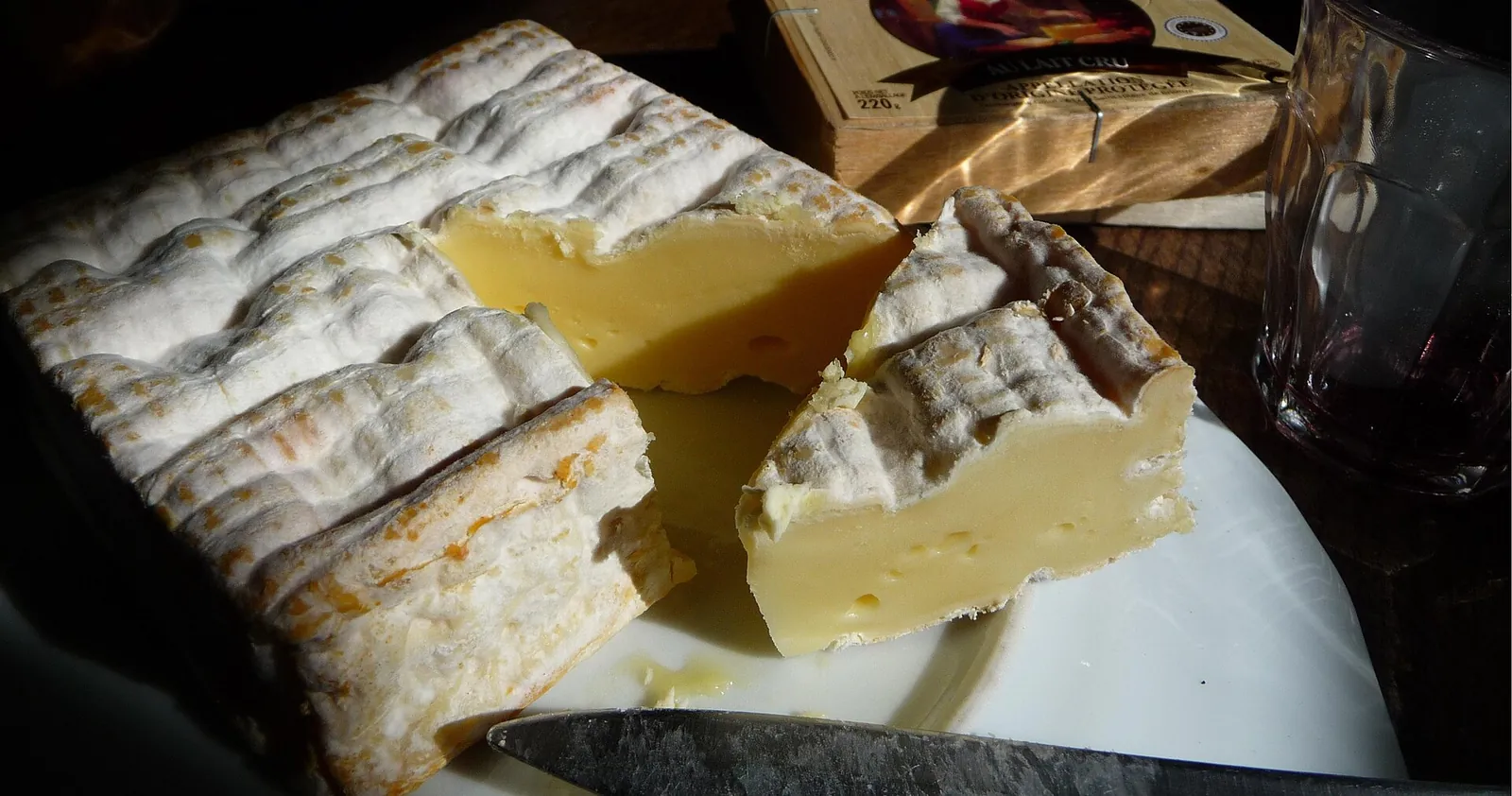
It is the gentlest of the great Normandy washed rinds: the aroma is stronger than the taste.
The square is the giveaway. Nearly every other soft cheese in Normandy is round, and the INAO says producers adopted the square form in the 18th century to stand out from the rest, which makes it one of the earliest bits of cheese marketing on record.
Pont-l'Évêque cheese at a glance
Here is Pont-l'Évêque cheese at a glance, taken from the INAO's product page.
| Detail | Pont-l'Évêque |
|---|---|
| Milk | Cow |
| Made in | A large part of former Lower Normandy: just over 1,300 communes in Orne, Calvados, Manche and part of Eure |
| Protected name | AOP (PDO) |
| Rind | Whitish to reddish; brushed and/or washed during ripening |
| Shape | Square or rectangular; four formats |
| Texture | Soft |
| Flavor | Sweet, with milky, plant, creamy and sometimes lightly smoky aromas |
What makes Pont-l'Évêque cheese square
Pont-l'Évêque cheese is square because makers in the 18th century chose that shape to set their cheese apart, according to the INAO, and it has stayed. The shape also suits a soft cheese that is sold in a small wooden or cardboard box, because a square fills the box without wasted space. The name itself is older than the shape: Pont-l'Évêque and its neighbor Livarot both claim kinship with the "angelot" mentioned in the 13th-century Roman de la Rose, according to the registration file for Livarot.
The production area is wide, covering over 1,300 communes, and the INAO's page credits excellent grass-growing conditions for milk that suits cheesemaking. Makers use soft-cheese techniques with a short ripening, and the INAO says this is what makes Pont-l'Évêque mild and aromatic. For what the seal on the label guarantees, see the PDO and PGI guide.
The rind of Pont-l'Évêque cheese
The rind of Pont-l'Évêque cheese is brushed and/or washed during ripening, which is why it ranges from whitish to reddish and sometimes looks a little dusty. Washing and brushing encourage the surface microbes that give washed-rind cheeses their savory smell. A short ripening keeps that smell in check, so the aroma stays below that of its louder Normandy neighbor.
Mild is relative. In a 2004 Cranfield University sniff test, Pont-l'Évêque came second among 15 cheeses, as the stinky cheese ranking reports, even though its official profile is sweet. Smell and taste are different measurements.
What Pont-l'Évêque cheese tastes like
Pont-l'Évêque cheese tastes sweet and soft, with milky, plant and creamy aromas and sometimes a hint of smoke, per the INAO's description. Expect a springy, creamy paste that gets more yielding as it ripens, a gentle savory edge toward the rind, and none of the sharp ammonia or heavy barnyard of stronger cheeses.
Next to Livarot it is rounder and sweeter; next to a mild Brie it has more savor and a more assertive smell. It is a sensible first washed rind for anyone nervous about smelly cheese.
How to buy Pont-l'Évêque cheese in the US
Buying Pont-l'Évêque cheese in the US means looking for the AOP name and a clean, supple square, usually in its box. Press the center through the box or wrapper if the counter allows: it should give slightly, not feel rock hard or collapse into liquid. The rind should be an even pale gold to light orange, not slimy or cracked, and it should smell savory, not sharply of ammonia.
Four formats exist, so ask for the smaller one if you are cooking for two. A piece cut from a larger format dries at the edges faster than a whole small one.
How to serve Pont-l'Évêque cheese
Serve Pont-l'Évêque cheese at room temperature, about an hour out of the fridge, so the paste softens and the sweetness shows (the room temperature guide explains why). Cut it into wedges or slices, leaving a bit of rind on each so everyone gets both.
Normandy cider is the classic partner, since apple acidity cuts the cheese's richness, and the cider and cheese guide has more. Crisp apples, pears, walnuts and a baguette round out a board. Pont-l'Évêque also melts well: lay slices on bread under the broiler, or stir cubes into a hot potato dish, and the flavor stays gentle.
Pont-l'Évêque cheese mistakes that cost you flavor
A few habits flatten Pont-l'Évêque cheese, which is a delicate cheese.
Serving Pont-l'Évêque cheese cold
Serving Pont-l'Évêque cheese cold hides its sweetness and leaves the paste firm and bland. The hour on the counter is the whole trick.
Treating mild as boring
Treating Pont-l'Évêque cheese as boring because it is mild misses the point. The flavor is quiet, so pair it with something that does not shout: cider, a light red or a dry white, not a heavy red.
Keeping it in its box too long
Keeping Pont-l'Évêque cheese in its box in the fridge for more than a few days dries the edges and concentrates the smell. Rewrap it in wax paper or parchment inside a lidded container, as the cheese storage guide suggests.
Throwing the rind away
Throwing away the Pont-l'Évêque rind removes much of the savor. The rind is edible, though if you find it too assertive, trim it; the rind guide covers when to skip it.
Pont-l'Évêque cheese substitutes
Pont-l'Évêque cheese is closest to other mild, soft washed rinds. Taleggio is a good match in texture and gentleness, Munster is a little louder, and a ripe Brie or Camembert is milder and more earthy. If you want the same square and more punch, Maroilles is the step up. The Substitute Finder lists more options.
Questions about Pont-l'Évêque cheese
These are the questions about Pont-l'Évêque cheese that come up most.
What does Pont-l'Évêque cheese taste like?
Pont-l'Évêque cheese tastes sweet, with milky, plant and creamy notes and sometimes a light smoky edge, according to the INAO.
Why is Pont-l'Évêque cheese square?
Pont-l'Évêque cheese is square because producers adopted the shape in the 18th century to differentiate their cheese, the INAO says.
Is Pont-l'Évêque cheese stinky?
Pont-l'Évêque cheese smells stronger than it tastes: it ranked second in a 2004 sniff test, but its official flavor description is mild and sweet.
What is the difference between Pont-l'Évêque and Livarot cheese?
The difference between Pont-l'Évêque and Livarot cheese is shape and strength: Pont-l'Évêque is square and mild, while Livarot is a round cylinder banded with five strips and more pungent.
Can you eat the rind on Pont-l'Évêque cheese?
You can eat the rind on Pont-l'Évêque cheese, which is brushed or washed during ripening, though some people trim it for a milder bite.
Your first Pont-l'Évêque cheese
For your first Pont-l'Évêque cheese, buy the smallest square you can find, let it warm up for an hour and serve it with cider, crisp apple slices and bread. If you enjoy it, move on to Livarot or Maroilles for more power.
Sources
- Pont-l'Évêque, product page, Institut national de l'origine et de la qualité (INAO)
- Livarot, product page, Institut national de l'origine et de la qualité (INAO)
- Livarot, request for registration of a PDO (Article 17), European Commission eAmbrosia register