
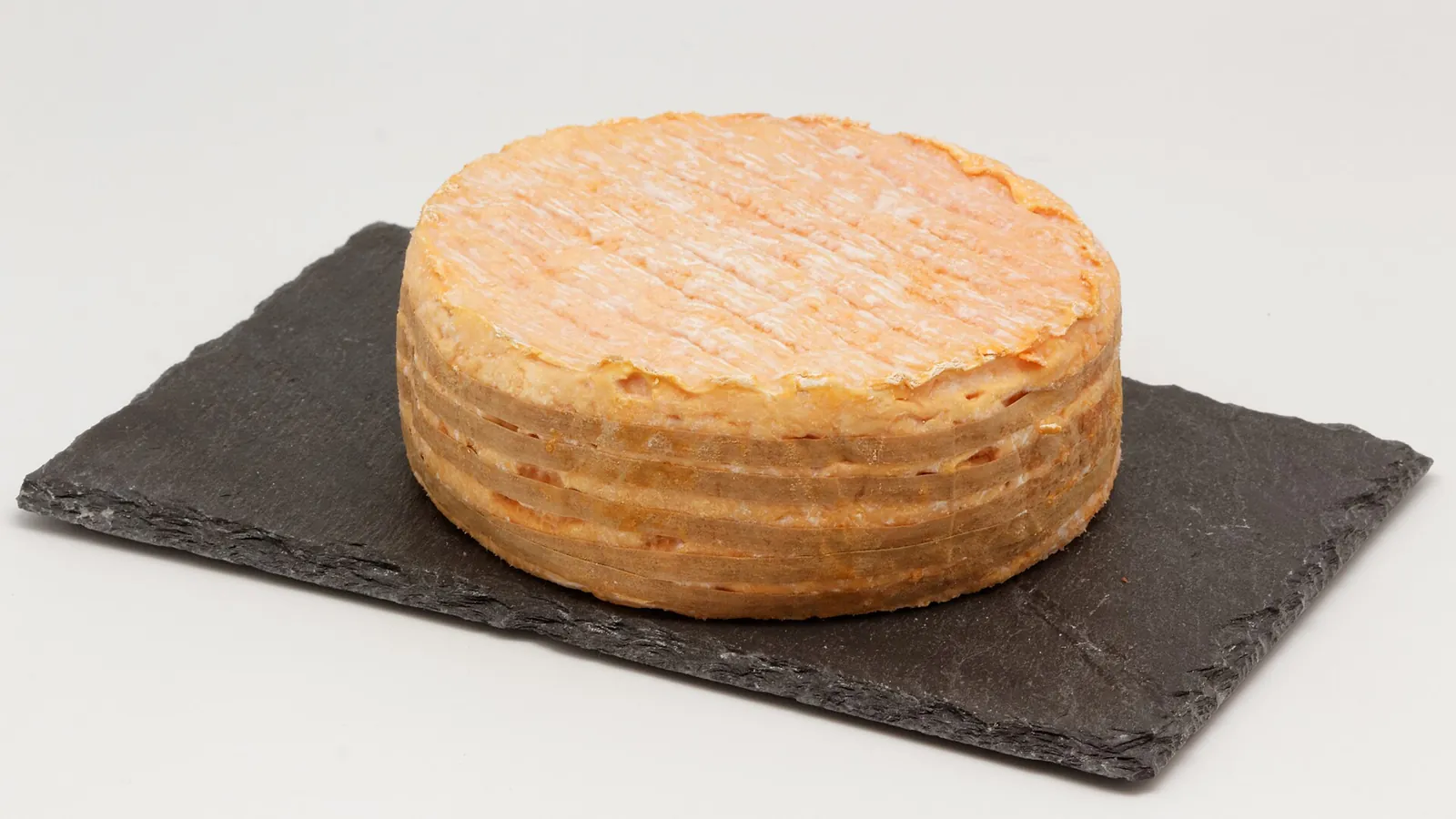
The smell comes from the wash, not from spoilage. Livarot's rind is bathed repeatedly while it ripens, and the orange microbes that grow in that damp surface produce the farmyard, savory aroma. Underneath, the paste is supple and only lightly salty.
Livarot cheese at a glance
Here is Livarot cheese at a glance, based on the INAO's product page and the original European registration file.
| Detail | Livarot |
|---|---|
| Milk | Cow, Normande breed only |
| Made in | Pays d'Auge, Normandy: 290 communes in Calvados, Orne and Eure |
| Protected name | AOC decree of December 17, 1975, now an AOP (PDO) |
| Rind | Washed, straw-yellow to reddish |
| Shape | Always a cylinder, banded with five strips; four sizes, 350 to 500 g (the registration file's range) |
| Texture | Soft, supple, melting |
| Flavor | Lightly salty, with straw, hay, animal and smoky notes |
Why Livarot cheese is called the Colonel
Livarot cheese is called "le Colonel" because the five bands around its middle look like the five stripes on a colonel's sleeve. The INAO says the bands are plant strips called laîches (sedge), added during ripening to hold the shape the mold gave the cheese, a step known as cerclage. The registration file from the 1990s adds that the bands were once willow wood, then reeds or paper, so what you find in a store today depends on the dairy.
Do not eat them. They are packaging that stayed because it works, and they are the quickest way to tell a Livarot from the square washed rinds around it.
How Livarot cheese is made
Livarot cheese starts with curd cut into large cubes, rested, cut again, stirred, drained and ladled into molds. After several turns and draining in a warm room it is salted, dry or in brine, then moved to the cellar. The original registration file says the cheeses are turned and washed at least three times with water, the last wash tinted with annatto, and may be eaten after a minimum of three weeks of ripening.
The area matters to the producers: the Pays d'Auge has a maritime climate and heavy clay soil, which grow thick grass, and the registration credits the region's native microflora for Livarot's fine aroma. The name has been argued over for centuries, since Livarot and its neighbor Pont-l'Évêque both claim kinship with the "angelot" cheese mentioned in the Roman de la Rose in 1260. For what the protected-name seal promises, see the PDO and PGI guide.
Livarot cheese: smell versus taste
Livarot cheese tastes gentler than it smells, and the official description says so: a supple paste, slightly salty and melting in the mouth, with a marked flavor of straw and hay plus animal and smoky notes, and aromas that are powerful and long-lasting. Think of a hayloft more than a gym bag.
Your nose sets the expectation, and the first bite usually undercuts it. A ripe piece is soft enough to dent with a fingertip and tastes savory, rounded and lightly meaty. A cheese that is chalky in the center is young; one that smells sharply of ammonia has gone too far. Livarot sits near the loud end of the washed-rind family, well above Pont-l'Évêque and a notch below the pudding-soft Époisses.
How to buy Livarot cheese in the US
Buying Livarot cheese in the US means asking at a cheese counter, because it is a specialty import. Look for a name that says Livarot AOP, an intact set of five bands and a rind that is supple and orange rather than dry or cracked. Skip a cheese that is sticky and wet through the paste, or that stings your nose with ammonia.
Buy it close to the day you will serve it and ask for a whole small cheese when you can, because a cut wedge loses its character quickly. Wrapped in its bands, Livarot is a cheese that rewards a first try in the smaller sizes.
How to serve Livarot cheese
Serve Livarot cheese at room temperature, about an hour out of the fridge, so the paste turns supple and the flavor opens (the room temperature guide has the method). Keep it under a cloche or in its box until guests sit down, and give it its own board so the aroma does not drift into milder cheeses.
Normandy cider is the natural drink, because its apple acidity and slight sweetness cut the salt and fat; the cider and cheese guide goes further, and Calvados works as a stronger sip. On the board, tart apples, pears and sturdy bread or rye suit it. Livarot also melts well, so a slice laid on a hot roast potato or stirred into a gratin gives you the flavor without the full aroma.
Livarot cheese mistakes that cost you flavor
Livarot cheese mistakes are mostly about temperature, wrapping and nerves.
Cutting Livarot cheese too early
Cutting Livarot cheese too early, straight from the fridge, gives you a stiff, bland, slightly sour piece. Cold mutes the savory notes and keeps the paste firm, so wait the hour.
Judging it by smell alone
Judging Livarot cheese by smell alone makes people reject a good one. The aroma is the loudest thing about it, and the paste is far milder. Taste a small piece before you decide.
Storing it in plain plastic
Storing Livarot cheese in plain plastic wrap traps moisture and the smell. Wrap it in wax paper or parchment and put it in a lidded container in the fridge, as the cheese storage guide describes. Eat a ripe cheese within a few days.
Eating the rind or not
Eating the Livarot rind is a choice, not a rule. The washed rind is edible and carries much of the flavor, but some people find it too salty and strong, so trim it if you do; the rind guide covers the common cases.
Livarot cheese substitutes
Livarot cheese has no exact twin, but a few cheeses come close. Maroilles is the nearest in power: also a cow's milk washed rind, from northern France, with a slightly ammoniated smell. Pont-l'Évêque is the gentler Normandy choice, and Époisses is creamier and richer. Munster and Taleggio are milder washed rinds that are easier to find. The Substitute Finder can narrow the options, and the stinky cheese ranking shows where each one sits on the scale.
Questions about Livarot cheese
These are the questions about Livarot cheese that come up most.
Why is Livarot cheese called the Colonel?
Livarot cheese is called the Colonel because the five bands around it resemble the five stripes of a colonel's sleeve, according to the INAO.
Does Livarot cheese taste as strong as it smells?
Livarot cheese does not taste as strong as it smells: the paste is supple and only slightly salty, with straw, hay, animal and smoky flavors behind a very powerful aroma.
Is Livarot cheese the same as Pont-l'Évêque?
Livarot cheese is not the same as Pont-l'Évêque: Livarot is a banded cylinder with a louder aroma, while Pont-l'Évêque is square and its official profile is sweet and mild. Both come from Normandy and both are washed rinds.
What do you drink with Livarot cheese?
With Livarot cheese, drink Normandy cider or Calvados, whose apple character balances the salt and pungency, or a spicy white such as Gewürztraminer.
Can you eat the bands on Livarot cheese?
You should not eat the bands on Livarot cheese: they are sedge, reed or paper strips that hold the shape, and you remove them before cutting.
Your first Livarot cheese
For your first Livarot cheese, buy the smallest size from a counter that can tell you how ripe it is, let it warm up for an hour, and serve it with cold cider, sliced apple and a baguette. If the smell is too much, trim the rind and try the paste on its own.
Sources
- Livarot, product page, Institut national de l'origine et de la qualité (INAO)
- Livarot, request for registration of a PDO (Article 17), European Commission eAmbrosia register
- Pont-l'Évêque, product page, Institut national de l'origine et de la qualité (INAO)