
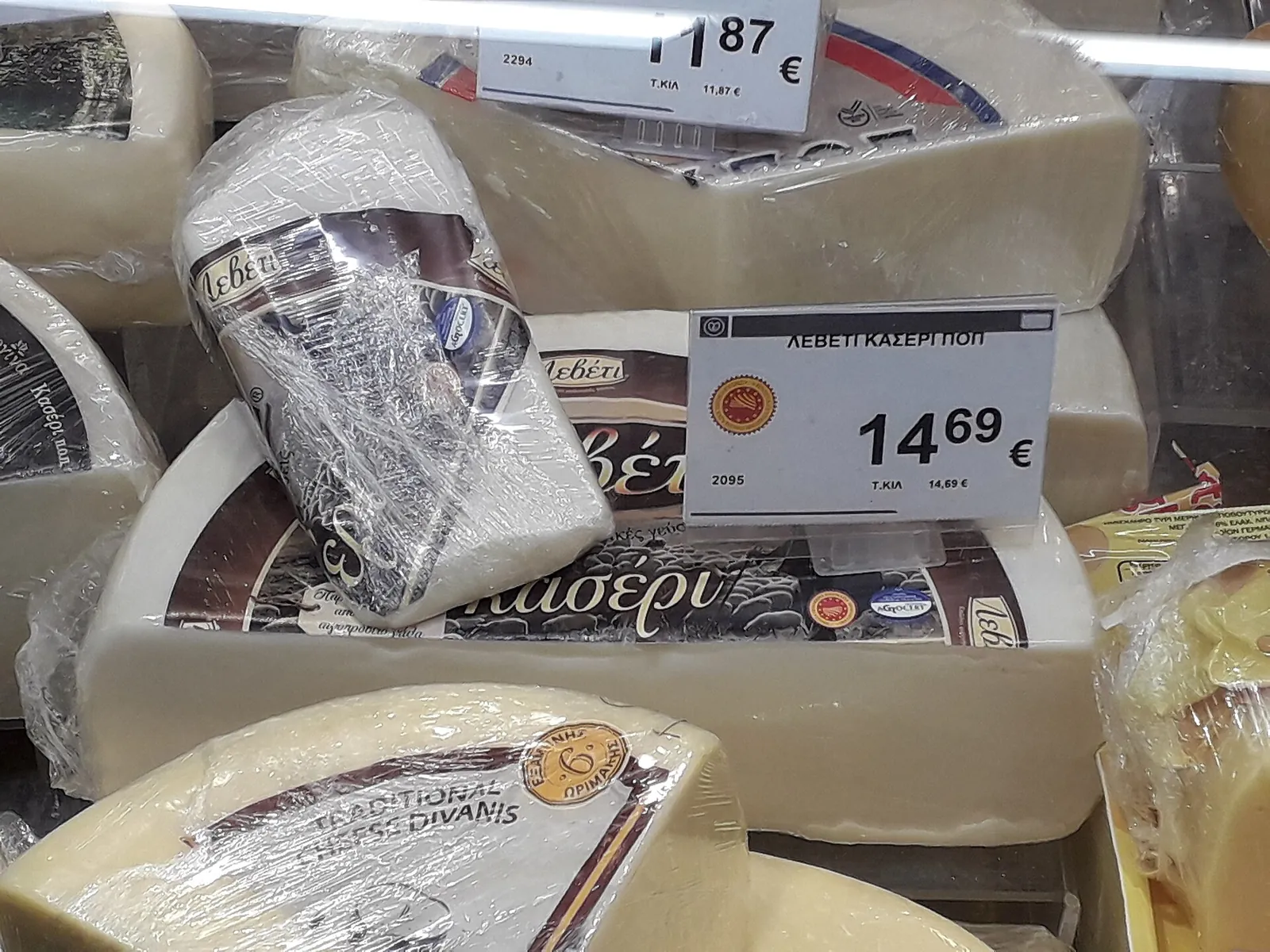
It is milder than feta and much easier to slice, grate and fry.
It carries a protected designation of origin (PDO), so the name is tied to specific regions of Greece, and the rules for how the curd is handled are written into the registration. That stretching step is what makes kasseri a close cousin of provolone rather than a relative of brined feta.
Kasseri cheese at a glance
Here is kasseri cheese at a glance, with the facts taken from the original PDO registration summary.
| Detail | Kasseri |
|---|---|
| Milk | Sheep's milk, or a mix of sheep's and goat's milk |
| Made in | Macedonia, Thessaly, and the prefectures of Xanthi and Lesvos, Greece |
| Protected name | PDO, labeled "Kasseri Cheese PDO" |
| Type | Semi-hard, pulled-curd (pasta filata) |
| Ripening | At 18°C (64°F) for not less than 3 months |
| Rind and salting | Surface salted 12 to 14 times |
| Texture | Springy, slightly stringy and chewy |
| Flavor | Mild, savory, a little tangy |
Kasseri cheese PDO rules
The kasseri cheese PDO limits the cheese to sheep's milk or a sheep and goat mix and to production in Macedonia, Thessaly and the prefectures of Xanthi and Lesvos. The registration summary on the EU register says the milk must come from sheep and goat breeds reared traditionally in that area, and that the cheese is ripened there too.
The method is the unusual part. After the milk coagulates, the curd is broken up, left for 5 to 10 minutes, heated to 38 to 40°C (100 to 104°F) with constant stirring, then left to settle. The curd is removed and left to drain and ripen until the pH falls to about 5.2. Only then is it cut into slabs, dipped in water at 70 to 80°C (158 to 176°F) and kneaded until it becomes one malleable mass, which goes into molds for two to three days.
Acid does the work before the hot water: the pH drop is what lets the curd stretch. The surface is salted 12 to 14 times and the cheese ripens at 18°C for at least 3 months. The guide to PDO and PGI labels covers what the seal means in general.
Kasseri cheese flavor and texture
Kasseri cheese tastes mild, savory and a little tangy, with a springy, slightly stringy and chewy texture, as America's Test Kitchen describes it. It has none of the sharp brine of feta, which is why it works as a table cheese for people who find feta too salty.
That chew comes from the kneading: stretching lines up the protein strands, so the cheese pulls instead of crumbling. If you know provolone, the texture will feel familiar, though kasseri's sheep's-milk tang is its own.
How to use kasseri cheese
Kasseri cheese is a good everyday cheese because it slices for sandwiches, melts smoothly and grates over baked dishes. Put it in a toastie, bake it over vegetables, or slice it onto a board with olives, tomatoes and bread. America's Test Kitchen also notes that it is used on top of moussaka's béchamel.
The stretch is the reason it melts so smoothly: the protein network is already aligned, so heat softens it into strings. The best melting cheeses ranking shows how it compares with others.
Kasseri cheese for saganaki
Kasseri cheese is one of the cheeses cooks fry for saganaki, the Greek dish of pan-fried cheese. Cut a slab about half an inch (1 cm) thick, rinse it and pat it dry, dust it with flour, and fry it in hot olive oil until golden on both sides. Squeeze lemon over it and eat it right away. Restaurants sometimes flame it at the table with brandy. The saganaki page has the full method, and graviera is the harder, nuttier alternative.
How to buy kasseri cheese in the US
Buying kasseri cheese in the US means checking supermarkets or specialty stores, according to America's Test Kitchen, and a Greek or Mediterranean market is the surest bet. For the real thing, read the label: the registered name is "Kasseri Cheese PDO", and a package without that wording is not guaranteed to follow the Greek rules.
Look for a pale yellow block or wedge that looks moist and supple, not dry or cracked at the edges. Store it wrapped in the fridge and use it within a couple of weeks; the storing cheese guide explains wraps.
Kasseri cheese substitutes
The best substitute for kasseri cheese is low-moisture, whole-milk block mozzarella or provolone, which America's Test Kitchen names for dishes that need a mild, stretchy cheese. Use the block kind, not fresh mozzarella, because fresh is too wet to fry or brown. The mozzarella versus provolone page explains the difference. For frying, halloumi holds its shape in a pan but is saltier and squeakier, so it changes the dish.
What most kasseri cheese advice gets wrong
Most kasseri cheese advice reduces it to "Greek mozzarella," and that skips what makes it different.
Kasseri is not feta
Kasseri is not interchangeable with feta: feta is brined, crumbly and only ripened for a minimum of 2 months under its own PDO papers, while kasseri is stretched, salted on the surface and ripened for 3 months or more. Swap them and a dish loses either its melt or its salt.
The stretch happens late
The stretch happens late: the hot-water kneading comes only after the curd has drained and ripened to about pH 5.2. Skip the acid development and the curd will not stretch, which is why the PDO papers fix the pH target before any hot water is used.
Not every Greek cheese is on the PDO
Other Greek cheeses can look similar in the case, so use the name on the label. Read the Greek cheeses beyond feta guide if you want to compare them side by side.
Questions about kasseri cheese
These are the questions about kasseri cheese that come up most.
What is kasseri cheese?
Kasseri cheese is a semi-hard, pulled-curd Greek cheese made from sheep's milk or a sheep and goat mix, with PDO status.
Is kasseri cheese like feta?
Kasseri cheese is not like feta: it is mild, chewy and stretchy, while feta is brined and crumbly.
Does kasseri cheese melt well?
Kasseri cheese melts well, because its stretched curd softens into strings when heated, which is why it works in toasties, bakes and saganaki.
What is kasseri cheese used for?
Kasseri cheese is used for saganaki, sandwiches, baked dishes and the cheese board.
What can replace kasseri cheese?
Kasseri cheese can be replaced by low-moisture whole-milk block mozzarella or provolone.
Your first kasseri cheese
For your first kasseri cheese, buy a small wedge labeled Kasseri Cheese PDO, fry a half-inch slab as saganaki with lemon, and keep a second slice for a toasted sandwich. Compare it with graviera to feel the difference between a stretched and a pressed cheese.
Sources
- Kasseri Cheese PDO registration summary, eAmbrosia, European Commission
- Feta Cheese PDO registration summary, eAmbrosia, European Commission
- 6 Greek cheeses you should seek out, America's Test Kitchen