
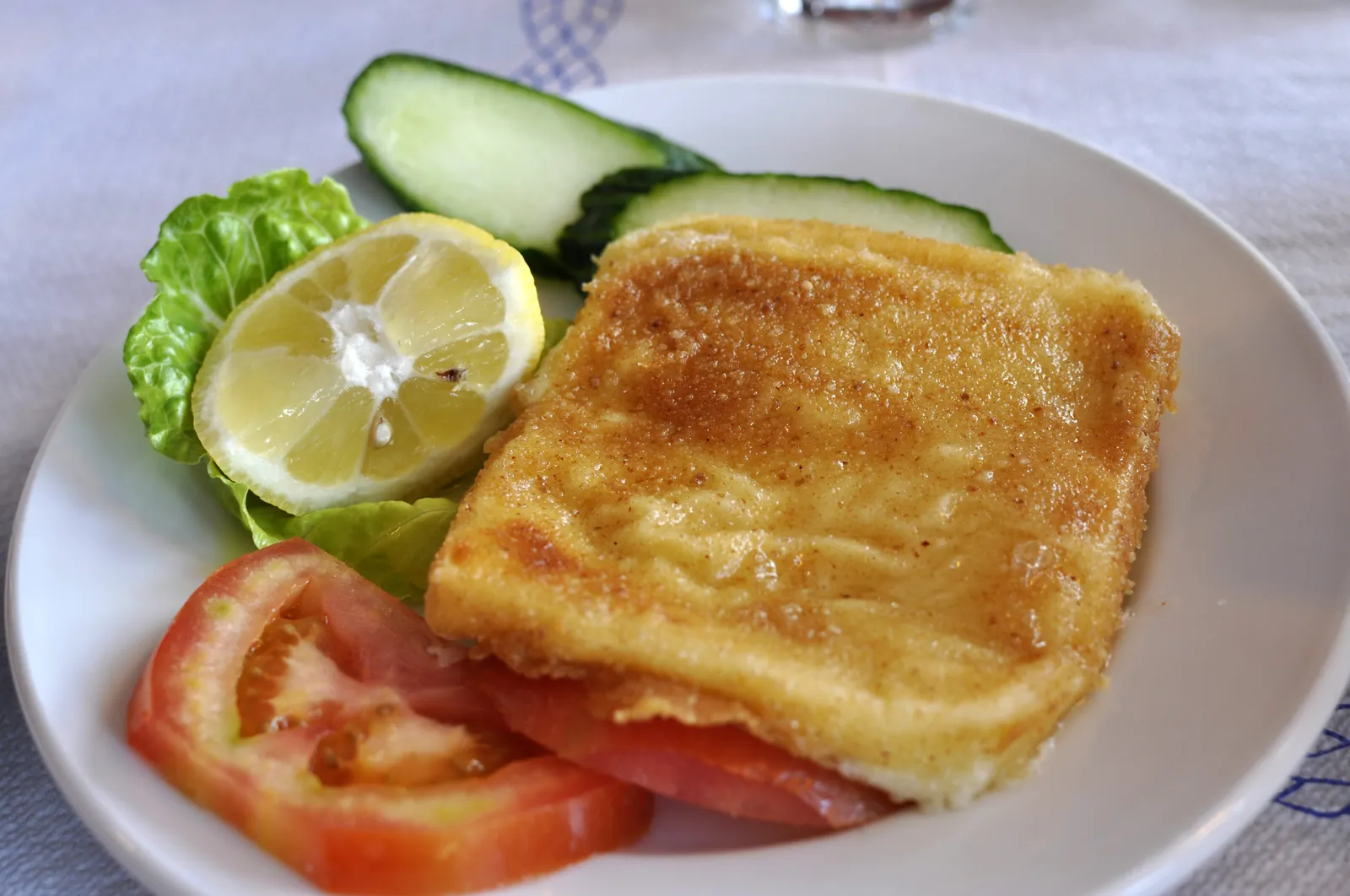
It is served hot, with lemon squeezed over it, and eaten with bread before it sets.
The name comes from the sagani, the small two-handled pan the dish was traditionally cooked in. The whole dish takes about 15 minutes, and the only real skill is choosing a cheese that softens without running.
Saganaki at a glance
This saganaki table gives the yield, timing and the cheeses that suit the dish.
| Yield | 4 servings as an appetizer (about 2 oz per person) |
| Active time | 15 minutes |
| Total time | 15 minutes |
| Pan temperature | Medium-high, oil shimmering |
| Best cheese | Kefalograviera, graviera, kasseri, kefalotyri or halloumi |
| Make ahead | Cut and chill the slabs a day ahead; flour and fry at the last moment |
How to make saganaki
This saganaki recipe sears one slab per serving in a skillet, with the flaming version in the variations below.
Ingredients for saganaki
The ingredients for saganaki are few, so the cheese and the olive oil matter most.
- 8 oz (225 g) kefalograviera, graviera, kasseri or halloumi, in one block
- 2 tablespoons (16 g) all-purpose flour
- 2 tablespoons (30 ml) olive oil
- 1 lemon, cut into wedges
- Freshly ground black pepper
- Pita or crusty bread, for serving
- Optional: 1 teaspoon dried oregano, or 1 tablespoon honey with sesame seeds
Steps for making saganaki
These steps for making saganaki take about 15 minutes, and the cheese goes from the pan to the table at once.
- Cut the cheese into 2 or 4 slabs about 1/2 inch (1.25 cm) thick, each roughly 3 by 2 inches, and pat them dry.
- Run each slab under cold water or dip it in a bowl of water, so the flour has something to stick to.
- Dredge the damp slabs in the flour, shake off every bit of excess and let them sit for 1 minute.
- Heat the olive oil in a small skillet over medium-high heat until it shimmers, about 1 minute.
- Lay the slabs in the pan with space around each and cook for 45 to 60 seconds, until the underside is deep golden and releases from the pan.
- Flip with a thin spatula and cook the second side for 30 to 45 seconds, until golden, the edges are just soft and the cheese is warm to the middle.
- Slide the slabs onto a warm plate right away, squeeze lemon over them and add pepper and oregano.
- Serve within a minute, with the bread and extra lemon, since saganaki turns firm and chewy as it cools.
The best cheese for saganaki
The best cheese for saganaki is a firm, salty Greek cheese that softens in the pan but keeps its shape. That means low moisture and a dense, cooked or pressed curd. America's Test Kitchen says kefalograviera is firm enough to hold up well to frying and grilling, with a nutty flavor and plenty of salt, which makes it the cheese most often used in Greek restaurants.
- Graviera: nutty, sweet and buttery, with the Cretan PDO from sheep's milk and the Naxos PDO mostly from cow's milk. It fries to a clean crust.
- Kasseri: a pulled-curd sheep's-milk cheese that is milder and stretchier, so the middle gets stringy and soft. Its PDO rules are in the guide to the cheese.
- Kefalotyri: harder and saltier, with a sharper bite.
- Halloumi: not a classic choice, but its cooked curd takes high heat and gives the easiest result for anyone who cannot find Greek cheese.
Feta is the wrong choice for a naked slab: it is brined, crumbly and breaks apart in a pan. It does appear in a different dish, a fried or baked feta wrapped in phyllo, which is closer to spanakopita. More Greek cheeses are covered in Greek cheeses beyond feta, and the PDO and PGI guide explains the labels.
Saganaki mistakes and fixes
Most saganaki mistakes come from a wet slab, a cold pan or too much time on the heat.
- The flour slides off: the slab was too dry. Wet it with water, then flour it.
- The cheese sticks: the oil was not hot enough or the slab was moved too soon. Wait for the shimmer, and let the crust release.
- Cheese oozes out and burns: the slab was too thin or the heat too high. Keep it at 1/2 inch.
- Rubbery inside: it cooked too long. Total pan time should stay under about 2 minutes.
- Too salty: do not salt anything; the cheese is already salty. Soak halloumi first.
Saganaki variations
Saganaki variations change the finish rather than the technique, so the pan steps stay the same.
- Flaming saganaki: in some Greek-American restaurants, brandy or ouzo is poured over the hot cheese and lit at the table, then put out with lemon. At home, use a long match, a small amount of spirit, stand back and keep hair and sleeves clear of the pan.
- Honey and sesame: drizzle the fried slab with honey and scatter toasted sesame seeds.
- Tomato saganaki: simmer chopped tomato, garlic and a pinch of oregano in the pan and set the fried slab on top.
- Shrimp saganaki: a different dish with the same name, in which shrimp bake in tomato sauce with feta.
- Halloumi sticks: cut the cheese into batons instead; see halloumi fries.
Storing and reheating saganaki
Storing and reheating saganaki is rarely needed, because it is meant to be eaten at once, so cook only what will be eaten. Leftovers should go in the fridge within 2 hours, and USDA FSIS says they keep 3 to 4 days. Reheat them in a skillet to 165°F (74°C), where they soften but never regain their crisp crust. The raw, cut slabs keep a day in the fridge, wrapped; the storage guide covers wrapping.
Questions about saganaki
These saganaki questions cover the name, the cheese and the flaming version.
What does saganaki mean?
Saganaki means a small frying pan, from the sagani, the two-handled pan used for the dish. Many Greek menus use the word for any dish cooked in one.
What cheese is used for saganaki?
The cheese used for saganaki is a firm Greek cheese such as kefalograviera, graviera, kasseri or kefalotyri. Halloumi is a good substitute.
Can you make saganaki with feta?
Saganaki with feta works only in a coating or wrapper, since a bare slab of brined feta crumbles and weeps in the pan.
Is saganaki served hot or cold?
Saganaki is served hot, straight from the pan, because the cheese firms up and turns chewy as it cools.
How do you flame saganaki?
Saganaki is flamed by warming a spoon of brandy or ouzo, pouring it over the hot cheese and lighting it at arm's length. Squeeze lemon over it to put out the flame.
Make saganaki tonight
Make saganaki tonight with one block of firm cheese, a splash of water, flour and a hot pan. Start with kefalograviera or halloumi, keep the slab at 1/2 inch and serve it the minute it leaves the pan, with lemon and bread.
Sources
- 6 Greek cheeses you should seek out, America's Test Kitchen
- Leftovers and food safety, USDA Food Safety and Inspection Service
- Safe minimum internal temperature chart, USDA Food Safety and Inspection Service