
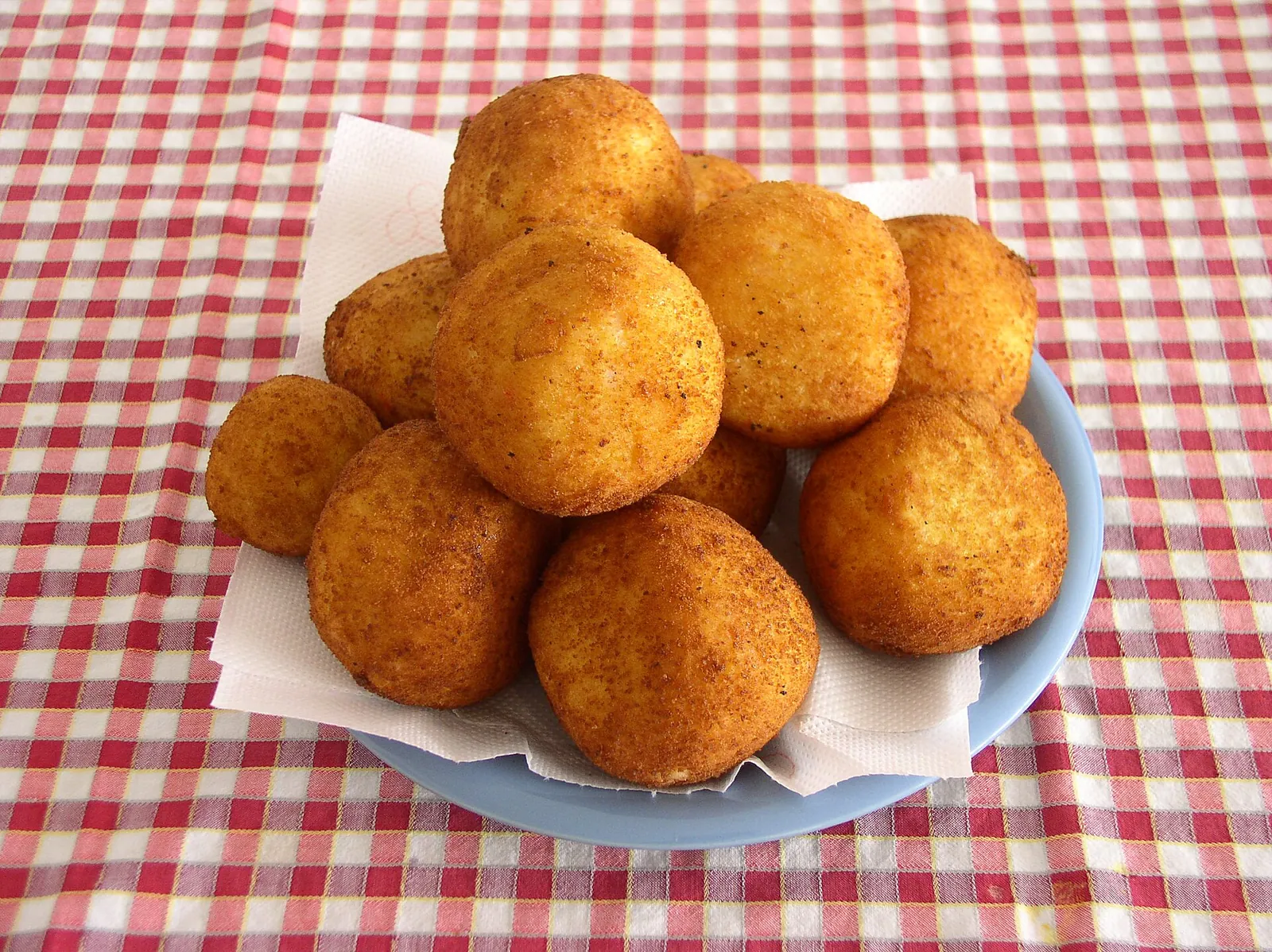
The name is Sicilian for "little oranges," and the finished color is the reason. Start with a day-old or at least fully chilled risotto, tuck in firm mozzarella, and the result is a crunchy shell around a creamy, stretchy middle.
Arancini at a glance
This arancini table gives the quick numbers before you commit to a Sunday of frying.
| Yield | 12 arancini, about 4 servings as a main or 6 as a starter |
| Active time | 45 minutes, plus 2 hours or more to chill the risotto |
| Cooking time | About 35 minutes for the risotto and the frying |
| Oil temperature | 350°F (175°C) |
| Best cheese | Low-moisture mozzarella cubes inside, Parmigiano-Reggiano in the rice |
| Make ahead | Shape and bread up to a day ahead; fry just before serving |
Where arancini come from
Where arancini come from is a Sicilian story, and accounts of their beginnings differ. Wikipedia's summary notes the name comes from a Sicilian diminutive of aranciu, orange, and that one view dates them to 10th-century Arab-ruled Sicily while the academic Annette Condello places them in 18th-century southern Italy. Treat the date as unsettled.
The grammar splits by region too: the eastern side of Sicily tends to say arancino, the western side arancina, and plain Italian has mostly settled on arancino, plural arancini. The common fillings are ragù with peas and cheese, or prosciutto with mozzarella or béchamel.
How to make arancini
This arancini recipe uses a saffron and Parmigiano risotto cooked a day ahead, with a mozzarella center, and it makes 12 balls about the size of a small orange.
Ingredients for arancini
Every part of the arancini list below is flat so you can shop in one pass, and the risotto is the only part that needs planning ahead.
- Risotto: 2 tablespoons (28 g) butter
- Risotto: 1 small onion, finely chopped
- Risotto: 1 cup (200 g) arborio rice
- Risotto: 1/2 cup (120 ml) dry white wine
- Risotto: 3 cups (700 ml) hot chicken or vegetable stock, kept at a simmer
- Risotto: 1 generous pinch saffron threads, steeped in 1/4 cup (60 ml) of the hot stock
- Risotto: 1/2 cup (50 g) finely grated Parmigiano-Reggiano
- Risotto: 1 egg yolk
- Risotto: 1/2 teaspoon salt, plus more to taste
- Filling: 3 oz (85 g) low-moisture mozzarella, cut into 12 cubes about 3/4 inch (2 cm)
- Coating: 1/2 cup (65 g) all-purpose flour
- Coating: 2 large eggs, beaten with 1 tablespoon water
- Coating: 1 1/2 cups (150 g) fine dry breadcrumbs
- Frying: about 1 1/2 quarts (1.4 L) neutral oil such as canola or sunflower
Steps for making arancini
These steps for making arancini run from the risotto through the final fry, and the chilling in step 4 is the one you cannot skip.
- Melt the butter in a wide pan over medium heat, add the onion and a pinch of salt, and cook 4 minutes until soft and translucent.
- Stir in the rice for 1 minute until the edges look glassy, pour in the wine, and cook until it has almost disappeared.
- Add the hot stock one ladle at a time, stirring often and letting each addition absorb before the next, for about 18 minutes, until the rice is tender with a little bite. Stir in the saffron and its stock for the last few minutes.
- Off the heat, stir in the Parmigiano and egg yolk, then spread the risotto in a thin layer on a sheet pan and chill at least 2 hours, or overnight, until completely cold and stiff.
- Wet your hands, scoop about 1/3 cup of risotto into your palm, flatten it, press a mozzarella cube into the center and close the rice around it into a ball, sealing every gap.
- Roll each ball in flour, shake off the extra, dip it in the egg, then roll it in breadcrumbs until coated all over, and set the balls on a tray.
- Heat the oil in a deep, heavy pot to 350°F (175°C), measured with a thermometer, and fry 3 or 4 balls at a time for 4 to 5 minutes, turning once, until deep golden brown.
- Lift them onto a wire rack, rest 2 minutes, and serve while the cheese is still soft, breaking one open to check that it has melted.
The best cheese for arancini
The best cheese for arancini is low-moisture mozzarella in the center, because a firm block melts into a stretchy core without releasing much water. The FDA draws its line between plain and low-moisture mozzarella at 52 percent moisture, and our guide to types of mozzarella explains why the wetter fresh ball weeps in the oven. In a fry the same thing happens faster: steam builds inside the crust and can split it.
Fresh mozzarella is fine if you pat the cubes dry and chill them first. For a sharper middle, swap in provolone; the mozzarella vs provolone page covers how they differ. Inside the rice, a dry, salty cheese like Parmigiano-Reggiano seasons every bite, and the technique is the same one used in a Parmesan risotto.
Arancini mistakes and fixes
Most arancini mistakes come from rice that is too warm, oil that is off temperature, or a seam in the coating.
- They fall apart in the oil. The risotto was not cold enough, or the coating has a gap. Chill the shaped balls 30 minutes before frying, and double-coat in egg and crumbs if the rice is loose.
- They burst and leak cheese. The cube touched the surface, or it was too wet. Keep the cheese centered, dry fresh mozzarella, and fry no hotter than 350°F (175°C) so the shell sets before the middle boils.
- They are greasy. The oil was too cool, below about 325°F (165°C), or the pot was crowded. Fry in small batches and let the temperature recover between them.
- They are brown outside and cold inside. The oil was too hot. A thermometer fixes this; if you cannot get one, test with one ball first.
- The rice is mushy. Overcooked risotto turns pasty when chilled. Pull it while it still has a slight bite.
Arancini variations
Arancini variations change the filling, and the risotto stays the same.
- Ragù: fold in 2 tablespoons of thick meat sauce, a few peas and a cube of mozzarella.
- Prosciutto and mozzarella: wrap a small slice around the cheese before closing the rice.
- Spinach and ricotta: use cooked, squeezed spinach and a spoonful of drained ricotta instead of mozzarella.
- Baked: brush the breaded balls with oil and bake at 425°F (220°C) for 25 minutes. They are paler and less crisp but need no frying.
Make ahead, store and reheat arancini
To make ahead, store and reheat arancini, shape and bread them a day ahead, keep them on a tray in the refrigerator, and fry them cold, adding a minute or so to the time. The fried balls keep in the refrigerator, covered, and USDA's leftovers guidance says to refrigerate perishable food within 2 hours, use most cooked leftovers within 3 to 4 days, and reheat them to 165°F (74°C). Reheat in a 400°F (200°C) oven for 12 to 15 minutes on a rack rather than in a microwave, which turns the crust soft. Raw breaded balls also freeze well; see freezing cheese for what the cheese itself tolerates.
Questions about arancini
These arancini questions come up most often once the risotto is in the fridge.
What are arancini made of?
Arancini are made of cooked, chilled risotto shaped around a filling, usually mozzarella, then coated in flour, egg and breadcrumbs and deep-fried.
Can you make arancini with leftover risotto?
Arancini are a classic use for leftover risotto, as long as it is firm and cold. Loose, wet risotto needs an extra egg yolk or a spoonful of grated Parmigiano to hold together.
What cheese goes inside arancini?
Cheese inside arancini is most often low-moisture mozzarella, though provolone and caciocavallo also appear in Sicilian versions. Pick one that melts without releasing much water.
Do arancini need to be deep-fried?
Arancini are best deep-fried at 350°F (175°C) for a crisp, even shell, but a 425°F (220°C) oven works for a lighter, paler baked version.
Why do arancini explode when frying?
Arancini explode when steam or melted cheese breaks through a thin or cracked coating, or when the oil is too hot. Seal the rice fully, double-coat, and hold the oil at 350°F.
Can you freeze arancini?
Arancini freeze well, either shaped and breaded before frying or fully cooked. Fry from frozen at a slightly lower heat so the center warms through, or reheat cooked ones in the oven.
Arancini, start to finish
Arancini, start to finish, come down to cold risotto, a dry mozzarella cube and steady oil, so cook the risotto the day before and do the shaping on a quiet afternoon. For a lighter use of the same Italian pantry, try Italy's cheeses for fillings you have not tried.
Sources
- Arancini, Wikipedia
- Leftovers and Food Safety, USDA Food Safety and Inspection Service
- 21 CFR 133.155, Mozzarella and scamorza cheese, Electronic Code of Federal Regulations