
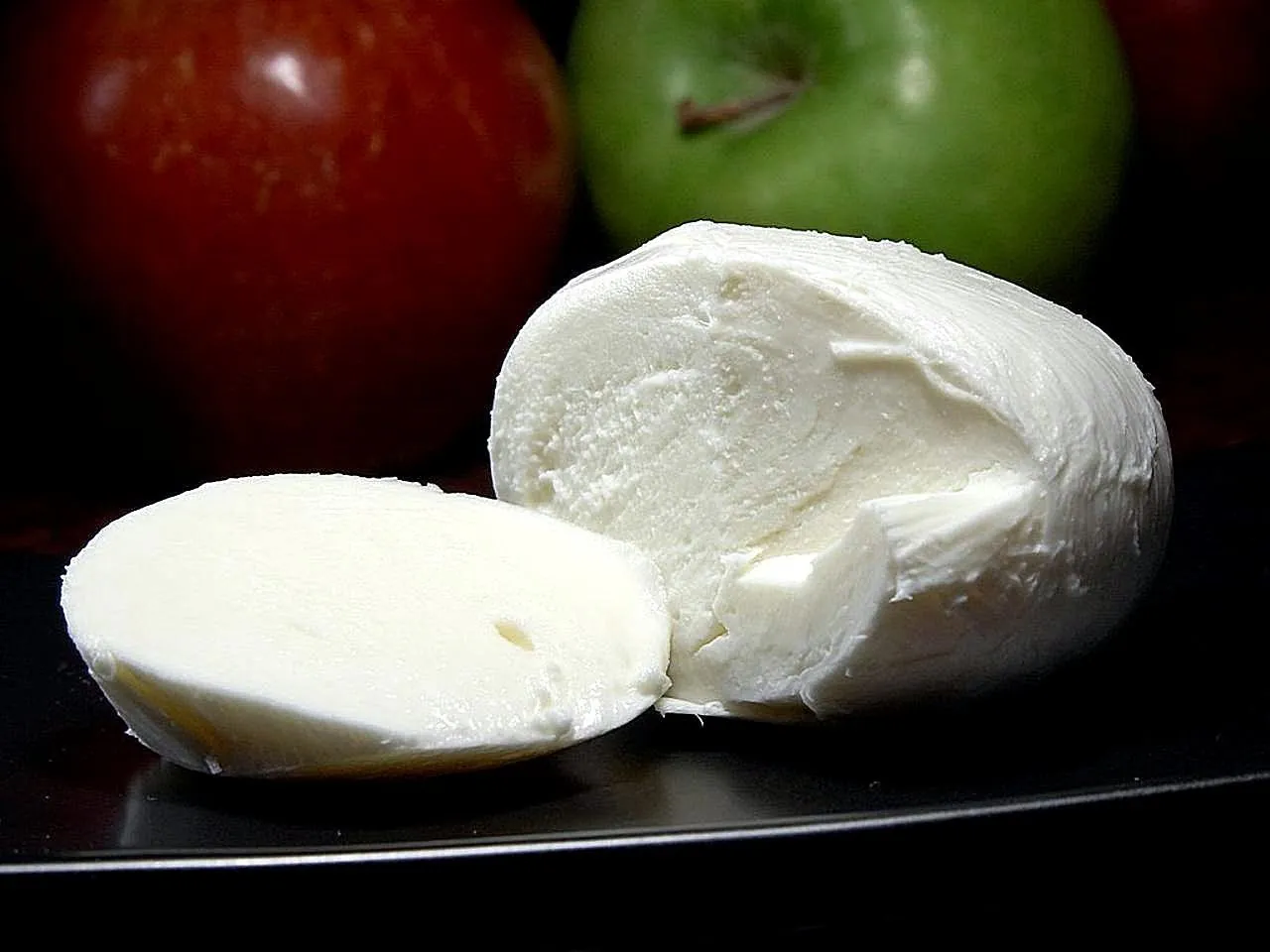
It is sold submerged in its own liquid, and it is the cheese for caprese, not for a long bake.
The classic version comes from water buffalo milk in southern Italy. Today most of what US shoppers find in the tub is made from cow's milk, which Italians call fior di latte, and the two taste differently: buffalo is richer and a little tangy, cow is milder and milkier.
Fresh mozzarella at a glance
Here is fresh mozzarella at a glance, as the cheese is sold in the US and Italy.
| Detail | Fresh mozzarella |
|---|---|
| Milk | Water buffalo (traditional); cow's milk in most US tubs |
| Style | Pasta filata (stretched curd), no rind, packed in liquid |
| Protected name | Mozzarella di Bufala Campana, PDO since June 1996 |
| Age | None: eat within days |
| Texture | Soft, springy, moist |
| Flavor | Milky, sweet, faintly lactic |
Where fresh mozzarella comes from
Fresh mozzarella is a southern Italian cheese, and its best-known form, Mozzarella di Bufala Campana, was the first mozzarella-type cheese to gain a protected name, in June 1996. It is made in Campania, especially around Caserta and Salerno, and the producers' consortium describes it as the only mozzarella made exclusively from buffalo milk to hold PDO status. Its rules call for fresh buffalo milk worked within 60 hours.
Only the buffalo cheese from that area may carry the name. Fresh mozzarella made from cow's milk, in Italy or the US, is a different product, and the guide to PDO and PGI labels explains what the seal does and does not promise.
How fresh mozzarella is made
Fresh mozzarella is made by letting a rennet-set curd sour until it can stretch, then working it in very hot water into a smooth ball. A study of the PDO process describes warmed milk set with calf rennet and a whey starter, then about 4 to 4.5 hours of curd ripening until the pH reaches roughly 4.8 to 4.9. At that point the curd stretches under water at about 90 to 95°C (194 to 203°F).
The cheese is shaped into balls, firmed in fresh water and brined. That short salting is why the finished cheese tastes so mild. The same stretch step makes low-moisture mozzarella; the difference is how much whey stays in the curd. The types of mozzarella page lays out fresh, low-moisture and buffalo side by side.
What fresh mozzarella tastes like
Fresh mozzarella tastes milky and faintly sweet, with a light lactic tang and a springy, squeaky bite that gives way to wet, tender layers. It is deliberately gentle, so it shows off whatever sits next to it: ripe tomato, good olive oil, salt.
Wisconsin's cheesemakers describe it as having a softer, moister texture and creamier taste than pizza-style mozzarella. Buffalo versions run richer and tangier.
How to buy fresh mozzarella in the US
Buying fresh mozzarella starts with the liquid and the date: choose a tub with plenty of brine, a firm white ball and the freshest date you can find. A soft, slimy or sour-smelling ball has gone past its best.
Sizes tell you the use. Cherry-size ciliegine and bite-size bocconcini suit salads and skewers; a large ball suits slicing. Check the milk on the label, since "mozzarella di bufala" in the US may be imported or domestic, and only the Campania cheese is PDO. If you are pregnant, check that the label says pasteurized, as FDA guidance advises against unpasteurized cheese.
How to serve and cook with fresh mozzarella
Serve fresh mozzarella torn rather than cut, at cool room temperature, with salt and olive oil. Pull it out of the fridge about 20 minutes ahead so the flavor wakes up. Torn edges also catch the dressing better than a clean slice.
For heat, add it late. Fresh mozzarella holds more water than a pizza block, so tear it, drain it on paper towels for about 30 minutes, and put it on a pizza for the last few minutes or in a very hot oven. For lasagna and long bakes, low-moisture mozzarella behaves better.
What to serve with fresh mozzarella
What to serve with fresh mozzarella comes down to sweet fruit, basil and a crisp white; the pairing guide covers other cheeses. For the plate, tomato, peach and fig all work, plus basil, olive oil and flaky salt.
For wine, Pinot Grigio, Vermentino and Frascati suit its softness. For beer, a pilsner, wheat beer or helles keeps things light. Skip big reds, which flatten a cheese this mild.
Substitutes for fresh mozzarella
The best substitutes for fresh mozzarella depend on the dish; the substitute finder lists more. For a salad, burrata is the richest swap, since it is mozzarella curd around cream. Chevre gives a tangier, crumblier result, and feta brings salt and a firmer bite.
For cooking, a block of low-moisture mozzarella melts more reliably than any of those.
How to store fresh mozzarella
Store fresh mozzarella in its liquid in the fridge and eat it within a day or two of opening. Wisconsin cheesemakers say it should stay submerged until it is eaten. If the liquid is gone, make a light brine of salt and water. Freezing breaks the texture, so use freezing only for cooked dishes. The storing cheese guide covers wraps for other styles.
What most fresh mozzarella advice gets wrong
Most fresh mozzarella advice assumes every ball is the same cheese, and the details change how you use it.
Buffalo and cow's milk cheeses are not interchangeable: the PDO buffalo cheese is tangier and costs more, so save it for eating raw. Cold also dulls fresh mozzarella, so a ball straight from the fridge tastes of little. And do not rinse the brine down the sink before you are ready, because the ball dries and toughens quickly once it is out.
Questions about fresh mozzarella
These are the questions about fresh mozzarella that come up most.
Is fresh mozzarella made from buffalo or cow's milk?
Fresh mozzarella was traditionally made from water buffalo milk, but today it is mostly made from cow's milk, as Wisconsin cheesemakers note. The PDO name is reserved for the buffalo cheese from Campania and nearby areas.
How long does fresh mozzarella last?
Fresh mozzarella is best eaten within a day or two of making, and an opened tub should be finished in a day or two. Keep it in its liquid and check the date.
What is the difference between fresh and low-moisture mozzarella?
Fresh mozzarella is soft, wet and mild, while low-moisture mozzarella is a firm block that melts evenly on pizza. The difference comes down to how much water stays in the curd, and low-moisture keeps far less.
Can you melt fresh mozzarella?
Fresh mozzarella melts, but it releases water, so drain it first and add it late. For a long bake, use low-moisture mozzarella.
Your next fresh mozzarella
For your next fresh mozzarella, buy one ball with a close date, tear it over ripe tomatoes with basil, olive oil and salt, and eat it the same day. Try the buffalo version once to taste the difference.
Sources
- The microbiota of Mozzarella di Bufala Campana PDO cheese: a study across the manufacturing process, Frontiers via PubMed Central
- Mozzarella di Bufala Campana DOP, Consorzio di tutela Mozzarella di Bufala Campana DOP
- Fresh Mozzarella, Dairy Farmers of Wisconsin