
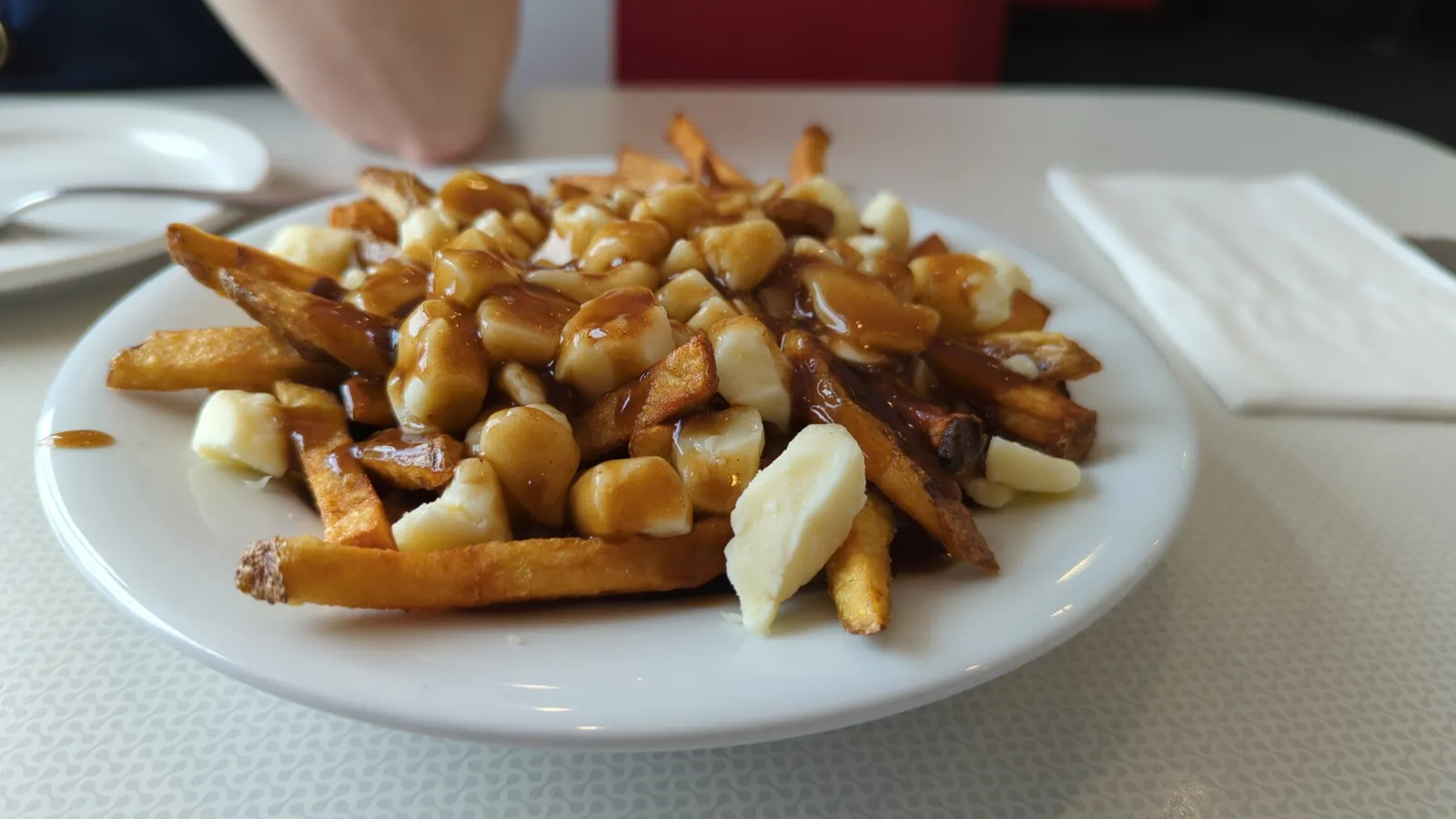
Buy curds made within a day or two, and pour the gravy hot but not bubbling, so the curds go soft at the edges and stay whole in the middle.
Freshness decides almost everything. A fresh curd squeaks because its proteins are still tightly bound, and that same tight structure lets it soften in hot gravy without dissolving into it.
What cheese curds are
Cheese curds are fresh pieces of young cheese, usually cheddar, sold before the curd is pressed into a block and aged. In the federal standard for cheddar, the curd is matted, cut into slabs that are piled to drain and sour, cut into pieces and salted, and only then pressed into forms; curds are those salted pieces, bagged instead of pressed. John Lucey, director of the University of Wisconsin's Center for Dairy Research (CDR), describes plain fresh curds as mild: salty, because they have just been salted, with some acidity and fresh milky notes. The texture is the point.
| Feature | Cheese curds |
|---|---|
| Milk | Cow's milk, pasteurized in US stores |
| Style | Fresh cheddar curd, salted, never pressed or aged |
| Flavor | Mild, salty, a little tangy, milky |
| Texture | Springy, squeaky when fresh |
| Color | White, or orange when color is added |
| Best eaten | The day they are made; some squeak lasts up to 10 days |
| Where in the US | Mostly the Midwest |
Why fresh cheese curds squeak
Fresh cheese curds squeak because their protein network is still bound tightly together and springy. Lucey describes one theory, the stick-slip effect: your teeth compress the curd, its tightly linked proteins resist, then the matrix gives way and releases the stored energy as a squeak. As curds age, moisture shifts, calcium leaves the proteins and enzymes start to break them down, so the curd softens. Lucey puts the loss of squeak mostly on those calcium-protein changes.
A later CDR study, reported in UW-Madison's Grow magazine, found that rising protein breakdown from milk enzymes and leftover rennet lowered measured squeakiness, and that curds usually lose the squeak within a few days to a couple of weeks, depending on how they are stored and served. To make it last, the team borrowed from Finland's squeaky bread cheese, which is never acidified and is baked after it is made.
How to buy cheese curds in the US
Buying cheese curds in the US is easy in the Midwest and harder almost everywhere else. Lucey notes that national sales of natural cheese curds grew to about $52 million in 2021, yet fresh curds are still bought mostly in the Midwest. Wisconsin's many local cheese plants keep curds fresh there, he writes, which isn't the case in most parts of the country.
Check the date. For the best flavor and the most squeak, Lucey says, curds should be eaten the day they are made, though some squeak can last up to 10 days. Buy the newest bag and give it a gentle squeeze: fresh curds feel springy, old ones soft.
Expect pasteurized milk. Under the federal cheddar standard, cheddar made from unpasteurized milk must be cured at least 60 days at 35°F or warmer, and curds are sold within days of making.
Ignore the color. Coloring is an optional ingredient in cheddar, so orange curds are simply white curds with color added.
Shop smart outside the Midwest. Ask cheese counters what day their curds were made, or order straight from a maker with overnight shipping. Wisconsin's cheesemakers are the obvious place to look, and Quebec's curd tradition is covered in Canadian cheese.
Freeze extras right away. Lucey reports that preliminary CDR trials suggest freezing curds while they are still fresh may extend the squeak.
Classic poutine recipe
This classic poutine recipe serves 4 and takes about 1 3/4 hours, an hour of it spent soaking the potatoes. You need a heavy Dutch oven, a deep-fry thermometer and about 2 quarts of oil.
Fries
- 2 pounds (900 g) russet potatoes, about 4 medium, scrubbed
- 2 quarts (1.9 L) peanut or canola oil
- Kosher salt
Gravy
- 3 tablespoons unsalted butter
- 1 garlic clove, minced
- 3 tablespoons all-purpose flour
- 1 1/2 cups (360 ml) beef broth
- 1 cup (240 ml) chicken broth
- 1 teaspoon cider vinegar or Worcestershire sauce
- 1/4 teaspoon black pepper
Curds
- 10 to 12 ounces (280 to 340 g) fresh cheddar cheese curds
Method
- Cut the potatoes into 3/8-inch sticks, skin on or off. Cover them with cold water and soak for 1 hour, then drain and dry them thoroughly on towels.
- Take the curds out of the refrigerator 30 to 60 minutes before serving and break any large ones into bite-size pieces. USDA's food-safety agency advises discarding perishable food left out more than 2 hours, so don't set them out sooner.
- For the gravy, melt the butter in a saucepan over medium heat and cook the garlic for 30 seconds. Whisk in the flour and cook, whisking, until it smells nutty and turns light brown, 2 to 3 minutes. Slowly whisk in both broths, add the vinegar and pepper, and simmer until the gravy coats a spoon and reduces to about 2 cups, 8 to 10 minutes. Season with salt and keep it warm over the lowest heat.
- Heat the oil in the Dutch oven to 325°F (165°C). Fry the potatoes in 3 batches until limp and pale but not browned, 5 to 6 minutes each, and drain them on a rack. Let the oil come back to temperature between batches.
- Heat the oil to 375°F (190°C) and fry the potatoes again in batches until deep golden and crisp, 3 to 4 minutes. Drain and salt them right away.
- Bring the gravy back to a simmer, then take it off the heat for a minute. Pile the fries into four shallow bowls, scatter the curds over them, tucking a few between the fries, and ladle about 1/2 cup of gravy over each bowl. Serve immediately.
No deep fryer? Toss the potato sticks with 3 tablespoons of oil and roast them on a sheet pan at 450°F (230°C) for 30 to 35 minutes, turning once, or bake a 2-pound bag of frozen fries a few minutes past the package time so they hold up under gravy.
How to keep cheese curds from melting into the gravy
To keep cheese curds from melting into the gravy, manage how fresh the curds are, how warm they are and how hot the gravy is. The target is curds that, in the words of the Serious Eats poutine recipe, are "soft and slightly (but not fully) melted."
Fresh curds hold together better. Very young cheese melts less. The University of Wisconsin's Center for Dairy Research explains that in the first several days after a cheese is made, calcium is still leaving its protein network, and that loss is the main reason young cheese gains melt and stretch. The springy, tightly bound protein that makes a fresh curd squeak also keeps it in one piece under hot gravy; a soft, week-old curd gives way much sooner.
Room temperature, not cold. Serious Eats explains that curds at room temperature soften from the heat of the fries and gravy alone. Cold curds stay rubbery and chill the gravy, which tempts you to pour it hotter.
Hot gravy, not boiling gravy. The same recipe says the gravy should be hot enough to soften the curds but not so hot that it melts them completely, and to let it cool a little if it would burn your tongue. A minute off the heat after it simmers does the job.
Whole curds, never shreds. Bite-size curds keep a firm center while their edges soften, but shredded cheese melts straight into the gravy, which is how disco fries end up under a blanket of mozzarella.
Assemble at the last second, with a light hand. About 1/2 cup of gravy per bowl coats everything without drowning the curds, and the fries stay crisp longer.
Questions about poutine and cheese curds
Here are short answers to common questions about poutine and cheese curds.
What kind of cheese curds do you use for poutine?
Poutine uses fresh cheddar cheese curds, white or orange, ideally made within a day or two. The Canadian Encyclopedia notes that purists consider authentic poutine to be the one made with squeaky curds like those produced where the dish began.
How do you make cheese curds for poutine at home?
Making cheese curds for poutine at home takes an afternoon and three supplies: mesophilic culture, calcium chloride and rennet. In the Serious Eats method, milk is held at 90°F (32°C) with the culture for an hour, set with rennet, cut, cooked up to 102°F (39°C) and drained, then left to knit and cheddar for about 2 hours before being broken into bite-size pieces and salted; how cheese is made walks through each stage.
What do Americans call poutine?
The closest American version of poutine is disco fries. The Canadian Encyclopedia says the dish had reached New York and New Jersey by the 1970s under that name, made with shredded mozzarella instead of cheddar curds.
Where does poutine come from?
Poutine comes from rural Quebec, where it first appeared in snack bars in the late 1950s, and several towns claim it. Fernand Lachance of Warwick said he first added curds to fries in 1957 and began pouring gravy over them in 1963, while Jean-Paul Roy claimed he invented the dish at his Drummondville drive-in in 1964. In Quebec slang, poutine means a mess.
How do you bring the squeak back to cheese curds?
To bring the squeak back to cheese curds, warm them briefly in the microwave; Lucey writes that curds up to two weeks old can regain their squeak that way. Start with a few seconds for a handful.
What can you substitute for cheese curds in poutine?
The best substitute for cheese curds in poutine is a young white cheddar or low-moisture mozzarella cut or torn into 1/2-inch pieces. Neither squeaks, and both melt faster than fresh curds, so pour the gravy a little cooler; the guide to what makes cheese melt explains why.
Make poutine the day you buy the curds
Make poutine the day you buy the curds, and plan the rest of the cooking around them. Ask the counter when they were made, set them out while the potatoes soak, and have the gravy ready before the second fry. If a curd squeaks when you taste it at the store, most of the work is done.
Sources
- Can the Dairy Industry Extend the Squeakiness of Fresh Cheese Curds? (October 21, 2022), John A. Lucey, Center for Dairy Research, in Dairy Foods
- And the Squeak Goes On (Spring 2025), Grow magazine, University of Wisconsin-Madison College of Agricultural and Life Sciences
- The Melt and Stretch of Cheese, Dairy Pipeline, Winter 2000, University of Wisconsin Center for Dairy Research
- The Ultimate Poutine, Serious Eats
- Poutine, The Canadian Encyclopedia
- 21 CFR 133.113, Cheddar cheese, eCFR (FDA standards of identity)
- A Safer Way to Host Mother's Day Brunch (May 7, 2026), USDA Food Safety and Inspection Service