
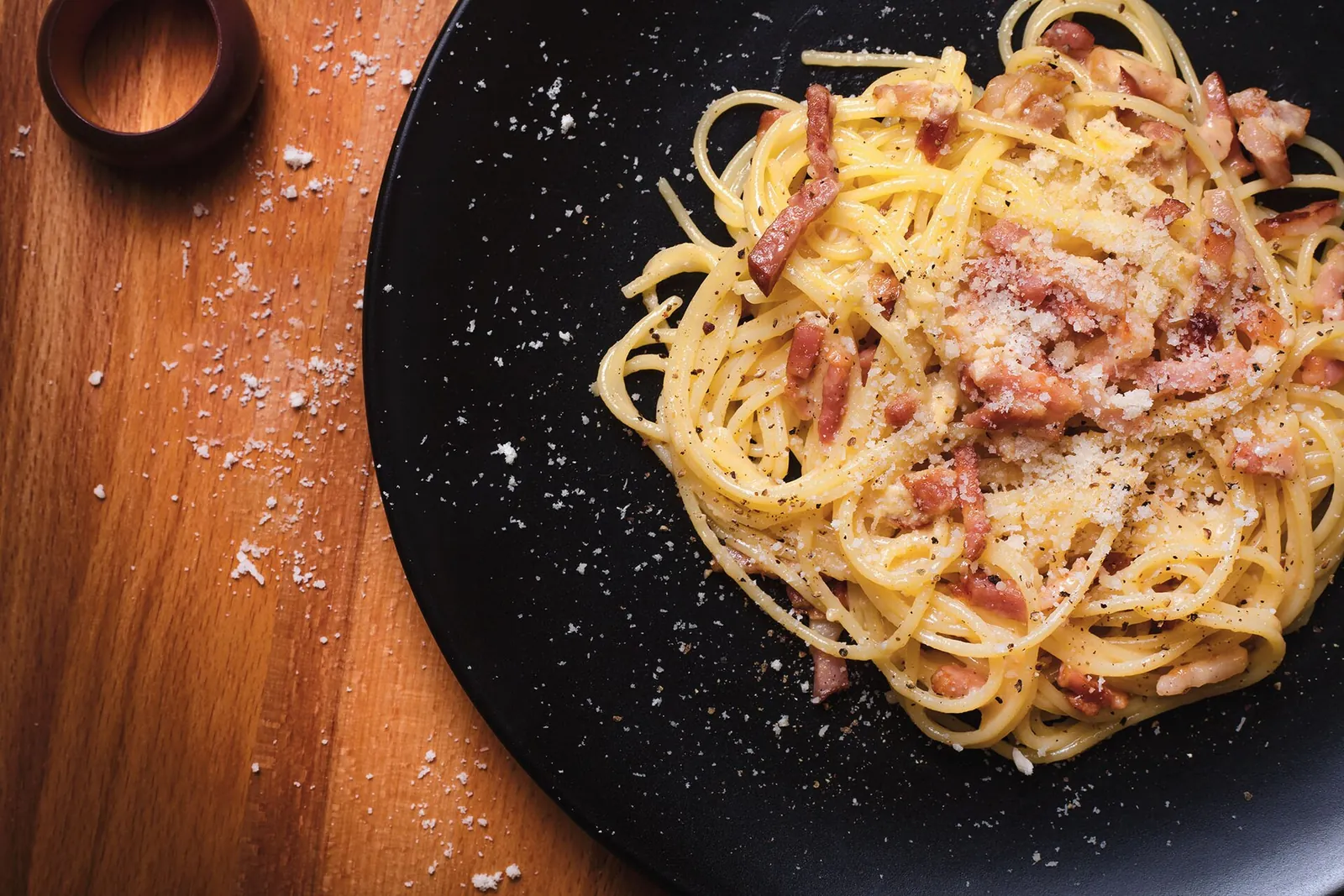
Cream is not part of the classic dish.
Two things decide whether it works: heat and cheese. Too much heat turns the eggs into scrambled bits, while the right amount leaves a glossy sauce that coats every strand. The cheese choice, Pecorino or Parmesan, sets how salty and sharp the finished plate tastes.
Carbonara at a glance
This carbonara table lists the planning numbers and the egg-safety note.
| Yield | 4 servings |
| Active and total time | 30 minutes active and total |
| Pan | Wide skillet, medium-low for the pork, then off the heat |
| Best cheese | Pecorino Romano, or half Pecorino and half Parmigiano-Reggiano |
| Eggs | Pasteurized, because the sauce is not cooked to a safe temperature |
| Make-ahead | No: serve at once |
How to make carbonara
This carbonara recipe cooks the pork first and mixes the egg sauce in a bowl, so nothing scrambles in the pan.
Ingredients for carbonara
These are the ingredients for carbonara, enough for four.
- 12 oz (340 g) spaghetti or rigatoni
- 5 oz (140 g) guanciale, cut into short strips
- 3 large pasteurized whole eggs
- 3 large pasteurized egg yolks
- 3 oz (85 g) Pecorino Romano, finely grated
- 2 teaspoons freshly cracked black pepper
- 1 teaspoon kosher salt, for the pasta water
- 3 quarts (about 3 L) water
Steps for making carbonara
These steps for making carbonara keep the egg sauce away from direct heat.
- Bring the water to a boil with the salt, which is a light amount because the pork and cheese are both salty.
- Put the guanciale in a cold wide skillet and cook over medium-low heat for 10 to 12 minutes, until the fat is clear and the pieces are golden and crisp at the edges.
- Whisk the whole eggs, yolks, Pecorino and pepper in a bowl into a thick paste.
- Cook the pasta until just al dente, scoop out 1 cup (240 ml) of the water, and drain.
- Take the skillet off the heat and let it sit for 1 minute, then add the drained pasta and toss in the pork fat for 30 seconds.
- Stir 1/4 cup (60 ml) hot pasta water into the egg paste to temper it, then pour it over the pasta.
- Toss and stir constantly for 1 minute, adding more pasta water a splash at a time, until the sauce is thick, pale gold and silky, with no visible scrambled bits.
- Serve at once in warm bowls with extra Pecorino and pepper.
Carbonara and raw eggs: the safety note
Carbonara and raw eggs go together in the traditional method, and the pasta's heat only partly cooks them. USDA FSIS advises using pasteurized eggs or egg products in recipes that call for raw or undercooked eggs. Pasteurization destroys Salmonella without cooking the egg or changing its flavor, and pasteurized shell eggs are sold at some grocery stores.
FSIS also gives 160°F (71°C) as the safe minimum for egg dishes, so a carbonara sauce made the traditional way is not cooked to that point. To reach it, stir the sauce over low heat until it reads 160°F on a thermometer, which risks a thicker, more scrambled texture. People who are pregnant, older or have weakened immune systems should use pasteurized eggs or cook the sauce through.
The best cheese for carbonara
The best cheese for carbonara is Pecorino Romano, a salty sheep's milk cheese aged at least 5 months, which gives the dish its sharp, tangy edge. Many cooks use Parmigiano-Reggiano for a rounder, nuttier plate, or a blend of the two. For the full comparison, see Parmesan vs Pecorino Romano.
Pecorino carries more salt than Parmesan, so a pecorino-only carbonara needs the lightest salting of the pasta water. A half-and-half blend is a good starting point for first-timers. Grate the cheese yourself and keep it fine, since pre-shredded cheese holds anti-caking starch and melts less smoothly.
Carbonara mistakes and fixes
Carbonara mistakes almost always come down to heat. Scrambled eggs mean the pan or the pasta water was too hot when the eggs went in, so take the skillet off the burner and let the pasta cool for a minute first.
- Sauce too thin. Not enough cheese or too much pasta water. Toss 30 seconds longer and add cheese by the spoonful.
- Sauce stiff and clumped. Too little water. Add a splash of hot pasta water and stir.
- Greasy plate. Too much rendered fat. Leave about 2 tablespoons in the pan and spoon off the rest.
- Cream. Skip it. It masks the eggs and cheese, and the classic dish has none.
Carbonara variations
Carbonara variations swap the pork or the pasta, not the method. Pancetta is the common substitute for guanciale, and thick-cut bacon works if you pour off extra fat, though smoke changes the flavor. Rigatoni holds the sauce in its ridges as well as spaghetti does.
Carbonara leftovers and storage
Carbonara leftovers are better skipped, because the egg sauce sets and turns grainy. Dishes with raw egg should be cooked right away or refrigerated and cooked within 24 hours, per FSIS. If any pasta is left, FSIS says to refrigerate it within 2 hours and eat it within 3 to 4 days, and the egg guidance above explains why to cook it through before eating.
Questions about carbonara
These questions about carbonara cover the cheese, the cream and the eggs.
Pecorino or Parmesan for carbonara?
Pecorino Romano is the traditional cheese for carbonara and gives the sharpest flavor. Parmigiano-Reggiano or a half-and-half blend gives a milder, nuttier result.
Is there cream in carbonara?
Carbonara has no cream in the classic recipe. The sauce is eggs, cheese, pork fat and pasta water.
Is carbonara safe with raw eggs?
Carbonara with raw eggs carries a Salmonella risk, so USDA FSIS advises pasteurized eggs for any recipe that uses eggs raw or undercooked.
How to stop carbonara from scrambling?
Carbonara scrambles when the pan is too hot, so take it off the heat, wait a minute, and toss the pasta with the egg paste and a splash of pasta water.
Is bacon a good swap in carbonara?
Bacon works in carbonara as a substitute, though it adds smoke and less rich fat. Pancetta is the closer swap for guanciale.
Make carbonara tonight
Make carbonara tonight with the plan that matters: it comes down to pasteurized eggs, fine Pecorino and a pan off the heat. The Italian cheese guide covers the other Roman cheeses if you want to cook further.
Sources
- Egg Products and Food Safety, USDA Food Safety and Inspection Service
- Leftovers and Food Safety, USDA Food Safety and Inspection Service
- Pecorino Romano PDO single document, European Commission