
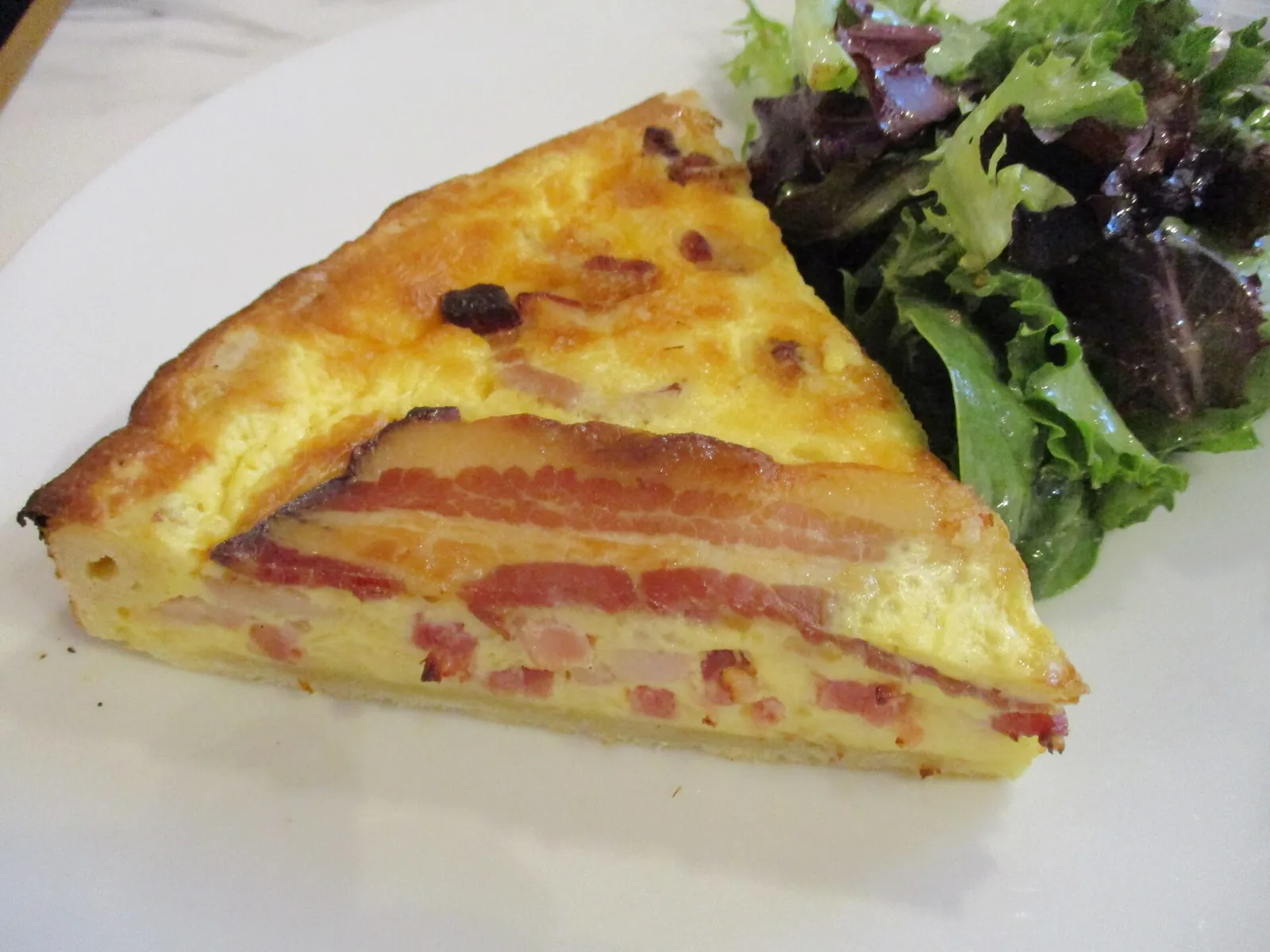
It works because a small amount of egg sets a lot of cream into something silky, and because a cheese that melts cleanly adds salt and nuttiness without turning the custard greasy.
Two things decide whether it comes out well: the ratio of egg to dairy, and a crust that was baked before the filling went in. Get those right and the rest is seasoning.
Quiche at a glance
This quiche at a glance table gives the numbers before the recipe.
| Cheese quiche Lorraine | |
|---|---|
| Yield | 6 servings from a 9-inch pan |
| Active time | 30 minutes |
| Total time | About 1 hour 30 minutes, plus cooling |
| Oven temperature | 375°F for the crust, 350°F for the filling |
| Best cheese | Gruyère, 4 oz (115 g) |
| Doneness | 160°F in the center |
| Make ahead | Bake a day ahead, or blind-bake the crust 2 days ahead |
How to make quiche
This quiche recipe uses a standard 9-inch (23 cm) tart pan or pie plate about 1 1/2 inches deep, and a pastry you make or buy.
Ingredients for quiche
The ingredients for quiche below make one 9-inch quiche that serves six as a main dish with a salad.
- 1 sheet (9-inch) unbaked pie or tart pastry, homemade or store-bought
- 6 slices (about 5 oz or 140 g) thick-cut bacon, cut into 1/2-inch pieces
- 1 small onion or 2 shallots, finely chopped
- 4 oz (115 g) Gruyère, coarsely grated
- 1 oz (28 g) Parmigiano-Reggiano, finely grated
- 3 large eggs
- 1 cup (240 ml) heavy cream
- 1/2 cup (120 ml) whole milk
- 1/2 teaspoon kosher salt
- 1/4 teaspoon black pepper
- 1/8 teaspoon freshly grated nutmeg
- 1 egg yolk, beaten, for sealing the crust
Steps for making quiche
These steps for making quiche start with the crust, since the shell has to be baked and sealed before any custard goes in.
- Heat the oven to 375°F (190°C), fit the pastry into the pan, trim the edge, and chill it for 20 minutes so it holds its shape.
- Line the shell with parchment, fill it with pie weights or dried beans, and bake 18 to 20 minutes until the rim looks set and dry.
- Lift out the parchment and weights, brush the bottom and sides with the beaten yolk, and bake 4 to 5 more minutes until the base is pale gold and no longer shiny. Lower the oven to 350°F (175°C).
- Cook the bacon in a skillet over medium heat for 8 to 10 minutes until browned and crisp, then lift it out onto paper towels.
- Pour off all but 1 tablespoon of fat, cook the onion for 5 minutes until soft and translucent, and let it cool for 5 minutes.
- Scatter the bacon, onion and both cheeses evenly over the base of the shell, saving a small handful of Gruyère for the top.
- Whisk the eggs, cream, milk, salt, pepper and nutmeg just until blended with no streaks of white, without beating in foam.
- Set the pan on a baking sheet, pour in the custard, and sprinkle the reserved Gruyère on top.
- Bake 35 to 40 minutes until the top is golden, the edges are set and the center barely jiggles, and an instant-read thermometer in the center reads 160°F (71°C).
- Cool on a rack for at least 15 minutes, then slice and serve warm or at room temperature.
The best cheese for quiche
The best cheese for quiche is Gruyère, because it melts into a smooth custard instead of pooling as oil. The Gruyère page covers the Swiss rules and ages; for a quiche, a Classic wheel aged 6 to 9 months is the one to buy, since it is milder and melts more smoothly than an older Réserve.
Comté is the nearest substitute and tastes a little sweeter and more savory (Comté is a French cousin from the same Alpine tradition). Emmental or ordinary Swiss gives a milder, stretchier result, and Swiss, Gruyère and Emmental lays out how they differ. A small amount of Parmigiano-Reggiano, as in the recipe, adds salt and depth without adding much moisture.
Cheese is also a source of water and fat, which is why the weight matters. About 4 to 5 oz (115 to 140 g) per 9-inch quiche is plenty. Much more and the custard turns heavy and weeps oil, and very wet cheeses such as fresh mozzarella release water into the filling. For the cheeses that melt best in general, see the best melting cheeses. Shredding from a block also matters: the shredding guide explains why.
The custard ratio for quiche
The custard ratio for quiche is about 1 large egg for every 1/2 cup (120 ml) of dairy, and the recipe above uses 3 eggs for 1 1/2 cups. Eggs set the custard, and cream makes it tender. More egg gives a firm, bouncy, almost rubbery slice. Less leaves it soft and prone to collapse when cut.
Heavy cream with some whole milk gives a rich filling that still slices cleanly. All cream is richer but heavier, and all milk is leaner and more fragile. Whisk until combined rather than frothy, because foam rises in the oven and then sinks into a pocked, spongy top.
Quiche mistakes and fixes
Quiche mistakes mostly come down to water, heat and timing, and each one has a fix.
- A soggy bottom comes from skipping the blind bake. Bake the shell with weights, seal it with egg yolk, and pour the custard into a warm shell.
- A weeping, watery filling comes from raw vegetables. Mushrooms, spinach, zucchini and tomatoes hold a lot of water, so cook them until dry and cool them first.
- A rubbery or curdled custard comes from too much heat or too long in the oven. Pull it as soon as the center reads 160°F.
- A greasy top comes from too much cheese or an aged, oily one. Stay near 4 to 5 oz.
- A cracked surface comes from a very hot oven. Keep it at 350°F.
The egg is the reason for the temperature. USDA's Food Safety and Inspection Service says casseroles and other egg dishes should reach a safe minimum internal temperature of 160°F, measured with a food thermometer. Judging by a wobble alone is not a safety check, so use the thermometer once, in the center.
Quiche variations
Quiche variations follow the same ratio, so swap the filling and keep the custard.
- Spinach and goat cheese: wilt 10 oz (280 g) of spinach, squeeze it very dry, and use 4 oz (115 g) of chèvre in place of the Gruyère and bacon.
- Cheddar and leek: soften 2 sliced leeks in butter and use sharp cheddar.
- Mushroom and Gruyère: brown 8 oz (225 g) of sliced mushrooms until their liquid cooks off.
- Crustless: grease the pan well, skip the pastry, and bake 25 to 30 minutes.
For a smaller, free-form relative with a puff pastry base and no custard, see savory cheese tarts. For a lighter egg-and-cheese dish that rises, try a cheese soufflé.
Making quiche ahead, storing and reheating
Making quiche ahead works well because it is good warm or at room temperature. Bake it a day early, cool it, and refrigerate it. Per the same FSIS guidance, egg dishes such as quiche may be refrigerated for later but should be reheated to 165°F before serving. Reheat slices on a baking sheet in a 325°F (165°C) oven for 15 to 20 minutes, which keeps the crust crisp better than a microwave.
Put leftovers in the refrigerator within 2 hours of baking and eat them within 3 to 4 days. To freeze, wrap whole cooled quiche tightly and thaw it overnight in the refrigerator; the custard can lose some texture, as the freezing cheese guide describes for cheese itself.
Questions about quiche
These questions about quiche cover the usual troubles with cheese, crust and doneness.
Does quiche Lorraine have cheese?
Quiche Lorraine is usually made today with cheese, most often Gruyère, along with bacon and a cream custard. Some cooks hold that the original had no cheese, so a version without it is also a fair quiche Lorraine.
What cheese is best for quiche?
The best cheese for quiche is Gruyère, with Comté, Swiss or sharp cheddar as good alternatives. Choose a cheese that melts smoothly and use only 4 to 5 oz for a 9-inch pan.
Is blind-baking the crust for quiche necessary?
Blind-baking the crust for quiche is worth doing, since it dries the base before the wet custard goes in. Skipping it is the main cause of a pale, soggy bottom.
How can you tell when quiche is done?
Quiche is done when the center reads 160°F on an instant-read thermometer, the edges are set and the middle barely jiggles. It continues to firm up as it cools.
Can quiche be made without a crust?
Quiche without a crust works if you grease the pan well and bake it 25 to 30 minutes at 350°F. The center still needs to reach 160°F.
Why is quiche watery?
A watery quiche usually comes from raw vegetables, frozen spinach that was not squeezed dry, or an underbaked custard. Cook and drain the filling first, then bake to 160°F.
Quiche takeaways
Quiche takeaways: quiche comes down to a ratio and a crust: 1 egg to 1/2 cup of dairy, 4 to 5 oz of Gruyère, a shell baked before filling, and a thermometer reading of 160°F. Start with the Lorraine recipe above, then change the filling once you have the custard down.
Sources
- Safe Minimum Internal Temperature Chart, USDA Food Safety and Inspection Service
- Shell Eggs from Farm to Table, USDA Food Safety and Inspection Service
- What You Need to Know About Egg Safety, U.S. Food and Drug Administration