
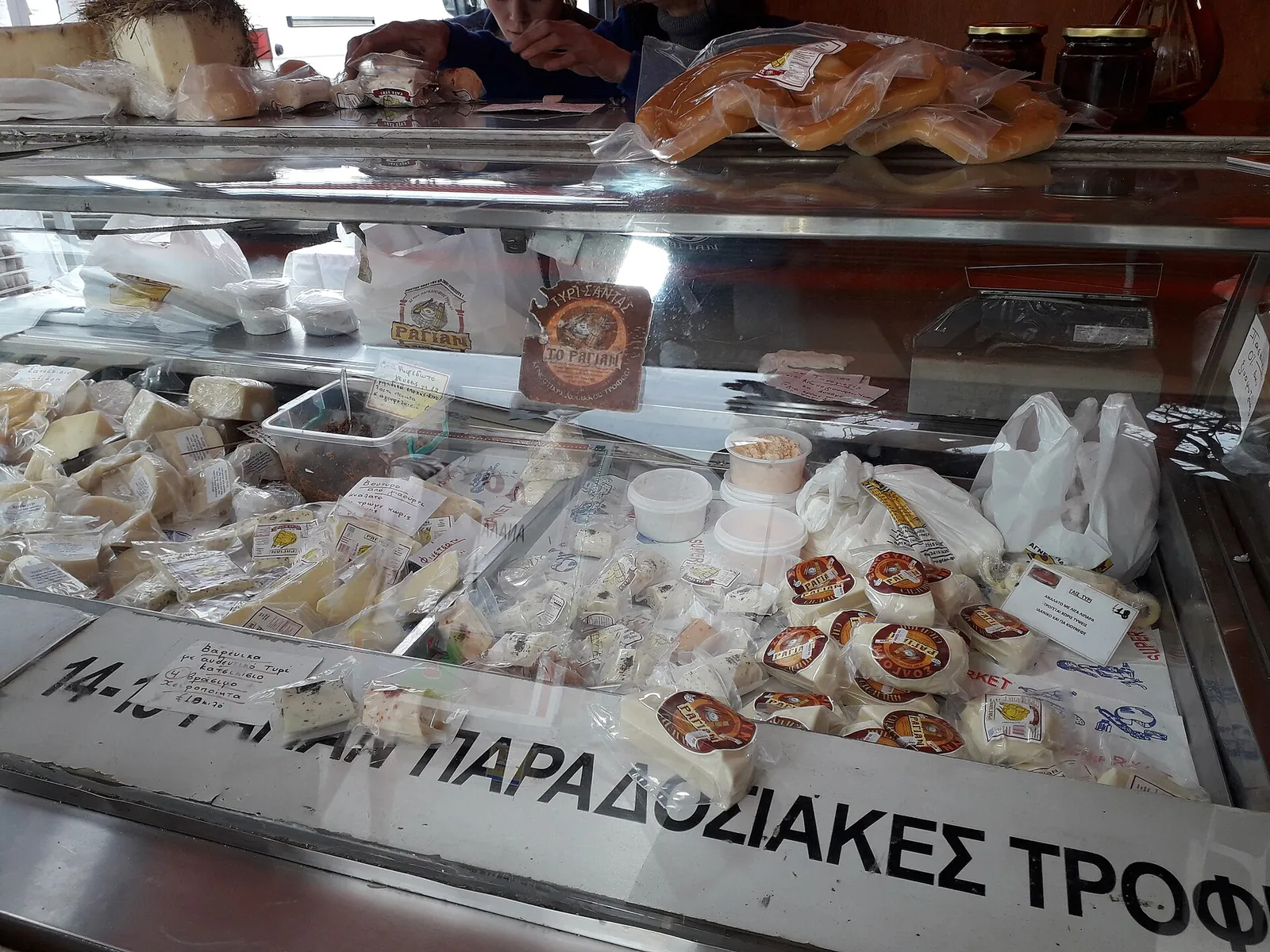
Most are made from sheep's or goat's milk, and several carry an EU protected name, so the label tells you more than the shape does.
Knowing the group tells you what to do with the cheese. Salty and crumbly goes in a salad, firm and high-melting goes in a hot pan, and soft and sweet goes with honey. The sections below follow that order, and the Greece country page lists the cheeses in the site directory.
Greek cheeses at a glance
This table of Greek cheeses sums up milk, texture, protection and best use.
| Cheese | Milk | Texture | Protected name | Try it with |
|---|---|---|---|---|
| Feta | Sheep, or sheep with up to 30% goat | Soft, crumbly, brined | EU PDO | Tomato, cucumber, olive oil |
| Graviera | Sheep (Crete); mostly cow (Naxos) | Hard, nutty | Kritis, Naxou and Agrafon PDOs | Fried as saganaki, on a board |
| Kefalotyri | Sheep, goat or both | Very hard, salty | Not protected | Grated, fried, in pies |
| Kefalograviera | Sheep, or sheep and goat | Hard, salty | PDO | Saganaki, grated on pasta |
| Kasseri | Sheep, up to 20% goat | Semi-hard, springy | PDO | Melted, fried, in sandwiches |
| Manouri | Sheep or goat whey, with cream | Semi-soft, creamy | PDO | Honey, fruit, pastries |
| Mizithra | Sheep or goat whey and milk | Soft fresh, or hard aged | None confirmed here | Honey fresh; grated aged on pasta |
Feta, the brined Greek cheese
Feta is the brined Greek cheese that anchors the table, and in the EU only Greek cheese made to the PDO rules may use the name. Real feta is sheep's milk, or sheep's milk with up to 30 percent goat's milk, cured at least two months in brine and registered as a PDO in 2002.
The rules do not carry over to the US, where a tub of feta can be cow's milk. If you want the Greek original, read the label for sheep's milk and the PDO seal, and check the milk.
Hard Greek cheeses: graviera, kefalotyri and kefalograviera
Hard Greek cheeses are the ones you grate or fry, and graviera is the one to know first. Graviera takes its name from Gruyère, and three versions hold PDO status: Kritis from Crete, Naxou from Naxos and Agrafon from the Agrafa mountains. The Cretan cheese is sheep's milk with a faintly sweet, caramel edge. The Naxos cheese is mostly cow's milk.
Kefalotyri is a hard, salty white cheese of sheep's or goat's milk, ripened two to three months when young and a year or more when aged, and the name combines the Greek words for head and cheese. See the kefalotyri profile. Kefalograviera is a similar PDO cheese, from Western Macedonia, Epirus and nearby areas, and it is sometimes sold under the kefalotyri name. If a recipe asks for kefalotyri and the shop has only kefalograviera, the swap works.
Kasseri, the stretched Greek cheese
Kasseri is the stretched Greek cheese, and it is the one that melts best. It is a pasta filata cheese, like provolone: the curd is kneaded in hot water, then aged at least three months, and the PDO limits it to sheep's milk with at most 20 percent goat's milk from Thessaly, Macedonia, Lesbos and Xanthi. The kasseri page covers its flavor and uses. It has a Turkish cousin in kashkaval, which cannot legally use the Greek name in the EU.
Greek whey cheeses: manouri and mizithra
Greek whey cheeses are the soft end of the range, made from the whey left after other cheeses. Manouri is a semi-soft cheese made from goat or sheep whey with cream added, with about 36 to 38 percent fat and only 0.8 percent salt, so it is far less salty than feta. It is a PDO cheese made in Thessaly and Macedonia, and the manouri profile has more.
Mizithra comes in two forms. Fresh mizithra is soft and unsalted, like ricotta. Aged mizithra is salted and dried, then grated over hot pasta. Anthotyro, a fresh whey cheese, belongs to the same family, though it is not covered on its own page here.
How to eat Greek cheeses
How to eat Greek cheeses comes down to heat and salt. Fry a firm one, crumble a brined one, and sweeten a soft one.
- Saganaki: graviera, kefalograviera or kasseri, cut thick, floured and fried until golden, then finished with lemon. See saganaki.
- Salad and pies: feta in a Greek salad, or with kefalotyri in spinach pie.
- Dessert and breakfast: manouri or fresh mizithra with honey.
- Pasta: aged mizithra or kefalotyri, grated.
For drinks, Greek white wine and ouzo are the traditional partners, and the regional pairings guide explains the thinking. Plan on about 2 ounces of cheese a person as an appetizer.
What most Greek cheese advice gets wrong
Greek cheese advice often gets wrong the idea that every Greek cheese is feta, or that one "Greek cheese" label means one product. Feta is one brined cheese among many, and it is the only one on this page with a protected name that US labels routinely ignore.
Two mix-ups come up at the cheese counter. Kefalograviera is sold as kefalotyri, so the name on the tub may not be the cheese inside. And "graviera" can mean a sheep's milk cheese from Crete or a mostly cow's milk cheese from Naxos, which behave and taste differently. When it matters, read the full name and the milk on the label.
Questions about Greek cheeses
These questions about Greek cheeses come up most often.
What are the main Greek cheeses besides feta?
The main Greek cheeses besides feta are graviera, kefalotyri, kefalograviera, kasseri, manouri and mizithra, which cover hard, semi-hard and soft styles.
What is the most popular Greek cheese after feta?
The most popular Greek cheese after feta is usually said to be graviera, though that ranking is not backed by a hard source.
Which Greek cheese is used for saganaki?
The Greek cheese used for saganaki is a firm one, such as graviera, kefalograviera or kasseri, because it holds its shape in the pan.
Are Greek cheeses protected names?
Greek cheeses include many protected names: feta, three gravieras, kasseri, kefalograviera and manouri are PDOs, while kefalotyri has no protected name. The PDO seal ties each name to a place and a method.
Can one Greek cheese replace another?
Greek cheeses can replace each other within a group: kefalograviera for kefalotyri, or graviera for kasseri in a frying pan, though the melt and salt differ.
Buying Greek cheeses
Buying Greek cheeses is simplest at a Greek or Mediterranean market, or the imported case of a good grocery. Start with a PDO feta in brine, a wedge of graviera and a piece of kasseri, then add manouri for dessert.
Sources
- Graviera, Wikipedia
- Kasseri, Wikipedia
- Kefalotyri, Wikipedia
- Kefalograviera, Wikipedia
- Manouri, Wikipedia
- Geographical indications and quality schemes explained, European Commission