
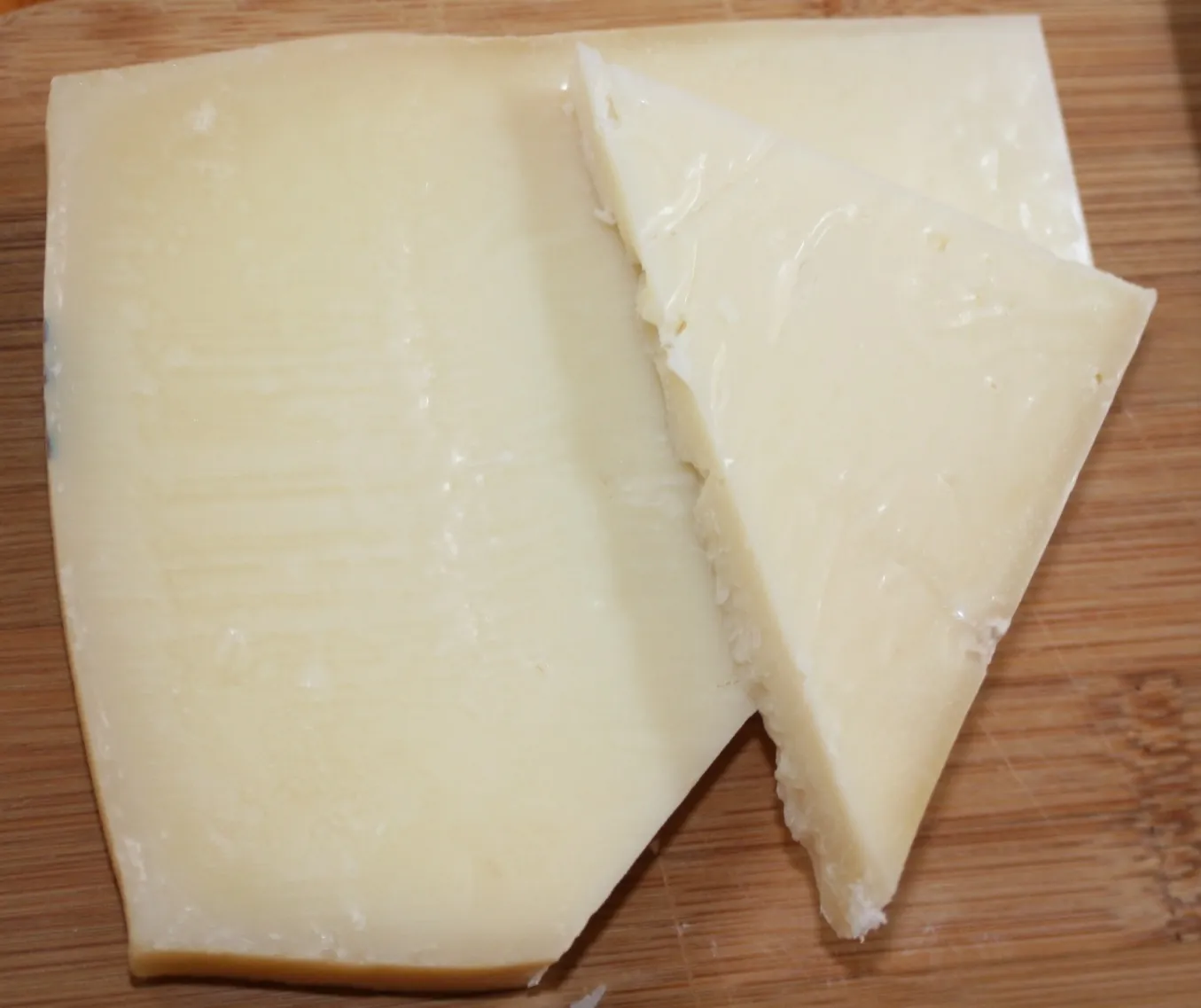
Grated, it does the job of Pecorino Romano in pasta and baked dishes.
Its name joins the Greek words for "head" and "cheese," possibly a nod to the shape of the wheel. The color runs between white and yellow depending on the milk, and the flavor sharpens as the wheel ages over the months it spends in storage.
Kefalotyri at a glance
Kefalotyri at a glance means a hard, dry, salty cheese that you grate or fry rather than slice for a board.
| Detail | Kefalotyri |
|---|---|
| Milk | Sheep, goat or both |
| Made in | Greece and Cyprus |
| Texture | Hard, dense, granular |
| Age | Three months or more; aged versions a year or more |
| Color | White to yellow |
| Flavor | Salty, sharp and savory; milder when young, drier and stronger when aged |
Kefalotyri origin and protected name
Kefalotyri origin is Greek and old, and the Greek cheeses guide places it with graviera and kefalograviera in the hard group. It is not the same as graviera, which is sweeter and nuttier and eaten as a table cheese.
A related cheese, kefalograviera, is a protected name in the EU, listed in the 1996 regulation that registered Greek cheese names. Kefalotyri did not turn up in that regulation's list of protected Greek cheeses when it was searched, so do not expect a PDO seal on a kefalotyri label. The PDO and PGI guide explains what those seals mean. Kefalograviera is sometimes sold as kefalotyri outside Greece and Cyprus.
How kefalotyri tastes by age
Kefalotyri tastes salty and savory when young, with a firm, slightly springy body, and it turns drier, more granular and stronger as it ages. At three months it can still be sliced and fried. A year or more in, it is better kept for grating, where its salt carries a dish.
The flavor is sharp and tangy rather than sweet, with a savory, almost brothy depth. That is why a little goes a long way over plain pasta, where it needs only olive oil and black pepper.
How to buy kefalotyri in the US
Buying kefalotyri in the US usually means a Greek or Mediterranean market, or a good cheese counter, where it is sold as a wedge. Check the label for the milk, since the cheese can be sheep, goat or a blend. Choose a wedge with a dry, even paste and no cracks or damp spots.
Because kefalograviera is sometimes sold under the same name, ask the counter which one you have. For frying and grating either works. Pre-grated tubs lose aroma quickly, so a wedge and a grater give a better result and usually keep longer.
How to cook with kefalotyri
Cooking with kefalotyri starts with saganaki: cut a slab about half an inch thick, dip it in water, dredge it in flour and fry it in olive oil until golden on both sides, then squeeze lemon over it. The firm, dry cheese holds its shape in hot oil instead of melting away. The saganaki recipe walks through it.
Grate it over pasta, baked vegetables, tomato dishes or pies as you would a hard Italian cheese, and taste before salting. A common Greek use is pastitsio and baked pasta, where a handful on top forms a golden, salty crust. Use a fine grater for a topping and a coarse one when you want it to melt into a sauce.
For saganaki, the pan matters: use a small, heavy skillet, get the oil hot before the cheese goes in, and serve at once, because the crust softens as it cools.
What to serve with kefalotyri
What to serve with kefalotyri leans on bright, crisp drinks that cut the salt. Assyrtiko, Agiorgitiko and retsina are the Greek choices, and a pilsner, amber lager or gose also works. On the plate, grapes, figs and olives suit it, with lemon, olive oil and crusty bread. The pairing guide covers more cheeses.
Substitutes for kefalotyri
Substitutes for kefalotyri are other hard, salty grating cheeses. Pecorino Romano is the nearest, since it is also sheep's milk, but it can be saltier. Graviera is milder and sweeter, good for frying. Parmigiano-Reggiano is nuttier and less sharp. The substitute finder lists more.
How to store kefalotyri
Store kefalotyri wrapped in wax paper or parchment, then loosely in a container in the fridge. Hard cheeses keep for weeks, and kefalotyri is salty and dry enough that a cut face seldom spoils. If it sweats or the surface turns tacky, wipe it with a paper towel and change the paper. The storing cheese guide covers wraps in detail.
What most kefalotyri advice gets wrong
Most kefalotyri advice says it is only a saganaki cheese, and that sells it short. It is also a grating cheese, and the older, drier pieces are better grated than fried. The other common mistake is salting a dish before tasting: the cheese brings plenty.
Questions about kefalotyri
These are the questions about kefalotyri that come up most.
Is kefalotyri the same as kefalograviera?
Kefalotyri is not the same as kefalograviera, though the two are close and kefalograviera is sometimes sold as kefalotyri outside Greece and Cyprus.
Can you melt kefalotyri?
Kefalotyri does not melt into strings: it softens and browns in a pan, which is why it works for saganaki, and it blends into hot sauces when grated.
What is kefalotyri made from?
Kefalotyri is made from sheep's milk, goat's milk or a blend of the two.
What can you use instead of kefalotyri?
Instead of kefalotyri, use Pecorino Romano for grating or graviera for frying, since both are close in firmness and saltiness.
Your first kefalotyri
For your first kefalotyri, buy a small wedge, fry a slab as saganaki with lemon, and grate the rest over pasta the next night.
Sources
- Kefalotyri, Wikipedia
- Commission Regulation (EC) No 1107/96, register of protected geographical indications and designations of origin, European Commission
- Geographical indications and quality schemes explained, European Commission