
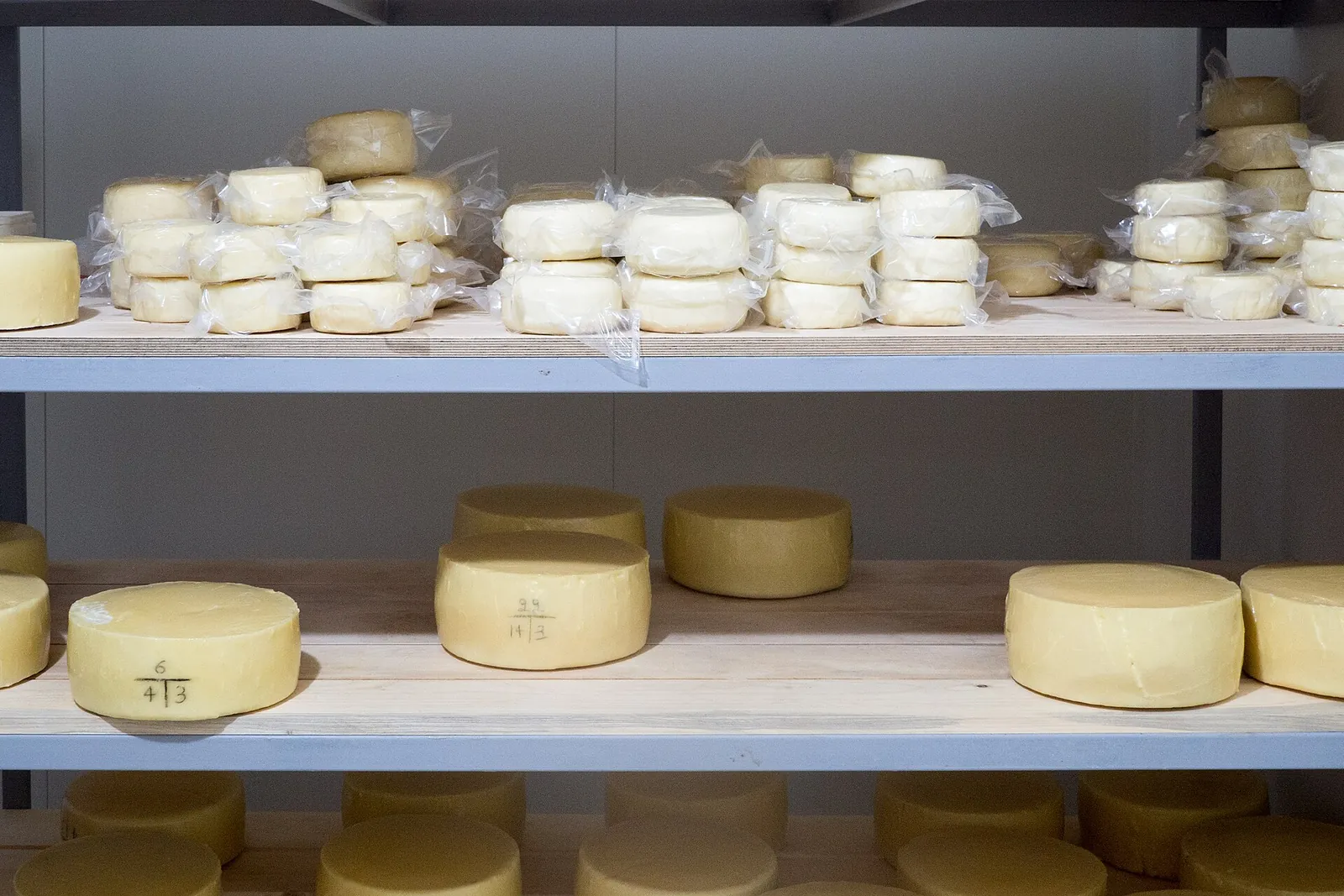
Greece has an unusually long list of EU protected names, and feta is the one most shoppers know.
This page maps the main Greek cheeses, what the protected names mean and how to find the real thing in a US store.
Greek cheese at a glance
Here is Greek cheese at a glance: the main cheeses, the milk each uses and whether the EU protects the name.
| Cheese | Milk | Style | EU protected name |
|---|---|---|---|
| Feta | Sheep's, or sheep's with up to 30% goat's | Soft, crumbly, brined | PDO, 2002 |
| Graviera | Sheep's (Crete), cow's in some versions | Hard, sweet and nutty | PDO for Kritis, Naxou and Agrafon |
| Kasseri | Sheep's | Semi-hard, stretched, melts well | PDO |
| Kefalotyri | Sheep's, or sheep's and goat's | Hard, salty, sharp | Not protected |
| Kefalograviera | Sheep's, or sheep's and goat's | Hard, salty | PDO |
| Manouri | Sheep's or goat's whey | Fresh, creamy, mild | PDO |
Greek cheese tradition
Greek cheese tradition follows the land: hilly, dry country suits sheep and goats better than cattle, so most traditional cheeses use their milk. The list of EU protected Greek cheese names reflects that, with sheep's and goat's milk dominating and cow's milk limited to a handful such as the Gravieras of Naxos and Agrafa, San Michali and Metsovone.
According to the Wikipedia list of Greek PDO cheeses, 19 Greek cheeses were registered as PDOs in 1996, feta followed in 2002, Xygalo Sitias in 2008 and Tsalafouti in 2023. The list also includes Batzos, Galotyri, Katiki Domokou, Ladotyri Mytilinis, Formaela Arachovas Parnassou and Sfela, most of them regional cheeses you will rarely meet in the US.
Feta, the Greek cheese everyone knows
Feta is the Greek cheese everyone knows, and it is the one with the strictest legal history. It must be sheep's milk, or sheep's milk mixed with up to 30 percent goat's milk from the same area, made in mainland Greece or the prefecture of Lesbos, and it ripens in brine. The EU registered it as a PDO in 2002 and, per Wikipedia's feta entry, upheld that decision in 2005 after Denmark and Germany challenged it. Danish makers then renamed their white cheese Apetina.
The feta page covers flavor and uses, and the label rules below show how to spot the Greek original.
Hard Greek cheese: graviera, kefalotyri and kefalograviera
Hard Greek cheese is what you grate, slice or fry, and the three names to know are graviera, kefalotyri and kefalograviera. Graviera takes its name from Gruyère and has three PDO versions: Kritis from Crete, Naxou from Naxos and Agrafon from the Agrafa mountains. Cretan graviera is the sheep's-milk one, with a sweet, nutty edge.
Kefalotyri is saltier and sharper, a hard sheep's or sheep-and-goat cheese for grating and frying. Kefalograviera sits between the two and is a common substitute when a recipe names kefalotyri. All three fry well, and saganaki, the fried cheese served with lemon, is usually made from one of them or from kasseri.
Kasseri and the soft Greek cheeses
Kasseri is the stretched Greek cheese: a firm, supple pasta filata cheese in the provolone family, salty, tangy and good at melting, so it turns up in sandwiches and baked dishes. The kasseri page has details.
At the soft end, manouri is a creamy, mild, milky-sweet whey cheese that suits honey and fruit, and mizithra is a whey cheese sold fresh or dried hard for grating. Neighboring Cyprus shares part of this world: its grilling cheese is covered on the Cyprus page.
How Greeks eat cheese
Greeks eat cheese at nearly every meal, and the style decides the job. Feta is crumbled over tomato and cucumber salads or served as a slab with olive oil and oregano. Hard cheeses are grated over pasta or fried. Manouri and fresh whey cheeses get honey. The pairings in the site's data point the same way: assyrtiko, sauvignon blanc or rose with feta, agiorgitiko with the harder cheeses, and moschofilero with manouri. The pairing guide has beers and fruit too.
How to find Greek cheese in the US
To find Greek cheese in the US, start with feta, which is in nearly every supermarket, then move to Greek and Mediterranean groceries for graviera, kasseri and kefalotyri. Read the label before the front of the pack: the EU's PDO rules apply in the EU, and the Wikipedia entry notes that most feta sold under that name in the US is American and made from cow's milk. A feta that says "Product of Greece" and lists sheep's milk, or sheep's and goat's milk, is following the Greek recipe. The PDO and PGI guide explains the seals.
Barrel-aged feta from a cheese counter, sold in brine, usually tastes better than shrink-wrapped blocks. For a full buying walk-through of every style, use the Greek cheeses guide.
What most Greek cheese lists get wrong
Most Greek cheese lists stop at feta and halloumi and miss how long the Greek list is. Halloumi belongs to Cyprus, not Greece. Several Greek PDO cheeses are cow's milk, not sheep's, so "all Greek cheese is sheep's milk" is wrong. And the protected name does not follow feta onto a US shelf, so the milk list on the label is the real evidence.
Questions about Greek cheese
These are the most common questions about Greek cheese.
What is the most popular Greek cheese?
The most popular Greek cheese is feta, a brined sheep's-milk cheese with an EU PDO since 2002.
Is Greek cheese made from sheep's milk?
Greek cheese is mostly made from sheep's and goat's milk, though a few protected cheeses such as San Michali and Graviera Naxou use cow's milk.
What is Greek fried cheese?
Greek fried cheese is saganaki, a thick slice of a firm cheese such as graviera, kefalograviera or kasseri, floured, fried and finished with lemon.
Is halloumi a Greek cheese?
Halloumi is a Cypriot cheese, though Greek restaurants and shops often sell it alongside Greek cheeses.
Is American feta real Greek cheese?
American feta is not Greek cheese unless it says Product of Greece, because a US tub labeled feta can be made from cow's milk.
Where to start with Greek cheese
Start with Greek cheese by buying a block of feta marked Product of Greece with sheep's milk on the list, and a piece of graviera. Serve the feta with tomato and olive oil, and fry thick slices of the graviera for saganaki. Then try kasseri on toast and manouri with honey.
Sources
- List of Greek Protected Designations of Origin cheeses, Wikipedia
- Feta, Wikipedia
- Regulation (EC) No 1829/2002, October 14, 2002, Official Journal of the European Union
- Geographical indications and quality schemes explained, European Commission