
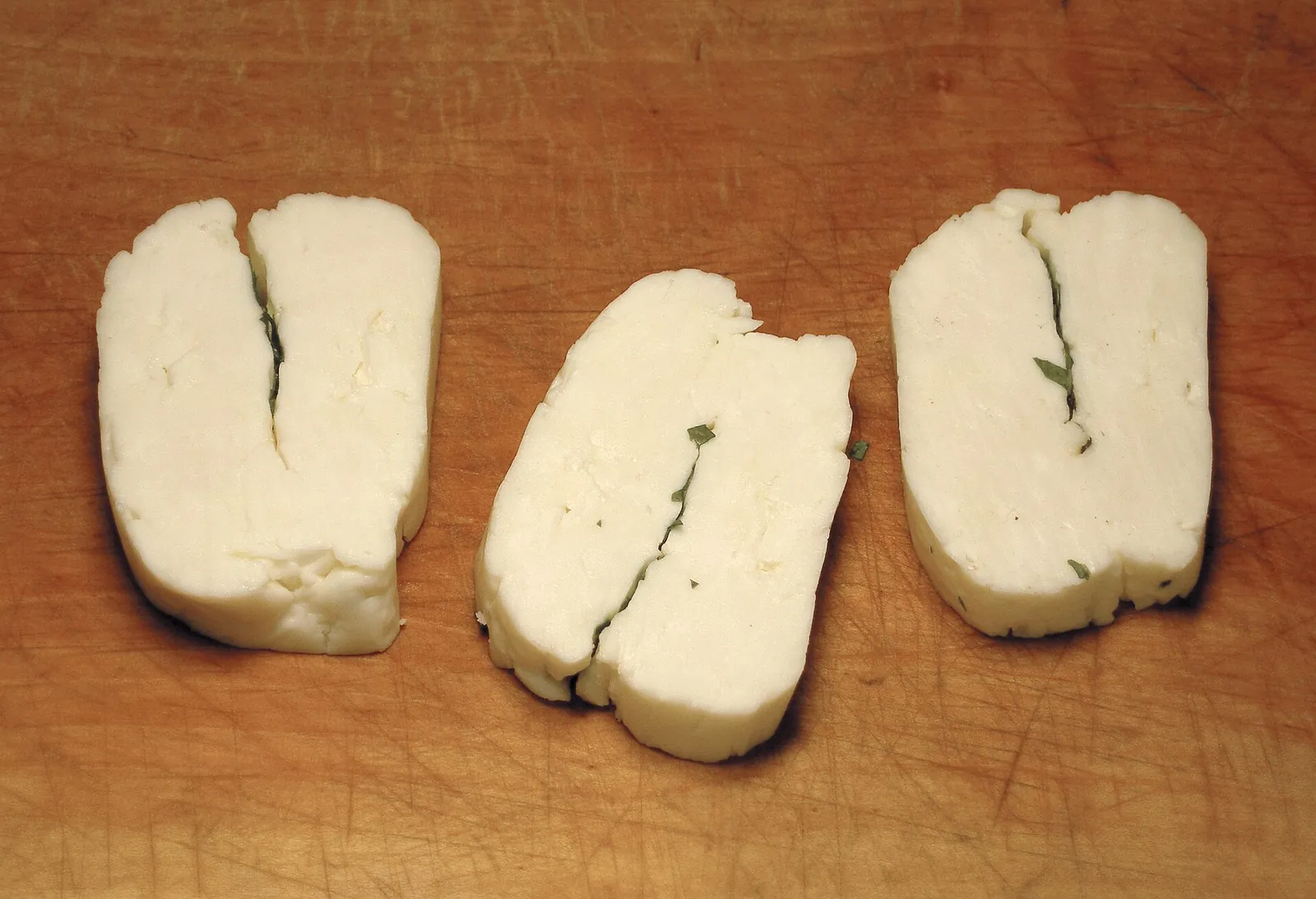
The EU protects two of those names: halloumi, also called hellim, since 2021, and halitzia since 2023.
This page covers what each cheese is, what the two protected names require and how to find them in a US store.
Cyprus cheese at a glance
Here is Cyprus cheese at a glance: the four cheeses worth knowing, the milk each one uses and whether the EU protects its name.
| Cheese | Milk | Style | EU protected name |
|---|---|---|---|
| Halloumi (hellim) | Sheep's and goat's, with or without cow's | Semi-hard and elastic, usually folded, grills without melting | PDO, registered April 2021, applying from October 1, 2021 |
| Halitzia Tillirias | Goat's | Soft to semi-hard, crumbly white pebbles ripened in salted whey | PGI, registered December 2023 |
| Anari | Milk added to whey left from halloumi | Fresh, or salted and air-dried hard for grating | None |
| Kefalotyri | Pasteurized sheep's | Hard, low in moisture | None |
Halloumi and halitzia are the only two Cypriot cheese names in the eAmbrosia register, checked October 5, 2026.
Cyprus cheese tradition
Cyprus cheese tradition is old enough to have a date: the EU's halloumi file puts the first written mention at 1554, in a codex of manuscripts on Cypriot history, now in the Correr Museum library in Venice, that calls the cheese "calumi."
The same file calls halloumi one of the most common accompaniments to bread in every Cypriot household, and notes that Halloumas and Halloumis are common Cypriot surnames. It describes the cheese as part of the diet of both Greek Cypriots and Turkish Cypriots since ancient times.
Sheep and goat milk sits behind most of the island's cheeses: halloumi must be mostly sheep's and goat's milk, halitzia is goat's milk, and kefalotyri is sheep's. Whey runs through the cheesemaking too. Halloumi curd is cooked in it, and mature halloumi and halitzia both ripen in salted whey for at least 40 days.
Halloumi and its EU protected name
Halloumi has carried an EU protected name since 2021, when Commission Implementing Regulation (EU) 2021/591 entered "Χαλλούμι (Halloumi)/Hellim" in the register as a PDO. The regulation is dated April 12, 2021 and applies from October 1, 2021, a delay the Commission allowed so the inspection body could set up its control plan.
What the halloumi PDO requires
The halloumi PDO requires one recipe and one place, and the single document writes both down.
- Milk: sheep's milk, goat's milk or both, with or without cow's milk, and the sheep and goat share must be larger than the cow's. The registration came with a transitional period for makers who cannot yet meet that rule.
- Other ingredients: rennet of any kind except pig rennet, salt and Cypriot mint, fresh or dried, laid between the layers of curd.
- Method: the curd is heated in whey above 194°F (90°C) for at least 30 minutes, then folded. Flat, unfolded halloumi has been allowed since a 2023 amendment.
- Place: the milk, the cheesemaking and the packing all happen in six districts, from Nicosia and Limassol to Famagusta and Kyrenia.
- Label: when milks are mixed, the pack lists them in decreasing order of percentage.
Hellim is the Turkish form of the same name: the EU's General Court held that the Greek "Halloumi" translates into Turkish as "Hellim," both meaning one Cypriot cheese. Because EU law is suspended in areas the Cypriot government does not effectively control, the Commission named the inspection firm Bureau Veritas to check producers throughout Cyprus.
How halloumi is made, why it keeps its shape over heat and how salty it runs are covered in the halloumi guide.
Anari, halitzia and kefalotyri
Anari, halitzia and kefalotyri are the other three Cypriot cheeses worth seeking out, and only halitzia has an EU protected name.
Anari
Anari is Cyprus's whey cheese: the Cyprus Trade Center says it is made by adding milk to the whey left over from halloumi. It comes two ways, fresh or salted and air-dried into a hard cheese for grating, and the Trade Center lists homemade pasta and pies among its uses. The anari guide has more.
Halitzia Tillirias
Halitzia Tillirias is a goat's-milk cheese from five communities in Tilliria, in northwest Cyprus, and the EU registered it as a PGI in December 2023. The single document describes a soft to semi-hard, crumbly white cheese with holes inside and a tart, fresh taste. It is sold as irregular pieces of 20 to 80 grams (about 0.7 to 2.8 ounces) packed in salted whey, and the plural name comes from their look of beach pebbles.
A PGI normally needs only one production stage in the named region, but this file requires every step from milk delivery to ripening there. The PDO and PGI guide explains the two labels.
Kefalotyri
Kefalotyri is the hard cheese of the group: the Cyprus Trade Center describes the Cypriot version as 100 percent pasteurized sheep's milk with at most 38 percent moisture, and it has no EU protected name. The kefalotyri profile covers the cheese itself.
How to find Cyprus cheese in the US
To find Cyprus cheese in the US, start with halloumi, which sits in the refrigerated cheese case, often near the feta, as a vacuum-sealed block.
Read the label for two things: "Product of Cyprus" and the milk list. On a pack made to the PDO, milks are listed in decreasing order of percentage, so sheep's or goat's milk should come before cow's. A pack that lists only cow's milk is not following the Cypriot recipe, whatever the front says.
The protected name is an EU rule, so it does not automatically follow the cheese to US shelves. The European Commission says protected names are safeguarded in the EU and in non-EU countries that have signed a specific protection agreement, and its halloumi regulation acknowledges that the cheese may be marketed in third countries where the name is not protected. A US pack labeled halloumi may therefore come from another country, which is why the label tells you more than the name does.
Beyond supermarkets, Greek, Turkish and Middle Eastern groceries and cheese counters with a Mediterranean section are the next places to look. Anari, halitzia and Cypriot kefalotyri are harder: the halitzia file says it is made in small household operations, so ask a Greek or Cypriot specialty importer instead of expecting it on a supermarket shelf. For fresh anari, fresh ricotta or soft mizithra is the nearest stand-in.
What most Cyprus cheese guides get wrong
Most Cyprus cheese guides get one thing wrong: they stop at halloumi and treat the name as proof of Cypriot origin. The EU registered it despite 17 notices of opposition, one of them from the Consortium for Common Food Names in the United States, and wrote that how the term is perceived outside the EU was not relevant to its decision. That settles the name for the EU market only; on a US shelf, the label is the evidence.
They also miss that the register holds two Cypriot cheese names, not one, and that the second, halitzia, is a goat's-milk cheese most lists never mention. A third gap is anari: it is not made from whey alone, because the Trade Center says milk is added to the leftover whey.
Questions about Cyprus cheese
These are the most common questions about Cyprus cheese.
What cheese is Cyprus known for?
Cyprus is known for halloumi, the salty, folded cheese that grills without melting and has been an EU PDO since 2021.
Is halloumi from Cyprus?
Halloumi is from Cyprus, and a pack that follows the EU protected name must have its milk, cheesemaking and packing all done on the island.
What is anari cheese?
Anari cheese is a Cypriot whey cheese made by adding milk to the whey left from halloumi, sold fresh or salted and air-dried for grating.
Is hellim the same as halloumi?
Hellim is the same cheese as halloumi: the EU's General Court held that the Greek "Halloumi" translates into Turkish as "Hellim," and the PDO registers both names together.
Where can you buy Cyprus cheese in the US?
Buy Cyprus cheese in the US from supermarket cheese cases and Greek, Turkish and Middle Eastern groceries, and look for "Product of Cyprus" on the pack.
Where to start with Cyprus cheese
Start with Cyprus cheese by buying one pack of halloumi marked Product of Cyprus, then pat 1/2-inch (1.3 cm) slices dry and sear them in a hot pan until golden on both sides. Squeeze lemon over the slices and serve them with watermelon or mint; the pairing guide has wines and beers to match. Next, try halloumi fries and ask a Greek market for anari.
Sources
- Commission Implementing Regulation (EU) 2021/591 entering 'Χαλλούμι' (Halloumi)/'Hellim' in the register (OJ L 125, 13.4.2021), Official Journal of the European Union
- Publication of an approved standard amendment, 'Χαλλούμι / Halloumi / Hellim' PDO-CY-01243-AM03, with the single document (OJ C 165, 10.5.2023), Official Journal of the European Union
- Single document for 'Χαλίτζια Τηλλυρίας / Halitzia Tillirias' PGI-CY-02872 (OJ C 290, 18.8.2023) and Commission Implementing Regulation (EU) 2023/2739 (OJ L, 7.12.2023), Official Journal of the European Union
- eAmbrosia, the EU geographical indications register (Cyprus entries, class 1.3 cheeses, checked October 5, 2026) and Geographical indications and quality schemes explained, European Commission
- Halloumi & Other Cheese Products, Cyprus Trade Center, Dubai, Ministry of Energy, Commerce and Industry of Cyprus