
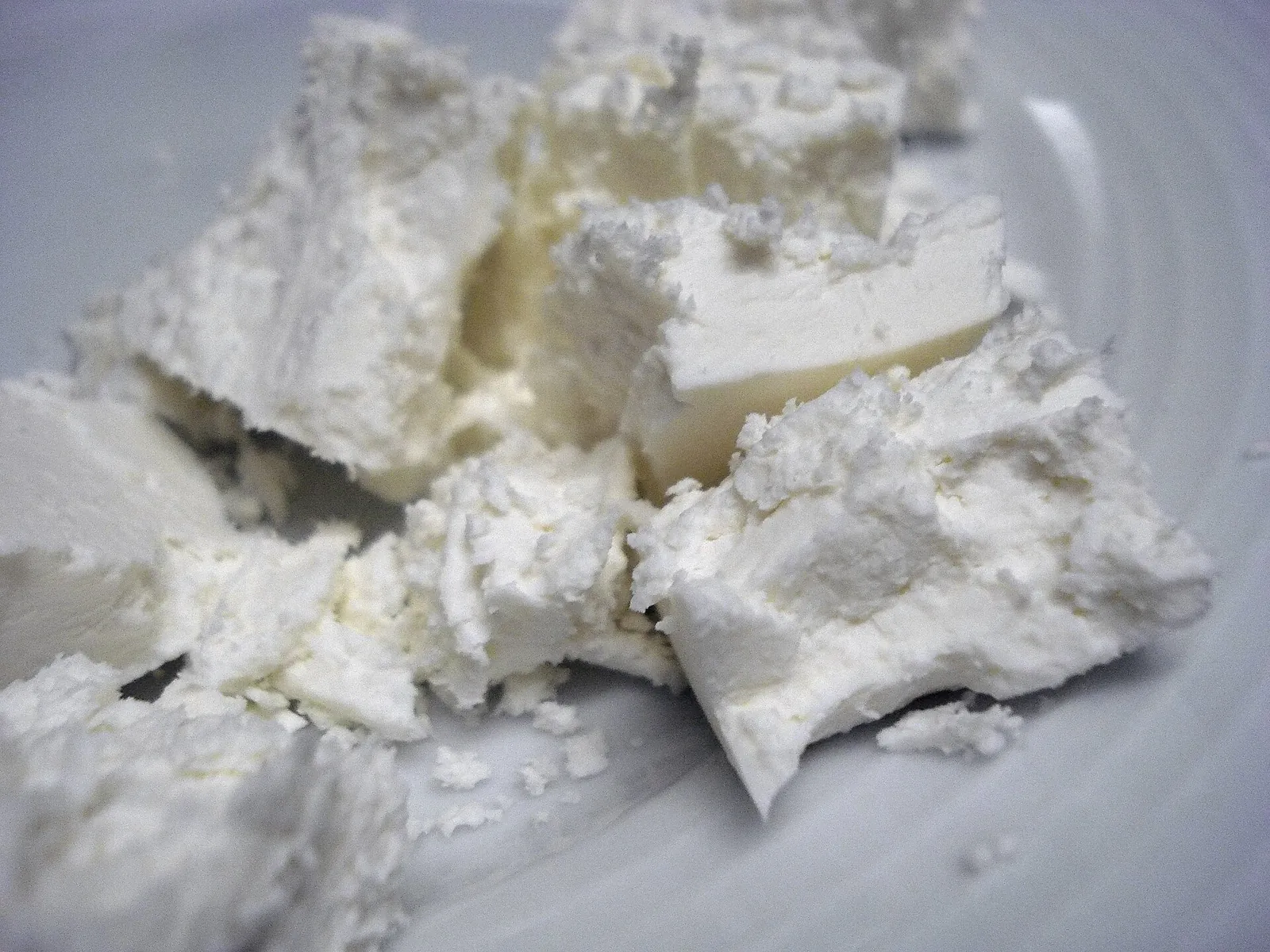
It is made from the whey left over from sheep's or goat's milk cheese, with cream added, so it is richer than the ricotta it resembles.
It is also far less salty than feta. That gentle, milky taste is why Greeks serve it with honey as a dessert and why it works in savory dishes where feta would take over.
Manouri cheese at a glance
Manouri cheese at a glance is a semi-soft, fresh cheese with little salt and a lot of cream, taken from the sources below.
| Detail | Manouri |
|---|---|
| Milk | Sheep's or goat's whey, with cream added |
| Made in | Thessaly and Macedonia, in northern and central Greece |
| Protected name | PDO, in the 1996 EU register of Greek names |
| Fat | About 36 to 38 percent |
| Salt | About 0.8 percent |
| Texture | Semi-soft, creamy, smooth |
| Flavor | Mild, milky, slightly nutty with a faint tang |
What manouri cheese is and how it is made
Manouri cheese is made from whey, the liquid left when milk is curdled for another cheese, and it is traditionally a byproduct of feta making. Cream is added to the whey before it is heated, which is where the fat and the smooth texture come from, according to Wikipedia's manouri entry. The curds that form are drained and shaped, often into a log.
That makes it a cousin of ricotta, mizithra and anthotyro, all whey cheeses, though manouri is the creamy one. The Greek cheeses guide places it among the whey cheeses.
Manouri cheese and its protected name
Manouri cheese is a PDO, a protected designation of origin: the name appears in the 1996 regulation that registered Greek cheese names, Commission Regulation (EC) No 1107/96. The cheese is made in Thessaly and Macedonia. The European Commission says a PDO means every part of production takes place in the region, and the PDO and PGI guide explains what the seal promises.
How manouri cheese tastes
Manouri cheese tastes clean, mild and milky, with a light nutty note, a hint of sheep and just a trace of tang. The Washington Post, quoted on Wikipedia, calls the flavor "clean, subtle nutty" with "the barest hint of tang." It has the texture of a light cheesecake, smooth and not wet.
How to buy manouri cheese in the US
Buying manouri cheese in the US means a Greek market or a cheese counter with a Greek section, where it is sold as a log or a wedge, often vacuum packed. Look for "Manouri PDO" and Greece on the label, and compare brands, because some logs are firmer and drier while others are softer and creamier. It is a fresh cheese, so check the date and choose a piece that is white and smooth, with no yellowing or sour smell. Pregnant readers should check that it is made from pasteurized milk, as the FDA advises for soft and fresh cheeses.
How to serve and cook with manouri cheese
Serving manouri cheese is easy because it needs little. Slice it and drizzle with honey, pistachios or walnuts, with figs or berries. For a savory plate, crumble it over a salad with tomatoes and thyme, or slice it onto grilled vegetables.
Its fat lets it soften when heated: it can be baked in phyllo, grilled in slices or folded into pastries and cheesecake. It will not melt into strings, so treat it like a soft, creamy cheese that browns at the edges and holds its shape.
Because it has so little salt, it takes seasoning well. A pinch of flaky salt, black pepper, lemon zest or fresh herbs on a warm slice changes it from dessert to appetizer.
What to serve with manouri cheese
What to serve with manouri cheese is light and fresh. Moschofilero, Assyrtiko and Prosecco suit it, and so do wheat beer, pilsner and saison. Honeydew, figs and berries work as fruit, with honey, pistachios and thyme. The cheese and honey guide has ideas, and the pairing guide covers more cheeses.
Substitutes for manouri cheese
Substitutes for manouri cheese are other soft, mild, creamy cheeses. Ricotta is the closest in origin, though lighter and wetter, so drain it first. Mascarpone is richer and works in desserts. Feta gives a salty, crumbly stand-in for salads, but it is much saltier, so use less. The substitute finder lists more.
How to store manouri cheese
Store manouri cheese in its original wrapper or in a lidded container in the fridge, and eat it within a few days of opening. As a fresh cheese it spoils faster than hard cheeses, so keep it cold, use a clean knife each time and throw it out if it smells sour or turns slimy. The storing cheese guide covers more.
What most manouri cheese advice gets wrong
Most manouri cheese advice calls it a Greek ricotta, which misses the point. The cream makes it noticeably richer and smoother, and it has far more fat than a typical ricotta. The other mistake is salting it like feta: manouri has only about 0.8 percent salt, so it needs honey, herbs or a pinch of salt on the plate.
Questions about manouri cheese
These are the questions about manouri cheese that come up most.
Is manouri cheese the same as feta?
Manouri cheese is not the same as feta: manouri is a creamy, low-salt whey cheese, while feta is a brined curd cheese.
What does manouri cheese taste like?
Manouri cheese tastes mild, milky and slightly nutty, with a faint tang and a smooth, creamy texture.
Is manouri cheese made from sheep or goat milk?
Manouri cheese is made from sheep's or goat's whey, with cream added, so it can be either.
Can you cook manouri cheese?
You can cook manouri cheese: grill or bake slices, or use it in pastries. It softens but does not melt into strings.
Your first manouri cheese
For your first manouri cheese, buy a small piece, slice it and drizzle it with honey and chopped pistachios. Next time, crumble it over a tomato salad.
Sources
- Manouri, Wikipedia
- Commission Regulation (EC) No 1107/96, register of protected geographical indications and designations of origin, European Commission
- Geographical indications and quality schemes explained, European Commission