
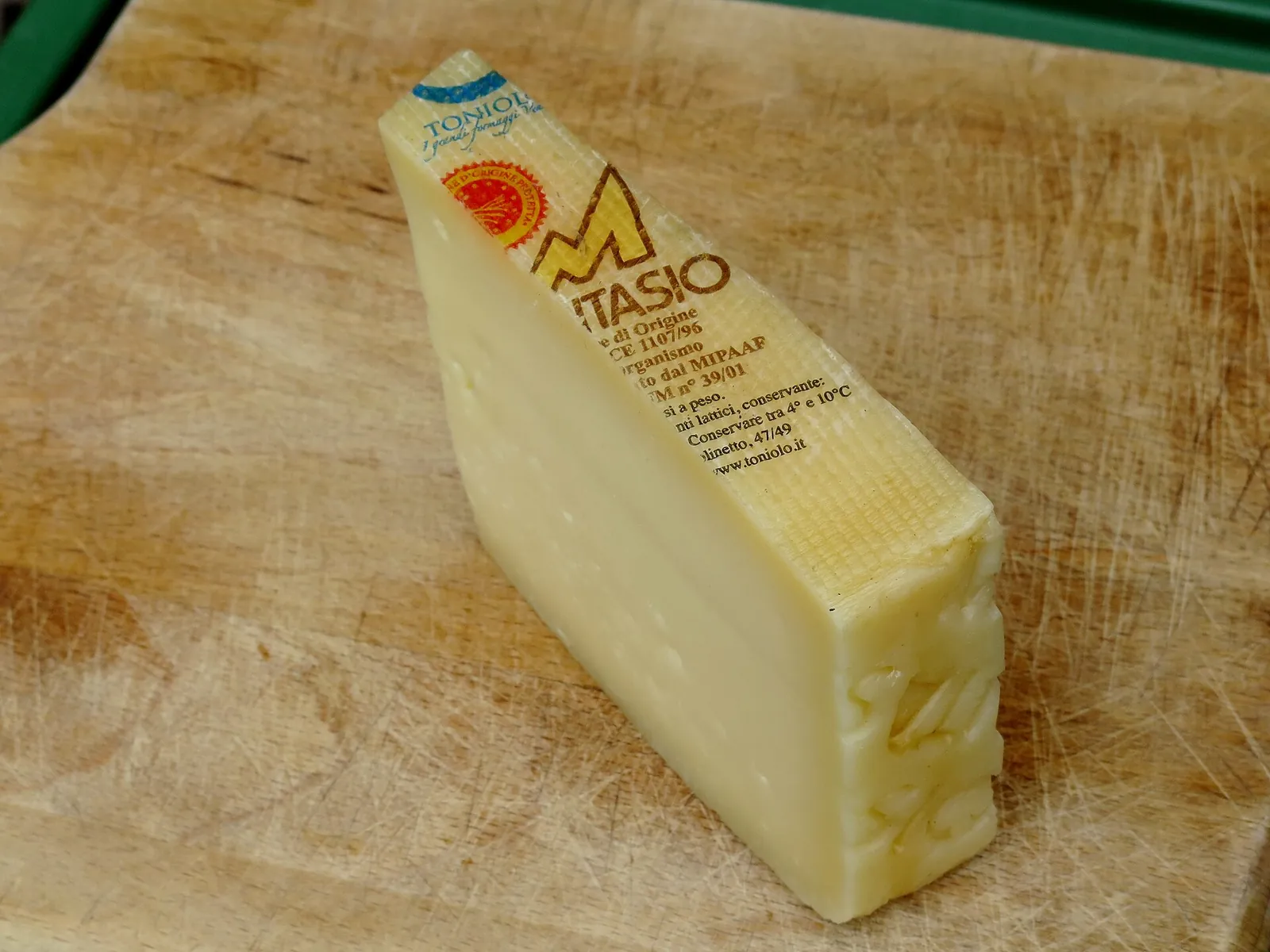
It is also the traditional cheese of frico, the crisp fried cheese of Friuli-Venezia Giulia.
What makes it versatile is one choice at the counter: age. Young Montasio melts into gratins and sandwiches, and the aged wheel shaves and grates like a hard cheese, so the same name covers two very different jobs.
Montasio cheese at a glance
Here is Montasio cheese at a glance, taken from its EU specification and the Montasio consortium.
| Detail | Montasio |
|---|---|
| Milk | Cow's milk, raw or thermised, never pasteurized |
| Made in | Friuli-Venezia Giulia and parts of Veneto, Italy |
| Protected name | PDO "Montasio" (the consortium dates the EU PDO to 1996) |
| Minimum age | 60 days; sold fresh (60 to 120 days), mezzano (5 to 10 months) and aged (10 months and more) |
| Wheel | 6 to 8 kg (about 13 to 18 lb), 30 to 35 cm across (about 12 to 14 in) |
| Texture | Compact paste with a few openings, firmer and crumblier with age |
| Flavor | Fresh: milk, yogurt, cream. Mezzano: butter and hay. Aged: fruity, spicy |
| Fat | At least 40 percent in the dry matter |
Where Montasio cheese comes from
Montasio cheese is made only inside its defined area, from milk to ripening, in Friuli-Venezia Giulia and parts of Veneto. The cows are Brown Swiss, Italian Red Pied and Black Pied, and the specification asks that part of their feed come from the area. The EU specification requires the milk to come from consecutive milkings collected within 48 hours of the first.
The tradition is old. The consortium says the method was refined by monks in the 17th century and that price lists documented the cheese by 1773. For how the PDO seal works in general, see the guide to PDO and PGI labels.
How Montasio cheese is made
Montasio cheese is a cooked, semi-hard cheese made with what the consortium calls soft technology: gentle handling that lets the milk's own microbes work slowly. The milk is raw or thermised, never pasteurized, and it is started with natural lactic cultures or authorized ferments. The curd is cooked at 42 to 48°C (about 108 to 118°F) and drained away from the heat for at least 10 minutes.
The wheels then ripen for at least 60 days, and the specification checks moisture by boring the cheese at 10 and 60 days. At 60 days a PDO Montasio can hold no more than 36.72 percent moisture and must have at least 40 percent fat in its dry matter. Ripening can run much longer, and the specification mentions up to 36 months. If raw milk matters to you, the raw-milk cheese guide covers the trade-offs.
Fresh, mezzano and aged Montasio cheese
Fresh, mezzano and aged Montasio cheese are one cheese at three ages, and each tastes different. Fresh Montasio is aged 60 to 120 days, with a straw-yellow, compact paste, even eyes, a smooth rind and a soft, delicate flavor of milk, yogurt and cream. Mezzano (5 to 10 months) is full-bodied, with butter and hay notes. Aged Montasio (10 months and more) brings fruity, dried-fruit and meaty notes, and the specification describes the long-ripened cheese as firmer, crumblier and slightly spicy.
Those flavor notes come from the consortium and the specification, so use them as a guide rather than a promise: every wheel is a bit different. The consortium also offers a "Quality Gold" mark for cheese aged 100 days or more that passes an expert check.
Frico: what Montasio cheese is famous for
Frico is the dish Montasio cheese is famous for, and it comes in two forms. The crisp version is grated cheese melted in a nonstick pan over medium heat until it lacks moisture and sets into a golden, lacy wafer you can lift out with a spatula. The soft version is a thick cake: the consortium's recipe fries pancetta with sliced onion, a boiled potato, cheese and pears, stirring until it holds together like an omelet roasted on both sides. That recipe calls for semi-aged Montasio at about 6 months, 600 g (about 21 oz) for 4 to 6 servings.
As a rule of thumb, younger cheese gives a softer, stretchier frico and older cheese a crisper, more savory one. Keep the pan temperature moderate so the fat does not scorch before the edges set.
How to buy Montasio cheese in the US
Buying Montasio cheese in the US is mostly a matter of asking for the age. Look for the PDO marking and for fresco, mezzano or stagionato (the consortium's terms) on the label or from the counter. If the shop sells only one Montasio, taste it: a milky, bendy slice is young, and a firmer, crumbly one is older.
Montasio is less common here than Asiago or provolone, so a good cheese counter or an Italian importer is the likeliest source. Italian cheeses by region puts it in context with its neighbors.
How to serve Montasio cheese
Serve Montasio cheese by age. Young wedges slice onto bread, melt into a gratin or a panini, or go on pizza. Aged wedges go on a board with pears, nuts and prosciutto, or are grated over pasta, risotto and soup. The wines of Friuli, crisp whites and light reds, suit it; the regional pairings guide explains matching cheese to local wine.
Wrap leftovers in wax paper or parchment in the fridge and let the cheese warm up for a little while before serving. Aged wedges keep longer than young ones, and the storing cheese guide has more detail.
Montasio cheese substitutes
Montasio cheese substitutes follow the age you need. For young Montasio, use young Asiago or fontina, which melt similarly. For aged Montasio, use aged Asiago, Grana Padano or Parmigiano-Reggiano, though they are drier and saltier. For frico, any firm, aged cheese that crisps works, but the flavor will drift from Friuli. The Substitute Finder lists more.
What most Montasio advice gets wrong
Most Montasio advice flattens it into one cheese, which hides a few useful facts.
Montasio is not always a grating cheese
Montasio is not always a grating cheese, because the young wheel is soft, milky and meant for melting and slicing. Only the older ones are dry enough to grate.
Frico does not need much fat
Frico does not need much added fat, because the cheese releases its own as it melts. A nonstick pan and a little patience beat adding butter, which can make the wafer greasy.
Montasio and Asiago are neighbors, not twins
Montasio and Asiago are neighbors, not twins: Asiago is semi-cooked and can be partly skimmed, while Montasio is cooked at 42 to 48°C and always raw or thermised. Their ages and flavors overlap, so they swap well but taste different.
Questions about Montasio cheese
These are the questions about Montasio cheese that come up most.
What is frico?
Frico is a Friulian dish of Montasio cheese cooked until crisp, either as a lacy wafer or as a cake with potato and onion.
How does Montasio cheese change with age?
Montasio cheese goes from soft and milky at 60 to 120 days to nutty and full-bodied at 5 to 10 months to firm, spicy and fruity after 10 months.
Is Montasio cheese good for melting?
Montasio cheese melts well when it is young, which is why frico and gratins use it, while aged Montasio is better shaved or grated.
Is Montasio cheese pasteurized?
Montasio cheese is never made from pasteurized milk, because the milk is raw or thermised, according to the consortium. See the raw-milk cheese guide above if you need to avoid it.
Your first Montasio cheese
For your first Montasio cheese, buy a small piece of mezzano or fresco and fry a handful of grated cheese in a nonstick pan until it sets into a frico, then eat it with a glass of crisp white wine. Next time try an aged wedge shaved over pasta.
Sources
- Commission Implementing Regulation (EU) No 1127/2013, Montasio specification, legislation.gov.uk
- Montasio PDO, Consorzio Tutela Formaggio Montasio
- Montasio cheese: maturation and flavor, Consorzio Tutela Formaggio Montasio
- Frico with pears, Consorzio Tutela Formaggio Montasio