
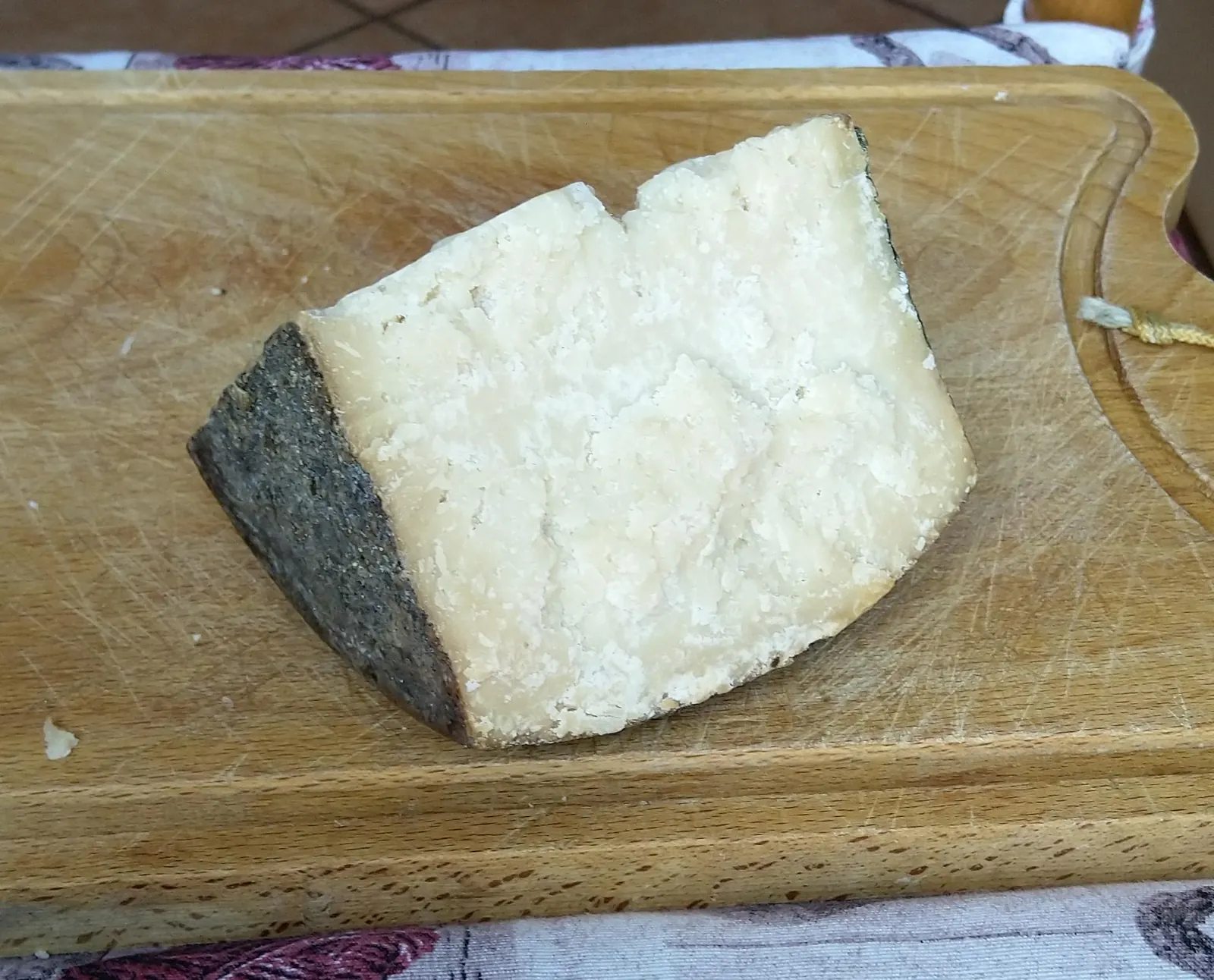
Its curd is set with lamb or kid rennet, and shepherds have long smoked it, which gives it a woodsy edge that other pecorinos lack.
It has two lives. Young, it is a table cheese you can fry or roast; old, it becomes a grating cheese for pasta, soups and polenta. Do not confuse it with Pecorino Romano, which is a different protected cheese.
Fiore Sardo cheese at a glance
Here is Fiore Sardo cheese at a glance, taken from the official production rules and the tasters' organization ONAF.
| Detail | Fiore Sardo |
|---|---|
| Milk | Whole raw sheep's milk, fresh; Sarda breed sheep |
| Made in | All of Sardinia, mostly Barbagia di Ollolai; Gavoi is the best-known town |
| Protected name | National denomination in 1955; EU PDO in 1996 |
| Rennet | Lamb or kid, "in paste" |
| Shape | Two flattened truncated cones, "mule's back" side; 15 to 22 cm across (6 to 9 inches), 1.5 to 4 kg (about 3 to 9 pounds) |
| Rind | Dark yellow to dark brown, oiled or blackened; not edible |
| Paste | White or straw yellow, compact, rarely with small holes |
| Fat | At least 40 percent of the dry matter |
Where Fiore Sardo cheese comes from
Fiore Sardo cheese comes from Sardinia, and ONAF dates the tradition back to the Nuragic age, around two thousand years or more. The name most likely refers to the carved wooden molds called pischeddas, which had a flower, maybe a lily or asphodel, carved into the bottom and left that mark on the cheese along with the producer's initials.
Gavoi produces the most, so in other parts of Italy the cheese is still sometimes called "Gavoi". The 1955 denomination covers all of Sardinia, and the EU's PDO register has listed it since 1996; the PDO and PGI guide explains what that seal means. For the island's other cheeses, see the Sardinia and Sicily cheese guide.
How Fiore Sardo cheese is made
Fiore Sardo cheese starts as raw whole sheep's milk, warmed to 33 to 35 degrees C (91 to 95 degrees F) in copper kettles over direct fire, and set with lamb or kid rennet in 23 to 27 minutes, according to the ONAF sheet. The curd is cut to rice-grain size and pressed into the double-cone molds.
The wheels get a short hot bath to build a smoother, tougher rind, then about 36 to 48 hours in brine. Smoking comes next: ONAF lists 10 to 15 days over Mediterranean scrub wood, including strawberry tree, mastic, myrtle and oak. Traditionally the smoke came from the central hearth of the shepherds' mountain huts, where wheels rested on a bed of reeds near the fire; Culture magazine describes wheels hung over the fireplace, then moved through a roof platform and an underground cellar. The rind is later oiled with sheep fat or olive oil, or blackened with vegetable residue and soot.
Fiore Sardo flavor and texture by age
Fiore Sardo flavor changes more with age than with anything else. Young wheels have a soft, crumbly, bright white paste that smells of milk and plants. Older wheels turn straw yellow, compact and easy to flake without going chalky, and they smell of dried fruit, herbs, melted butter, smoke and animal notes.
The heat grows with time; the specification says only "more or less piquant depending on maturity". ONAF is frank about the downside: the taste is not always balanced, and in older wheels the salty, sour and bitter notes plus a granular paste make it less pleasant as a table cheese. That is why the old wheels are grated. Culture magazine describes the flavor as sweet, rich and nut-like with burned caramel, smoke and salt.
How to use Fiore Sardo cheese
Use Fiore Sardo cheese by age. The specification calls it a table cheese up to three months and a grating cheese past six months. Young, it can be eaten at breakfast, as an aperitif or after a meal, or fried or roasted, and ONAF suggests roasted potatoes, cured meats, fresh tomatoes and onions.
Fresh and just made, before salting, it is melted for Sardinian ravioli (culurjones) and the sweets seadas and rubiolos. Aged, it goes grated onto pasta, soups, meatballs, polenta, pane frattau and stewed eel. A very aged wheel keeps for a long time, even outside the fridge, and holds its taste after portioning, ONAF says.
Fiore Sardo cheese wine and honey pairings
Fiore Sardo cheese wants aged reds, preferably from the island. ONAF names Cannonau di Sardegna, Mandrolisai and Carignano del Sulcis, and also Brunello di Montalcino and Montepulciano; the red wine and cheese guide covers how to choose.
For honey, ONAF prefers heather or wildflower over chestnut honey, because chestnut's own bitterness stacks on the cheese's bitterness. The cheese and honey guide has more.
How to buy Fiore Sardo cheese in the US
Buying Fiore Sardo cheese in the US starts with the label "Fiore Sardo DOP" and an age statement. Ask whether you are getting a young wheel for the table or an aged one for grating, because the two taste different. Check the rind: it should be a dark, oiled brown or blackened crust, not waxed.
Because the rules require raw milk, the usual cautions apply for pregnancy and weak immune systems, which the raw-milk cheese guide covers. Keep a wedge in paper or foil in the fridge, and see the storing cheese guide.
Fiore Sardo cheese substitutes
Fiore Sardo cheese has no perfect twin, but two swaps cover most jobs. For grating, Pecorino Romano gives a similar sheep's milk bite, though it is saltier and has no smoke. For the smoky table cheese, Idiazabal from Spain is a smoked sheep cheese.
Pecorino Sardo is another Sardinian sheep cheese with its own name, usually milder. The Substitute Finder has more.
What most Fiore Sardo advice gets wrong
Most Fiore Sardo advice repeats three things that do not hold up.
Fiore Sardo smoke is not a flavoring
Fiore Sardo smoke is not a flavoring added at the end. It is a traditional step: wheels near the hearth fire took on the smoke in the first period of aging, and that is why the cheese reads as smoky. ONAF lists a smoking step of 10 to 15 days.
Fiore Sardo is not Pecorino Romano
Fiore Sardo is not Pecorino Romano: it is made from raw milk, shaped like a mule's back, and can be smoked, while Romano is a separate PDO. ONAF calls Fiore Sardo the only Italian sheep's cheese made from raw milk.
Old Fiore Sardo is not a good snacking cheese
Old Fiore Sardo is not a good snacking cheese, because aged wheels grow salty, sharp and granular. Grate them, or buy a younger piece for the board.
Questions about Fiore Sardo cheese
These are the questions about Fiore Sardo cheese that come up most.
Is Fiore Sardo the same as Pecorino Romano?
Fiore Sardo is not the same as Pecorino Romano: both are Sardinian sheep's milk cheeses, but Fiore Sardo is raw-milk, shaped like a mule's back and traditionally smoked.
Why is Fiore Sardo smoky?
Fiore Sardo is smoky because wheels were traditionally aged near the hearths of shepherds' huts, and producers still smoke them over scrub wood.
What does Fiore Sardo taste like?
Fiore Sardo tastes of milk and plants when young, and of dried fruit, herbs, melted butter and smoke when old, with a spicy edge that grows with age.
What does Fiore Sardo mean?
Fiore Sardo means "Sardinian flower", most likely for the flower carved into its traditional wooden molds.
Is Fiore Sardo made from raw milk?
Fiore Sardo is made from raw sheep's milk, which is a requirement of its production rules.
Your first Fiore Sardo cheese
For your first Fiore Sardo cheese, buy a young wedge for the board and eat it with heather honey and a Cannonau. Then grate a small piece of an older wheel over a bowl of plain pasta to taste the other side.
Sources
- Fiore sardo, product sheet and tasting notes, ONAF (Organizzazione Nazionale Assaggiatori Formaggi)
- Disciplinare di produzione della Denominazione di origine del formaggio "Fiore sardo", Italian denomination decree text (DPR 30 October 1955, amended 1974), as published by ONAF
- Fiore Sardo, Culture: The Word on Cheese