
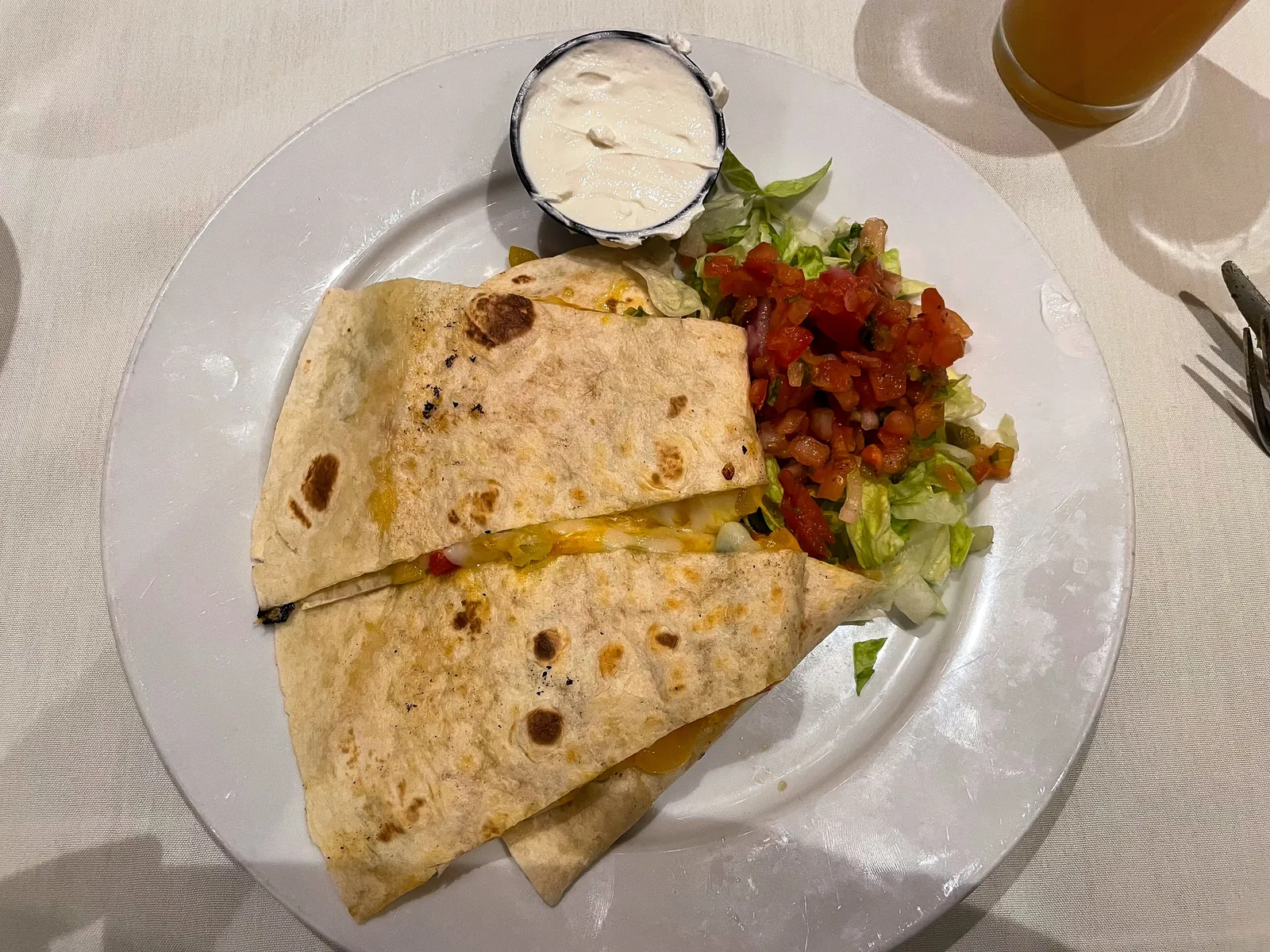
The whole trick is moisture and age. Young cheeses with plenty of water, such as Oaxaca and Monterey Jack, flow into one smooth layer under heat. Aged or dry cheeses squeeze out oil and crumble. Pick the cheese first and the technique is easy.
Quesadillas at a glance
This quesadillas table shows the basics for a two-serving batch.
| Yield | 2 large quesadillas (2 servings) |
| Time | 5 minutes active, about 15 minutes total |
| Pan temperature | Medium heat, about 350°F (175°C) on a griddle |
| Best cheese | Oaxaca, with Chihuahua or Monterey Jack as backups |
| Make ahead | Assemble up to 1 day ahead; cook just before eating |
How to make quesadillas
Quesadillas take one skillet and about ten minutes, and the amounts below make two 10-inch flour tortilla quesadillas.
Ingredients for quesadillas
These ingredients for quesadillas keep the filling simple so the cheese does the work.
- 4 oz (115 g) Oaxaca cheese, torn into strands
- 4 oz (115 g) Chihuahua or Monterey Jack, coarsely grated
- 2 flour tortillas, 10 inches (25 cm)
- 1 tablespoon neutral oil or butter
- 1/2 cup cooked chicken, black beans or sauteed peppers, optional
- 2 tablespoons chopped cilantro, optional
- Salsa and sour cream, for serving
Steps for making quesadillas
These steps for making quesadillas produce a crisp shell and a fully melted center.
- Toss the Oaxaca and the grated cheese together so the stretch and the melt are mixed through.
- Heat a large skillet over medium heat for 2 minutes, then brush it with a little of the oil.
- Lay one tortilla in the pan and spread half the cheese over one half, leaving a 1/2 inch (1 cm) border, then add any filling in a thin layer.
- Fold the empty half over the cheese and press down gently with a spatula.
- Cook 2 to 3 minutes, until the underside is golden with brown spots and the tortilla stiffens.
- Flip with a wide spatula and cook another 2 minutes, until the cheese is fully melted and visibly oozing at the edge.
- Slide onto a board, rest 1 minute so the cheese sets slightly, and cut into 3 or 4 wedges.
- Wipe the pan, add the rest of the oil and repeat with the second tortilla.
The best cheese for quesadillas
The best cheese for quesadillas is a young, high-moisture cheese, and the Mexican answer is Oaxaca cheese. Wisconsin cheesemakers call it the mozzarella of Mexico for its stringy, easy melt. It is a stretched-curd cheese, so the proteins are already aligned into strands that pull rather than pool.
Chihuahua cheese is a mild, young cheddar-style cheese with 41 to 45 percent moisture, so it melts smoothly and tastes buttery. Monterey Jack is the easiest to find in a US supermarket: the federal standard lets it hold up to 44 percent moisture, which is why it flows so evenly. Spiced pepper Jack is the same cheese with chiles and works well when you want heat without adding salsa inside.
A blend beats any single cheese. Oaxaca gives stretch, and Jack or Chihuahua adds a little more flavor and a faster melt. If you cannot find Oaxaca, low-moisture mozzarella is made the same way and is the closest swap. Mild cheddar works but can turn greasy on its own, so mix it half and half with Jack.
Grate or tear from a block. Pre-shredded bags are coated with anti-caking starch, which keeps the shreds from fusing into a single sheet. For more options, see the best melting cheeses.
Which cheeses do not work in quesadillas
Queso fresco and cotija are the wrong main cheese for quesadillas. Queso fresco is set with rennet but stays at a pH of 6.1 or higher, so it softens in the pan without melting, and cotija is a dry, salty, aged cheese. Both are good crumbled over the top at the end, where they add salt and tang without needing to flow.
Quesadilla mistakes and fixes
Quesadilla mistakes almost always come from the pan or the filling, not the cheese. A few fixes cover most failures.
- Too much filling. More than about 1/2 cup of extras pushes steam into the tortilla and the cheese cannot seal it. Keep wet fillings, such as salsa or sauteed vegetables, drained.
- Heat too high. The tortilla burns before the center melts. Medium heat, and a lid for 30 seconds if the cheese is stubborn.
- Heat too low. The tortilla dries out and turns leathery before it browns. The pan should sizzle faintly when the tortilla goes in.
- Greasy puddles. Usually an aged or sharp cheese. Switch to a younger cheese or blend it with Jack.
- Cheese leaks out. Overfilling or no border. Leave the edge bare so the fold seals.
Quesadilla variations and storage
Quesadilla variations are easy, and corn tortillas give a more traditional, slightly sturdier shell and should be warmed first so they do not crack; a sheet pan version bakes at 425°F (220°C) for 8 to 10 minutes and feeds a crowd.
To make quesadillas ahead, assemble but do not cook, wrap tightly and refrigerate up to a day. Cooked quesadillas should go in the fridge within 2 hours of cooking and be eaten within 3 to 4 days, according to USDA FSIS leftovers guidance. Reheat in a dry skillet or 400°F (205°C) oven until steaming hot, 165°F (74°C) in the center if there is meat inside; a microwave makes the tortilla soft and chewy.
Questions about quesadillas
These quesadillas questions cover cheese, texture and storage.
What is the best cheese for quesadillas?
The best cheese for quesadillas is Oaxaca, which melts into long strings, with Chihuahua cheese and Monterey Jack as close, easier-to-find alternatives.
Can you use cheddar in quesadillas?
Cheddar in quesadillas works when it is mild and mixed with a softer melter such as Monterey Jack, because sharp aged cheddar on its own tends to turn oily.
How do you keep quesadillas from getting soggy?
To keep quesadillas from getting soggy, drain wet fillings, use a thin layer, and cook on medium heat in a hot pan until the tortilla is rigid before flipping.
Should you use flour or corn tortillas for quesadillas?
Flour tortillas are easier for quesadillas because they fold without cracking, while corn tortillas taste more traditional but need to be warmed first.
Can you freeze quesadillas?
You can freeze quesadillas after cooking: cool them, wrap tightly and freeze for up to 2 months, then reheat in a hot oven or skillet until the cheese is melted.
Making quesadillas well
Making quesadillas well starts at the cheese counter: buy a block of Oaxaca or Monterey Jack, tear or grate it yourself, and cook over medium heat until the tortilla crackles. For the next step up, try the same method with the grilled cheese guide and see how the cheeses behave between bread.
Sources
- Mexican Cheese for Quesadillas, Dairy Farmers of Wisconsin
- 21 CFR 133.153, Monterey cheese and Monterey Jack cheese, eCFR
- Leftovers and food safety, USDA Food Safety and Inspection Service
- Hispanic cheeses: the quest for queso, Food Technology Magazine, Institute of Food Technologists