
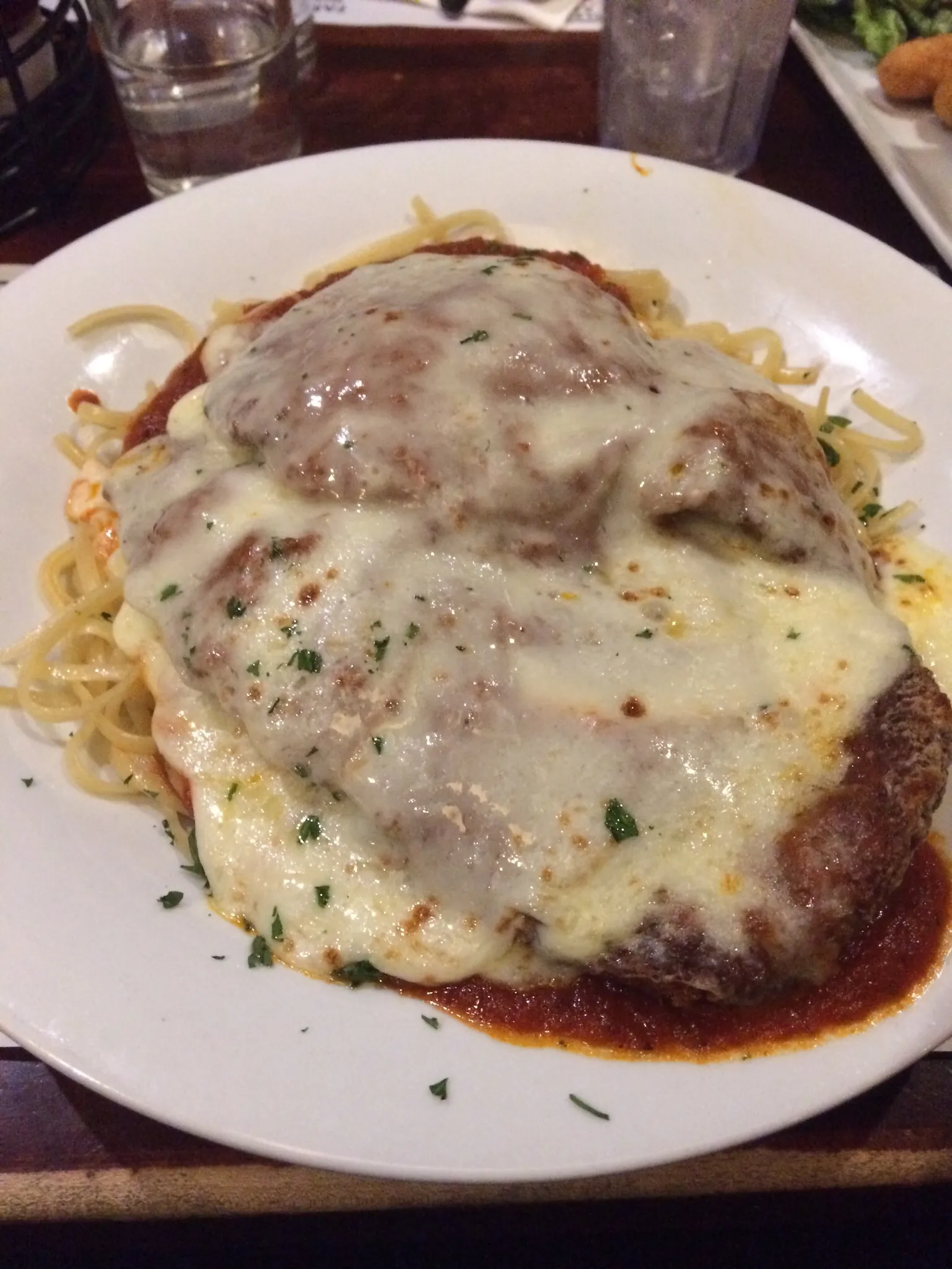
What makes it work is contrast: a crunchy crust, a bright sauce and a blanket of stretchy cheese, and the whole job is keeping those three from turning each other soggy.
Most failures come from the cheese layer, not the chicken. Too much sauce, wet cheese or a crowded pan steams the crust, so the recipe below protects the crumbs and leans on a low-moisture melter.
Chicken parmesan at a glance
This chicken parmesan table gives the time, heat and cheese choices before you start.
| Yield | 4 servings |
| Active time | About 40 minutes |
| Total time | About 55 minutes |
| Oven | 450°F (230°C), top rack, then broil to finish if wanted |
| Best cheese | Low-moisture mozzarella plus aged Parmigiano-Reggiano |
| Make ahead | Fry and bread early; sauce and bake just before serving |
How to make chicken parmesan
This chicken parmesan recipe fries thin cutlets, sauces only their centers and bakes them just long enough to melt the cheese.
Ingredients for chicken parmesan
The ingredients for chicken parmesan are ordinary, but the cheese should be a block you grate yourself.
- 2 large boneless, skinless chicken breasts (about 1.5 lb, 680 g), each sliced horizontally into two cutlets
- Breading: 1/2 cup (65 g) all-purpose flour
- Breading: 2 large eggs, beaten with 1 tablespoon water
- Breading: 1 1/2 cups (80 g) panko breadcrumbs
- Breading: 1/2 cup (50 g) finely grated Parmigiano-Reggiano
- Breading: 1 teaspoon dried oregano
- 3/4 teaspoon kosher salt, plus more for the chicken
- 1/2 teaspoon black pepper
- 1/2 cup (120 ml) neutral oil for pan-frying
- 1 1/2 cups (360 g) tomato sauce, warm
- 6 oz (170 g) low-moisture mozzarella, coarsely grated
- 2 tablespoons (10 g) finely grated Parmigiano-Reggiano, for the top
- Fresh basil leaves, for serving
Steps for making chicken parmesan
These steps for making chicken parmesan take about an hour, and the oven does the last ten minutes.
- Heat the oven to 450°F (230°C) with a rack in the upper third and set a wire rack on a sheet pan.
- Pound each cutlet to an even 1/2 inch (1.25 cm) thickness between sheets of plastic wrap, then season both sides with salt and pepper.
- Set up three shallow dishes: flour, the egg mixture, and the panko mixed with the grated Parmigiano-Reggiano, oregano and 3/4 teaspoon salt.
- Dredge each cutlet in flour and shake off the excess, dip it in egg and let it drip, then press it firmly into the crumbs on both sides.
- Warm the oil in a large skillet over medium-high heat until a pinch of crumbs sizzles at once, about 350°F (175°C).
- Fry the cutlets 2 to 3 minutes per side, in two batches so the pan is not crowded, until deep golden, then move them to the wire rack.
- Spoon about 2 tablespoons of sauce onto the center of each cutlet, leaving a bare border of crust.
- Pile the mozzarella over the sauce, then sprinkle each cutlet with the remaining Parmigiano-Reggiano.
- Bake on the upper rack for 8 to 10 minutes, until the cheese is bubbling and the thickest part of the chicken reads 165°F (74°C) on an instant-read thermometer.
- Broil for 30 to 60 seconds if you want brown spots on the cheese, watching closely, then rest 3 minutes and serve with the rest of the warm sauce and basil.
The best cheese for chicken parmesan
The best cheese for chicken parmesan is low-moisture mozzarella on the surface and a little aged Parmigiano-Reggiano worked in and on top. Mozzarella supplies the stretch; the hard cheese supplies the salt and the browning.
Moisture is the reason. The FDA draws the line between plain and low-moisture mozzarella at 52 percent moisture, and the drier block melts into strings without releasing the water that would flood the cutlet. Fresh mozzarella tastes milkier but weeps in a 450°F oven, so save it for dishes where a puddle is welcome. The details are in types of mozzarella.
Parmigiano-Reggiano is a raw cow's milk PDO cheese aged at least 12 months, and the 20 to 26 month range is the consortium's balanced pick for cooking. Its low moisture and high salt are why it dries into a crisp, golden crust in the crumbs instead of going gummy. A cheaper domestic Parmesan works, and Pecorino Romano makes it sharper and saltier, so cut the added salt if you swap it in. See Parmesan vs Pecorino for the difference.
A handful of provolone mixed with the mozzarella adds a sharper note. For more options, see the best melting cheeses, and grate from a block, because pre-shredded cheese melts poorly.
Mistakes that make chicken parmesan soggy
Soggy chicken parmesan has three usual causes, and each has a fix.
- Sauce to the edges. Sauce soaks the crumbs it touches. Spoon it on the center and serve the rest on the side.
- Uneven cutlets. A thick end dries out while the thin end overcooks. Pound to an even 1/2 inch.
- Skipping the rack. A cutlet that sits on a flat pan steams its underside. A wire rack lets air circulate.
- Cold, wet cheese. Cheese straight from a tub of brine adds water. Pat fresh mozzarella dry if you use it, or stay with the block.
- Oil too cool. Below about 325°F the crumbs soak up oil instead of crisping. Let the oil come back to heat between batches.
Poultry is done at an internal temperature of 165°F, according to USDA's Food Safety and Inspection Service, so check the thickest part with a thermometer rather than trusting color.
Chicken parmesan variations
Chicken parmesan variations start with baking instead of frying. For a lighter version, spray the breaded cutlets with oil and bake them on a rack at 450°F for 15 to 18 minutes before saucing, or cook them in an air fryer at 400°F. Swap the chicken for veal or pork cutlets, or serve the cutlet on a split roll as a sandwich.
The same cheese layer is the basis of eggplant parmesan, which swaps the cutlet for fried or roasted eggplant. The dish is Italian-American, and its name echoes the older southern Italian parmigiana of layered eggplant.
Storing and reheating chicken parmesan
Storing and reheating chicken parmesan starts earlier: bread the cutlets up to 4 hours ahead and refrigerate them uncovered on a rack, which dries the surface and helps the crust. Fry, sauce and bake when you are ready to eat.
Leftovers should go into the refrigerator within 2 hours of cooking and be eaten within 3 to 4 days, according to FSIS, and reheated to 165°F. Reheat on a rack in a 375°F (190°C) oven for 10 to 15 minutes rather than in a microwave, which turns the crust leathery.
Chicken parmesan FAQ
These chicken parmesan questions come up most often.
Why is it called chicken parmesan?
Chicken parmesan takes its name from the older dish eggplant parmigiana, and "parmesan" refers to the grated hard cheese used on top. Where the name itself comes from is debated, so treat any single story as a guess.
Is fresh mozzarella good for chicken parmesan?
Fresh mozzarella works for chicken parmesan if you slice it thin and pat it very dry, but it releases water in a hot oven. Low-moisture mozzarella melts more evenly and keeps the crust crisp.
What temperature should chicken parmesan reach?
The chicken should reach 165°F (74°C) in the thickest part, the safe minimum for poultry according to USDA FSIS. Thin cutlets usually get there as the cheese melts.
Is chicken parmesan possible without frying?
Yes, chicken parmesan without frying works baked. Bake the breaded cutlets on a rack at 450°F until golden, add the sauce and cheese, and return them to the oven. The crust is drier and lighter than fried.
Why does the cheese slide off chicken parmesan?
Cheese slides off chicken parmesan when too much sauce makes a slippery base. Use a thin layer of sauce, press the mozzarella down lightly, and let the cutlet rest for a few minutes before serving.
Chicken parmesan, in short
A good chicken parmesan comes down to an even, fried cutlet, a little sauce in the middle and a block of low-moisture mozzarella with Parmigiano-Reggiano on top. For the cheeses behind it, start with Parmigiano-Reggiano and then three-cheese lasagna.