
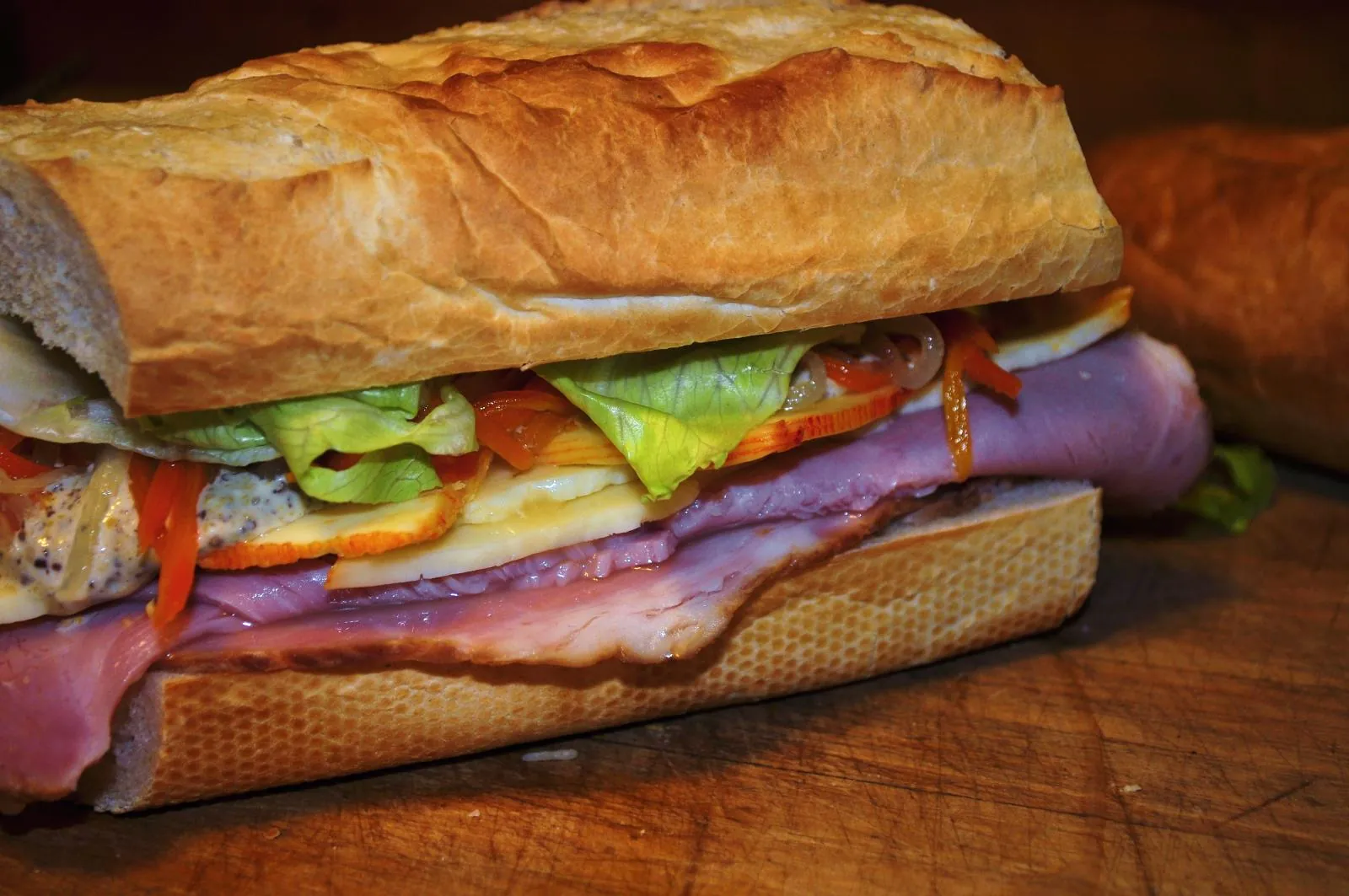
For a cold deli sandwich, Swiss and provolone are the safest picks, with sharp cheddar when the filling needs more flavor. For anything pressed, toasted or melted, switch to a young, moist melter like deli American, Muenster, Monterey Jack or Gruyère.
Temperature decides it because cheese changes character as it warms. Milk fat turns liquid at around 90°F, which is why cheese left out on a warm day beads with grease, and the proteins holding the slice together let go only another 40 to 90 degrees above that, according to Serious Eats' guide to melting cheese. A cold sandwich wants a cheese that stays firm below the first line. A hot one wants a cheese that crosses the second line smoothly instead of splitting into rubber and oil. After that, the filling decides.
The best sandwich cheese at a glance
Each sandwich cheese below is rated for cold and hot use, along with the habit that decides where it belongs.
| Cheese | Cold sandwich | Hot sandwich | How it behaves | Weak spot |
|---|---|---|---|---|
| Swiss | Excellent | Very good | Firm, bendable slices; mild and low in salt | Holes let mustard through |
| Provolone | Excellent | Excellent | Stretched curd folds without cracking; melts stringy | Mild deli provolone is quiet |
| Sharp cheddar | Excellent | Good (medium is better) | Most flavor per slice | Crumbles if sliced thin at home; aged cheddar turns greasy hot |
| Havarti | Very good | Very good | Soft, buttery, melts fast | Smears and slumps in a warm bag |
| Deli American | Good | Excellent | Emulsifying salts keep it smooth at any heat | Saltiest choice; mild |
| Muenster | Fair | Excellent | Mild, moist, even melt | Bland cold |
| Monterey Jack or pepper jack | Good | Excellent | Smooth melt; pepper version adds heat | Plain Jack is mild |
| Gruyère | Good | Excellent | Nutty and strong; glossy melt | Price |
| Fresh mozzarella | Good (caprese) | Fair | Milky and wet | Weeps water into bread |
| Low-moisture mozzarella | Fair | Very good | Stretchy, mild | Rubbery cold |
Best cheese for cold sandwiches
The best cheese for cold sandwiches has to slice thin and bend around a roll, and it has to taste of something straight from the fridge, where flavor goes quiet. Swiss, provolone and sharp cheddar clear that bar; Havarti trades a little firmness for richness. Greasy beads and slumping slices are mostly a temperature problem, covered further down.
Swiss
Swiss is the easiest cheese to love in a cold sandwich. Federal rules require it to have holes ("eyes") throughout, to be aged at least 60 days and to hold no more than 41 percent moisture (21 CFR 133.195), which gives you a firm slice that cuts paper-thin and still bends. Its mild, slightly sweet flavor sits under salty meats instead of fighting them.
It is also unusually low in salt. USDA FoodData Central lists Swiss at 53 mg of sodium per ounce, against 185 mg for cheddar. Buy domestic deli Swiss for everyday turkey and ham, or imported Emmentaler for a fuller, nuttier slice. Weak spot: the holes, which let mustard soak through, so overlap two thin slices.
Provolone
Provolone is the deli's other workhorse, and its stretched curd is the reason a thin slice folds over salami instead of snapping. Like mozzarella, it is a pasta filata cheese: the curd is kneaded and stretched in hot water, and the federal standard describes the result as stringy. Mild (dolce) provolone suits turkey and chicken. Sharp (piccante) provolone has the bite to stand up to cured meats, vinegar and hot peppers, and the provolone guide explains how the two are made. Weak spot: mild deli provolone can taste of very little.
Sharp cheddar
Sharp cheddar puts the most flavor into a cold sandwich, which matters because fridge-cold cheese tastes muted. The catch is texture. Cheddar is crumbly enough that slicing it thin at home ends in shards, so buy it sliced at the deli counter. If the sandwich will be heated, step down to a medium cheddar: well-aged cheddar is one of the cheeses whose proteins clump and squeeze out fat as they melt. Weak spot: a strong cheddar can bury delicate fillings like egg salad.
Havarti
Havarti is the soft, buttery choice for lean fillings such as turkey and grilled chicken. This semi-soft Danish cheese slices cleanly when cold and melts almost as soon as it warms, so it works in both kinds of sandwich, and dill Havarti is lovely with turkey or cucumber. Weak spot: on a warm day it smears and slumps, so keep it for sandwiches that stay chilled.
Best cheese for hot pressed sandwiches
The best cheese for hot pressed sandwiches is young and moist, because it has to melt in the time the bread takes to brown. Young cheeses hold fat and water in a flexible protein network that sags into a smooth melt. Aged cheeses have tighter protein clumps that let go of their fat, and any cheese turns greasy once the heat runs long enough to cook off its water. Swiss and provolone from the cold list both melt well; the four below do their best work hot. For grilled cheese, where the cheese is the whole point, see the best cheeses for grilled cheese.
Deli American cheese
Deli American cheese melts better than any natural cheese because it is built to. Under federal rules, pasteurized process American cheese is cheddar, Colby or a mix, melted down with up to 3 percent emulsifying salts such as sodium citrate (21 CFR 133.169). Those salts keep the proteins from tightening, so the slice turns glossy instead of greasy at nearly any heat.
Read the label, though. Serious Eats lists deli brands such as Boar's Head and Land O'Lakes as pasteurized process cheese, while some packaged singles carry the looser name "pasteurized prepared cheese product," which no federal standard defines. White American is the same product without the annatto coloring. Weak spot: salt, at 473 mg of sodium per ounce in USDA data, and a mild flavor that needs a sharp partner like pickles or mustard.
Muenster
Muenster, the mild American style with the orange edge, is the quiet melter for turkey, chicken and veggie panini. In USDA data it holds about 42 percent water against about 37 percent for cheddar, and that extra moisture helps it soften evenly instead of oiling out. It is not the pungent, washed-rind French Munster, and the two are easy to mix up. Weak spot: bland cold, so save it for the pan.
Monterey Jack and pepper jack
Monterey Jack is one of the young, moist cheeses that Serious Eats counts among the most reliable melters. It is mild on purpose, and pepper jack adds flecks of hot pepper that wake up turkey, chicken and tuna melts. USDA puts Monterey at about 41 percent water, close to Muenster, so the two can stand in for each other. Weak spot: plain Jack adds texture more than flavor.
Gruyère
Gruyère is the melter to buy when the cheese should taste like something. It is the cheese of the croque monsieur, and Serious Eats calls for Swiss, "preferably Gruyère," in a hot ham and cheese, because its bold flavor lets thin slices go a long way and it melts well. Two thin slices on each side of the filling are enough. Weak spot: the price, and a strength that can flatten mild turkey.
Best cheese for each sandwich filling
Once you know whether the sandwich is hot or cold, the filling chooses the cheese, and this table pairs the common sandwich fillings with a cold pick and a hot pick.
| Filling | Cold sandwich | Hot or pressed | Why it works |
|---|---|---|---|
| Ham | Swiss, sharp cheddar | Gruyère, Swiss | Nutty or sharp cheese balances sweet, salty ham |
| Turkey | Havarti, Swiss, sharp cheddar | Pepper jack, Muenster | Lean, mild meat needs fat or flavor from the cheese |
| Roast beef | Sharp cheddar, sharp provolone | Provolone, American | Strong enough for horseradish and beefy juices |
| Italian sub (salami, capicola, mortadella) | Sharp provolone | Provolone with low-moisture mozzarella | Sharpness cuts fatty cured meat and oil |
| Chicken (salad, grilled or cutlet) | Sharp cheddar, Havarti | Pepper jack, provolone, mozzarella | Mild meat, so the cheese sets the flavor |
| Tuna | Sharp cheddar | Cheddar, Swiss, pepper jack | Cheddar for diner style, Swiss on rye |
| Corned beef or pastrami | Swiss | Swiss | The Reuben's cheese |
| Veggie | Fresh mozzarella, Havarti | Fontina, Muenster, provolone | Adds the richness vegetables lack |
Best cheese for ham and cheese
The best cheese for ham and cheese is Swiss when the sandwich is cold and Gruyère when it is hot. Ham brings salt and a little sweetness, so it wants a cheese that is nutty, tangy or both, and Swiss adds little extra salt. For a pressed version, Serious Eats' ham and cheese method uses about 2 ounces of thinly sliced cheese per sandwich, split above and below 3 ounces of ham so the melted cheese glues both slices of bread to the filling, then presses the sandwich under a heavy pot over medium-low heat. Sharp cheddar with pickles is the best cold alternative.
Turkey sandwiches
Turkey sandwiches need a cheese that supplies what lean, mild turkey lacks. Havarti brings fat, sharp cheddar brings flavor, and Swiss does a little of both, which is why turkey and Swiss is a deli classic. For a hot turkey melt, pepper jack or Muenster melts before the bread darkens. Brie with cranberry makes a good holiday sandwich, but slice it cold: at about 48 percent water in USDA data, it turns squishy at room temperature.
Roast beef
Roast beef can carry a stronger cheese than turkey, especially when horseradish is involved. For a hot roast beef sandwich, lay the provolone or American on the meat while it is still in the pan, so the cheese melts before the bread goes on. Cheesesteaks get their own cheese debate.
Italian subs
Italian subs need sharp provolone, sliced thin, because its bite cuts through salami, capicola and the oil-and-vinegar dressing. Layer the cheese against the bread with the meats, and keep tomatoes and dressed lettuce toward the top so their juice doesn't soak the roll. For hot subs such as meatball or chicken parm, melt low-moisture mozzarella, alone or with provolone, under the broiler; fresh mozzarella releases too much water for a sub.
Chicken sandwiches
Chicken sandwiches take most of their flavor from the cheese and the sauce, since chicken breast is mild, so pick the cheese to match the sauce: pepper jack with chipotle mayo, provolone with pesto, sharp cheddar with barbecue sauce and bacon, low-moisture mozzarella with marinara.
Veggie sandwiches
Veggie sandwiches rely on cheese for the richness meat would otherwise bring. Fresh mozzarella makes the classic caprese, but it and ripe tomatoes both shed water, so salt the tomato slices, pat everything dry and eat the sandwich soon. For a hot veggie panini, use fontina, Muenster or provolone. Fresh goat cheese and ricotta are acid-set cheeses that soften but never truly melt, so spread them on the bread instead of counting on a melt.
What most sandwich cheese advice gets wrong
Most sandwich cheese advice stops at a list of names, but the common failures (greasy cheese at lunch, soggy bread, a cold center in a hot sandwich) come from handling, not from the cheese you bought.
Sweating is a temperature problem. No cheese stays dry once it passes that 90°F fat line, so the fix is keeping the sandwich cold, which food safety asks for anyway: the USDA's bag-lunch guidance treats combos of luncheon meat and cheese as perishable, limits time out of the fridge to 2 hours (1 hour above 90°F), and calls for at least two cold sources, such as frozen gel packs above and below the food. The same page lists hard cheese among the foods that are safe without a cold source, so a cheddar, mustard and pickle sandwich is the one that can skip the ice pack.
Thin slices beat thick ones. Two thin slices cover more bread, bend with the sandwich and put cheese in every bite, while a single thick slab tends to pull out whole on the first bite. About an ounce of cheese is plenty for a cold sandwich, so ask the deli to slice it thin.
Cheese protects the bread. Cheese and meat make a moisture barrier, so lay them directly on the bread and keep wet fillings such as tomatoes, pickles and dressed greens in the middle.
Hot sandwiches need a hot filling. A thick pile of cold deli meat is why the bread burns before the cheese melts. Serious Eats warms the corned beef and sauerkraut before building a Reuben, cooks it covered for about 2 minutes so trapped steam melts the cheese, then uncovers it to crisp the bread (their Reuben method). Put cheese both above and below the filling, keep the heat at medium-low, and rest the finished sandwich for a few minutes on a rack before cutting, or the cheese runs straight out.
Questions about the best cheese for sandwiches
These quick answers cover the sandwich cheese questions that come up most at the deli counter.
What is the best sliced cheese for sandwiches?
The best sliced cheese for sandwiches is provolone if you only buy one, because it is good cold, melts well and suits most meats. Swiss is a close second and the better match for ham and turkey.
Is provolone or Swiss better on a sandwich?
Provolone is better on Italian meats, roast beef and hot subs, while Swiss is better with ham, turkey and corned beef. Swiss also has roughly a quarter of provolone's sodium in USDA data.
What cheese is used in deli sandwiches?
The cheese in most deli sandwiches comes from a short list sliced to order: white or yellow American, Swiss, provolone, cheddar, Muenster and pepper jack. Ask for a taste before you commit to a new one.
What types of cheese are good for sandwiches?
Good types of cheese for sandwiches are semi-firm cheeses that slice cleanly, such as Swiss, provolone, cheddar, Havarti, Muenster and Jack, plus process American for melting. Very hard grating cheeses like Parmesan won't melt smoothly, but shaved thin they add a salty punch to a cold sandwich.
What is the healthiest cheese for a sandwich?
The healthiest cheese for a sandwich depends on what you are limiting. In USDA data, Swiss has the least sodium of the common deli cheeses, and part-skim mozzarella has the least fat of them, 4.5 g per ounce against 9.4 g for cheddar.
Can you make a cheese sandwich the night before?
You can make a cheese sandwich the night before, and the USDA's advice is to pack the lunch bag right before you leave. Freezing the sandwich helps it stay cold, but add mayonnaise, lettuce and tomato in the morning, since they don't freeze well.
Your sandwich cheese shopping list
The shortest sandwich cheese shopping list that covers nearly everything has two items: deli provolone or Swiss for cold sandwiches, and deli American or Muenster for hot ones. Ask for both sliced thin; a half pound of each covers a week of lunches. Add a wedge of sharp cheddar or Gruyère for sandwiches that need more flavor, and start with the two classics that show the difference best: cold turkey and Swiss on rye, and a pressed ham and Gruyère.
Sources
- The Science of Melting Cheese, Serious Eats
- What Is American Cheese, Anyway?, Serious Eats
- Ham and Cheese Sandwich, Serious Eats
- Classic Reuben Sandwiches, Serious Eats
- 21 CFR 133.169, Pasteurized process cheese, Electronic Code of Federal Regulations (FDA)
- 21 CFR 133.195, Swiss and emmentaler cheese, Electronic Code of Federal Regulations (FDA)
- Cheese, swiss (SR Legacy 171251), USDA FoodData Central
- Keeping "Bag" Lunches Safe, USDA Food Safety and Inspection Service