
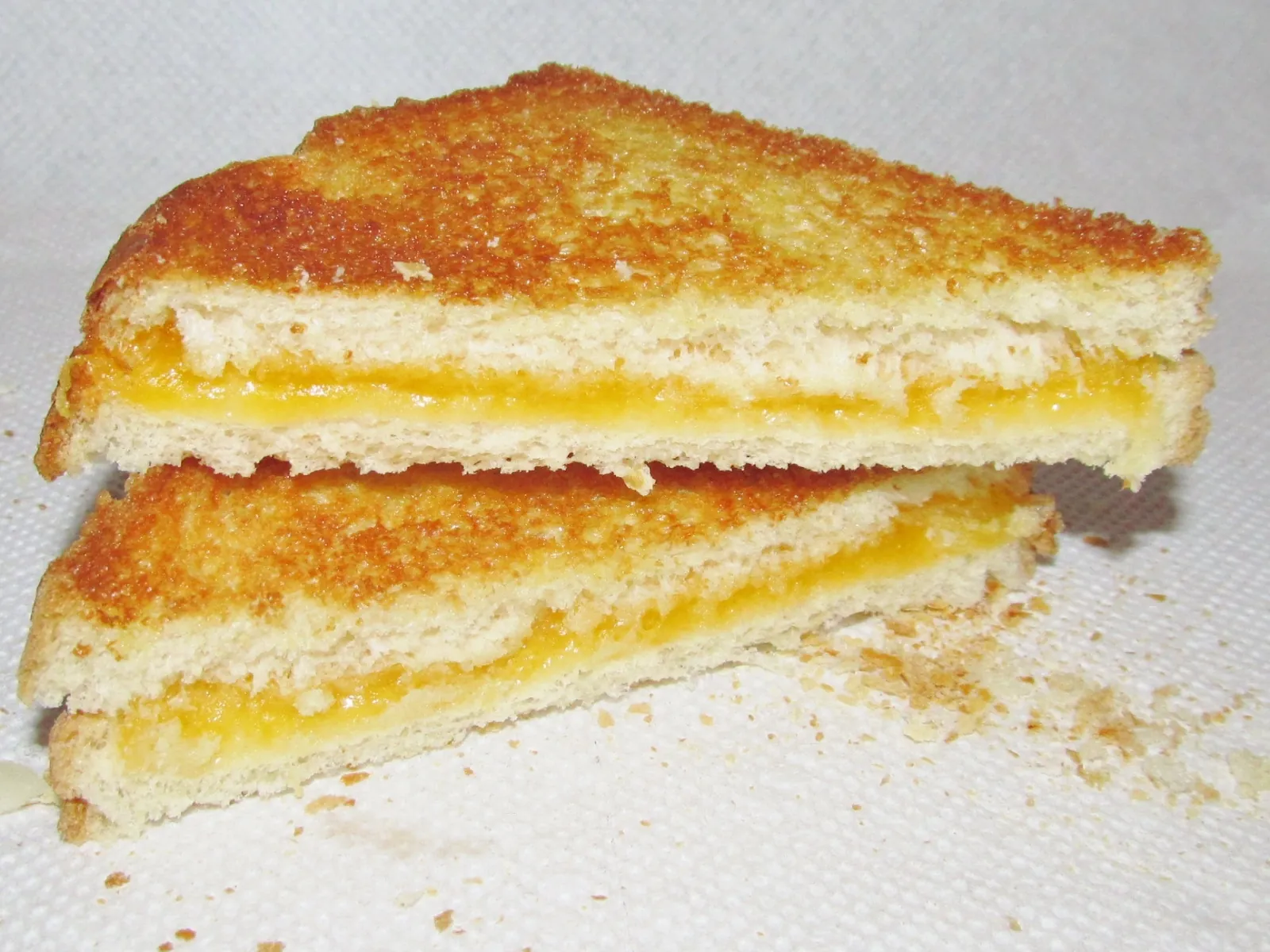
Deli American, young cheddar, Monterey Jack, muenster, fontina and Havarti all manage that easily. Sharp cheddar and Gruyère bring more flavor but melt more slowly, so the best sandwiches usually pair one fast melter with one flavor cheese.
That timing problem is the whole game. A grilled cheese has a single heat source under the bread, and the cheese only gets the heat that makes it through the toast. America's Test Kitchen (ATK) cooks its grown-up grilled cheese 6 to 9 minutes per side over medium-low heat, which is roughly the window your cheese has to go from cold to molten.
Best cheeses for grilled cheese at a glance
The best cheeses for grilled cheese fall into fast melters and flavor cheeses, and the strongest sandwiches use one of each.
| Cheese | Melt speed | Flavor | Best role | Watch out for |
|---|---|---|---|---|
| Deli American | Fastest | Mild, salty | Melter | Imitation "slices" |
| Mild or medium cheddar | Fast | Gentle tang | Melter or solo | Little bite |
| Monterey Jack, muenster | Fast | Mild, buttery | Melter | Bland alone |
| Havarti, fontina | Fast | Buttery, earthy | Melter | Can ooze out |
| Low-moisture mozzarella, young provolone | Medium | Mild | Stretch | Greasy, rubbery when cool |
| Sharp cheddar, up to a year old | Medium | Tangy | Flavor | Older blocks turn greasy |
| Gruyère | Medium | Nutty | Flavor | Price |
| Brie, raclette | Fast | Rich | Indulgent melter | Runs out the sides |
| Parmesan, feta, halloumi | Barely or never | Salty | Accent only | Stays solid |
Melt speed vs bread browning in a grilled cheese
In a grilled cheese, melt speed has to keep pace with bread browning, and most failures come from cheese that is too cold, too thick or too old. J. Kenji López-Alt of Serious Eats explains in his Food Lab notes on melting that milk fat softens around 90°F (32°C), but cheese only flows once enough protein bonds break: at about 120°F (49°C) for high-moisture process cheese, and 180°F (82°C) or more for well-aged Parmigiano-Reggiano.
Now add the starting point. The FDA says a refrigerator should hold food at 40°F (4°C) or below, so a thick slab straight from the fridge has a long climb, and every degree has to pass through bread that is already browning. Moisture and fat shorten the climb. Younger, moister cheeses melt at lower temperatures, and according to the University of Wisconsin's Center for Dairy Research, fat globules break up cheese's protein network, so a higher-fat cheese melts at a cooler temperature than a lower-fat one.
Cover the pan for the first couple of minutes on each side. The Serious Eats guide to melting cheese notes that steam heats cheese more gently and evenly and puts back moisture that dry heat drives off.
How to slice and portion cheese for grilled cheese
How you slice cheese for grilled cheese matters nearly as much as which cheese you buy. Aim for thin slices, about 1/8 inch (3 mm), laid edge to edge with no gaps, or coarsely grate firmer and older cheeses so the heat has more surface to work on.
Two to 3 ounces per sandwich is the sweet spot. ATK's recipe spreads 9 ounces of cheese across four sandwiches, a little over 2 ounces each. Pile on more and the center stays cool while the outside overbrowns.
Start with room-temperature cheese
Room-temperature cheese gives you a head start that no amount of fiddling with the burner can match. ATK warms its cheddar before it ever meets the bread, either by leaving it out or by microwaving the pieces for about 30 seconds. Twenty to 30 minutes on the counter does the same job; here is how to bring cheese to room temperature without making it sweat.
The best cheeses for grilled cheese, pick by pick
Each of the best cheeses for grilled cheese below earns its spot for a specific reason, and each has a weak spot worth knowing before you buy.
Deli American cheese, the fastest melter
Deli American cheese is the fastest melter you can buy, because it is real cheese reworked with emulsifying salts, extra milk and milk protein. Serious Eats points out that all that added liquid gives American-style cheese extremely low melting points, which is why it turns to lava before the toast is done.
Buy it sliced at the deli counter and check the label for "pasteurized process American cheese." Two slices make a classic diner-style sandwich, or use one slice alongside a flavor cheese. The weak spot is flavor: that meltability comes at the cost of intensity, so it shines brightest as a partner. If you want the full story, here is what American cheese actually is.
Young and medium cheddar, the all-rounder
Young and medium cheddar is the all-rounder: it melts smoothly on its own and still tastes like cheddar. America's Test Kitchen found during its grilled cheese testing that younger cheeses almost always outperformed aged ones, partly because they hold more moisture.
Buy a block of mild or medium and slice it thin. It works solo at 2 to 3 ounces per sandwich. Its weak spot is that it can taste a little plain, which is easy to fix with an ounce of something sharper.
Sharp cheddar, aged a year or less
Sharp cheddar brings the tang, but only cheddar aged about a year or less melts well in a sandwich. ATK's recipe says to avoid cheddar older than a year, and its melt test of 3-, 16- and 24-month cheddars shows why: the youngest flowed smoothly, the 16-month cheese clumped, and the 24-month cheese never melted at all.
Grate it rather than slicing it, and pair it with a fast melter. ATK goes further, blending 7 ounces of aged cheddar with 2 ounces of rindless Brie and 2 tablespoons of dry white wine into a spreadable paste, because the Brie and wine help the cheddar melt evenly without turning greasy.
Monterey Jack, muenster and Havarti, the creamy melters
Monterey Jack, muenster and Havarti are the creamy melters: soft, mild and quick to go gooey. Jack and muenster both appear on López-Alt's list of good melting cheeses, and Havarti behaves the same way, with a buttery edge.
Plain or pepper Jack both work, as does a mild block of Havarti. Use them as half the cheese or more. Their weak spot is flavor on their own, and Havarti is soft enough to ooze out of the sides if the pan runs hot.
Gruyère and fontina, the flavorful melters
Gruyère and fontina are flavorful melters, which makes them the closest thing to a one-cheese upgrade. Serious Eats lists Gruyère with Jack and mozzarella among reliable melters, and fontina's earthy, buttery melt anchors the chef's grilled cheese at PS in New York.
Buy a younger, softer Gruyère rather than a crunchy, long-aged one. A 50-50 mix of the two on rye or sourdough is hard to beat. The weak spots are price for Gruyère and mildness for fontina.
Mozzarella and provolone, the stretch
Low-moisture mozzarella and young provolone are the stretch cheeses, the ones behind a long cheese pull. Stretch needs an intact, interconnected protein network, and these pulled-curd cheeses have one.
Skip fresh mozzarella, which is wetter, and buy the low-moisture block. Use it as half the cheese, never all of it. The weak spot is fat: the Center for Dairy Research notes that the stretching process pools mozzarella's fat, which is released readily when the cheese heats, so an all-mozzarella sandwich can turn greasy and goes rubbery as it cools.
Brie and raclette, the indulgent melters
Brie and raclette are indulgent melters that turn almost liquid. Serious Eats counts Brie among the reliable melters, and chef John Mooney of Bidwell in Washington, D.C., told the trade magazine Flavor & The Menu that raclette "melts like no other."
Trim the Brie rind if you want a uniform melt, as ATK does, and buy raclette at a cheese counter. Use about an ounce of either with a sturdier cheese. The weak spot is runoff, so keep the heat at medium-low.
Best cheese combinations for grilled cheese
The best cheese combinations for grilled cheese pair one fast melter with one flavor cheese, roughly half and half by weight. Ratios below are starting points for one sandwich's 2 to 3 ounces.
| Combination | Suggested ratio | Bread | Why it works |
|---|---|---|---|
| Sharp cheddar + deli American | 1 to 1 | White or sourdough | Tang from the cheddar, sure melt from the American |
| Aged cheddar + Brie + a splash of white wine | About 7 to 2 | Hearty white | ATK's method for making aged cheddar melt |
| Gruyère + fontina | 1 to 1 | Rye or sourdough | Nutty flavor, creamy melt |
| Cheddar + muenster | 1 to 1 | Tuscan or country loaf | The pairing in Cheese Louise's "Vermonter" in Portland, Maine |
| Raclette + Gouda | 2 to 1 | Sourdough | Bidwell's base in Washington, D.C. |
| Fontina + pecorino | 3 to 1 | Sourdough | The foundation at PS in New York |
| Low-moisture mozzarella + provolone | 1 to 1 | Italian loaf | Stretch with a little bite |
| Pepper Jack + Colby | 1 to 1 | White | Mild heat, very gooey |
What restaurants use for grilled cheese
What restaurants use for grilled cheese runs from unapologetic process cheese to local sharp cheddar. A 2022 menu-trends feature in Flavor & The Menu describes melt-worthy processed cheeses as "no longer a guilty-pleasure secret" for chefs, who also draw on a growing range of artisan cheeses. The sandwich earns its menu space, too: Datassential research cited there found 80 percent of consumers love or like grilled cheese.
The chef versions in that feature follow the melter-plus-flavor pattern. High Street Philly uses local Pennsylvania sharp cheddar on long-fermented sourdough, PS in New York builds on fontina and pecorino, and Cheese Louise in Portland, Maine, pairs Cabot cheddar with muenster. Technique travels with the cheese. At Fox & Falcon in South Orange, New Jersey, the kitchen spreads mayo on brioche right before it goes on the plancha, a flat-top griddle.
What most grilled cheese advice gets wrong
Most grilled cheese advice stops at "use American cheese" and skips the label details and kitchen habits that decide whether the sandwich melts.
"American" on the label can mean three different things. Serious Eats' guide to what is really in American cheese separates deli-style pasteurized process cheese, the regulated real thing, from looser terms such as "prepared cheese product" and from "American slices" or "sandwich slices" that never use the word cheese. Those last ones are vegetable oil products, which Serious Eats says do a poor job of copying real American cheese's melt and flavor.
Reduced-fat cheese fights you. With fewer fat globules breaking up the protein network, it needs more heat to melt, which is exactly what the bread cannot spare. Buy full-fat cheese for grilling.
Cold, thick cheese burns the bread. When the toast is dark and the middle is still firm, the usual culprit is cheese that went in cold or thick, and turning up the burner only makes it worse.
The sandwich needs a rest. ATK lets each sandwich stand for 2 minutes before serving. Cut it straight from the pan and the hottest cheese runs onto the board; give it a moment and the cheese thickens just enough to stay put.
Questions about the best cheese for grilled cheese
Here are quick answers to common questions about the best cheese for grilled cheese.
What three cheeses make the best grilled cheese sandwich?
The three cheeses that make the best grilled cheese sandwich are a fast melter (deli American or Monterey Jack), a flavor cheese (sharp cheddar or Gruyère), and a small amount of a creamy cheese such as Brie or fontina. Keep the total to 2 to 3 ounces.
What kind of cheese do restaurants use for grilled cheese?
Restaurants use both process cheese and artisan cheese for grilled cheese, often together. Chef versions pair a melter with a flavor cheese, such as raclette with Gouda at Bidwell in Washington, D.C., or cheddar with muenster at Cheese Louise in Portland, Maine.
What is the secret to making the best grilled cheese?
The secret to making the best grilled cheese is matching melt time to browning time. Use thin, room-temperature slices of a good melter, cook over medium-low heat, and cover the pan briefly so steam helps the cheese along.
What is the best melting cheese for grilled cheese?
The best melting cheese for grilled cheese is deli American, which is made with emulsifying salts and melts at a lower temperature than natural cheese. Among natural cheeses, young cheddar, Monterey Jack, muenster, fontina and Havarti are the most reliable quick melters.
Is sharp cheddar good for grilled cheese?
Sharp cheddar is good for grilled cheese if it is aged about a year or less and you grate it or pair it with a faster melter. Older cheddar tends to clump and leak fat instead of melting.
Which cheeses don't melt in a grilled cheese?
The cheeses that don't melt in a grilled cheese include feta and halloumi, whose protein structure is too tight to melt, plus acid-set cheeses such as paneer and ricotta, and queso fresco. Use them as accents next to a real melter, and see the full ranking of melting cheeses for why.
Your next grilled cheese
Your next grilled cheese needs two cheeses and a little patience. Buy a deli American or a block of Monterey Jack as the melter and a sharp cheddar no more than a year old (or a wedge of Gruyère) for flavor, slice both thin, and let them sit out while the pan heats.
From there it is all technique: bread, butter versus mayo, and heat control, which the step-by-step grilled cheese guide covers in full. For cold sandwiches, the best cheeses for sandwiches is the better guide.
Sources
- Grown-Up Grilled Cheese Sandwiches with Cheddar and Shallot, America's Test Kitchen
- Why Young Cheese Melts Better than Aged Cheese, America's Test Kitchen
- The Science of Melting Cheese, Serious Eats
- What Is American Cheese, Anyway?, Serious Eats
- The Food Lab's Ultra-Gooey Stovetop Mac and Cheese (melting science excerpt), Serious Eats
- The Melt and Stretch of Cheese, Dairy Pipeline, Winter 2000, University of Wisconsin Center for Dairy Research
- Refrigerator Thermometers: Cold Facts about Food Safety, U.S. Food and Drug Administration
- Grilled Cheese, Please!, Flavor & The Menu