
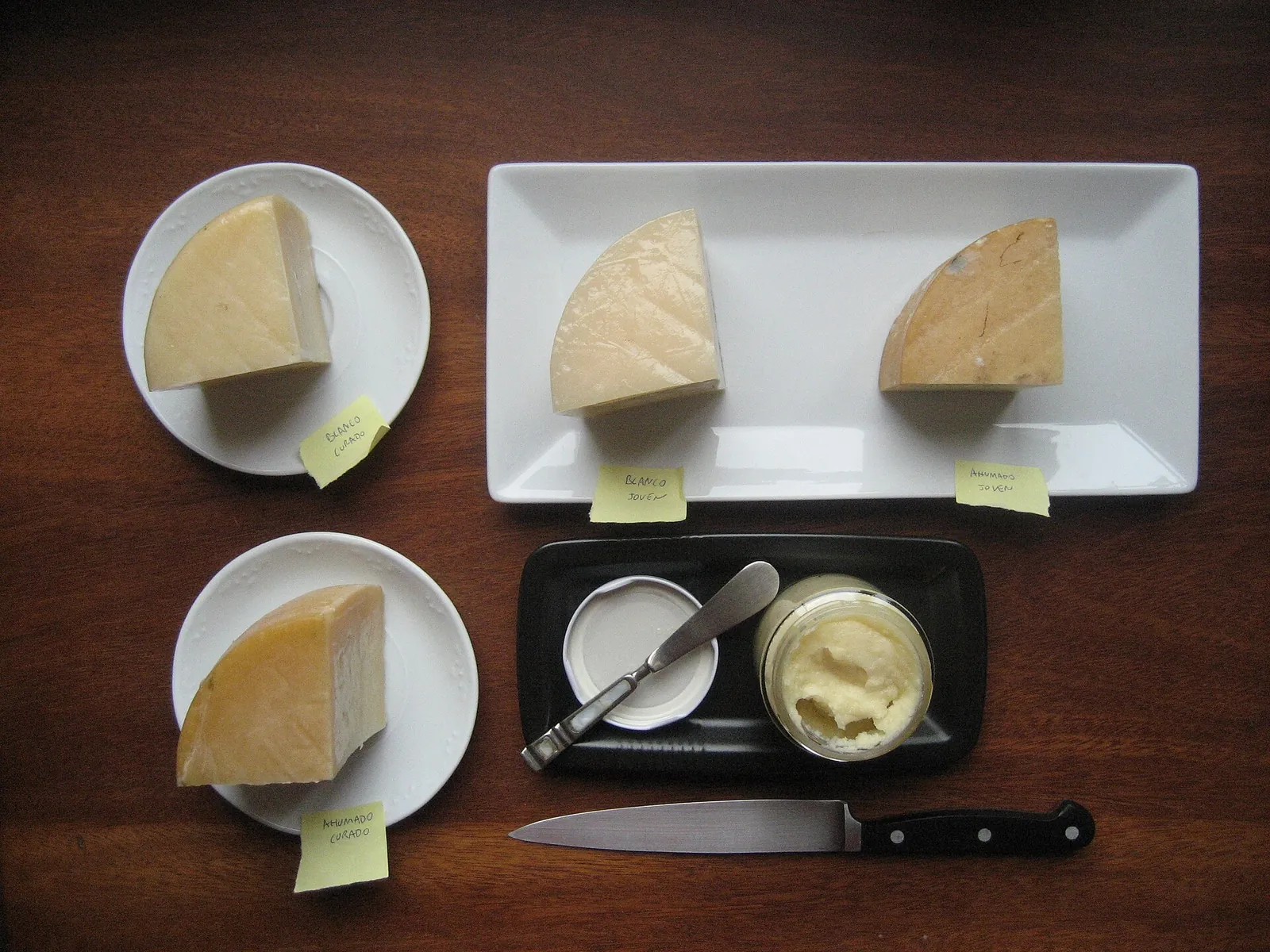
The EU has protected all five names since 1996.
This page lays out the main Spanish cheeses, what the protected names guarantee and how to find them in a US store.
Spanish cheese at a glance
Here is Spanish cheese at a glance: the five names most US shoppers meet, with the milk behind each and its EU status.
| Cheese | Region | Milk | Style | EU protected name |
|---|---|---|---|---|
| Manchego | La Mancha | Sheep (Manchega breed) | Firm, nutty, aged from weeks to two years | PDO, June 1996 |
| Idiazabal | Basque Country, Navarre | Sheep | Hard, often smoked | PDO, June 1996 |
| Cabrales | Asturias | Mixed (cow, sheep, goat) | Cave-aged blue, pungent | PDO, June 1996 |
| Mahon | Menorca | Cow | Semi-hard, orange paprika-and-butter rind | PDO, June 1996 |
| Tetilla | Galicia | Cow | Semi-soft, teardrop-shaped, mild | PDO, June 1996 |
All five appear in the Spanish list of Commission Regulation (EC) No 1107/96, dated June 12, 1996. The same list also names Zamorano, Roncal, La Serena and others.
Spanish cheese tradition
Spanish cheese tradition is regional and mostly sheep and goat country, because much of the interior is dry upland where sheep do better than cows. The north is the exception: green, wet Asturias, the Basque Country and Galicia keep cows and make the cow's-milk and mixed-milk cheeses.
Cheeses often take their names from a place or a village, and the protected-name system now backs that up. The Spanish cheese guide tours the country region by region, and the Basque cheese guide covers the north in detail.
Manchego and the sheep's-milk cheeses
Manchego is the Spanish cheese most Americans know, a firm sheep's-milk wheel with a woven rind pattern. The Manchego consortium says it can only be made from the milk of the Manchega breed in La Mancha, and sets a minimum age of 30 days for pasteurized wheels of 1.5 kg (3.3 lb) or less and 60 days for others. The Manchego page covers young, semi-cured and cured styles.
Idiazabal is the Basque counterpart, a hard sheep's-milk cheese that is frequently smoked over wood, which gives it a nutty, woodsy flavor that suits grilled meat and Rioja. Read more in the Idiazabal guide.
Cabrales, Mahon and Tetilla
Cabrales, Mahon and Tetilla are the three Spanish cheeses that are not Manchego-style, and each gives a different reason to look past it.
Cabrales is Spain's powerful blue, made from a blend of cow, goat and sheep's milk and aged in caves in Asturias. It is salty and intense, so serve it in small pieces with something sweet such as honey, pear or quince.
Mahon is a cow's-milk cheese from Menorca with a distinctive orange rind rubbed with paprika and butter. Young Mahon is buttery; older wheels turn sharp and salty.
Tetilla is the mild one: a creamy Galician cow's-milk cheese shaped like a teardrop, buttery and faintly tangy. It melts easily and suits people who find Manchego too strong.
How Spaniards eat cheese
How Spaniards eat cheese is simple: sliced thin as a tapa or ration with bread, olives, almonds and cured ham, often with a glass of sherry, cider or red wine. Quince paste, called membrillo, is the classic partner for firm sheep's-milk cheese, and honey or walnuts suit the blues. Cabrales is classically matched with cider in Asturias, where the cheese and the drink come from the same region, and the pour is part of the ritual. For board portions, the serving guide suggests about 1 to 2 ounces a person as an appetizer.
How to buy Spanish cheese in the US
To buy Spanish cheese in the US, look for the protected name on the rind or label: Manchego wheels carry a stamped casein plate and a numbered back label, and the word alone is not proof. A cow's-milk "Manchego-style" wedge is a different product from the sheep's-milk original.
The PDO and PGI guide explains the labels. Buy Manchego by age: about 3 months (curado) is the easy all-round pick, older wheels are sharper and a little grainy. Buy Cabrales from a shop that cuts to order, since the blue dries out fast, and wrap blues separately from other cheese so the mold does not travel. Keep Mahon in its rind, wrapped loosely in parchment, and bring any of these to cool room temperature for about 30 minutes before serving, because cold cheese tastes flat. A small plate of three or four Spanish cheeses with membrillo and almonds makes a complete appetizer without any cooking.
What most Spanish cheese guides get wrong
What most Spanish cheese guides get wrong is stopping at Manchego and treating it as the whole country. Spain's protected list includes dozens of regional names, and the best match for a dish is often not a sheep's-milk wheel at all: Tetilla for melting, Mahon for sandwiches, Cabrales for a sweet-and-salty finish.
They also skip the label. A cheese called Manchego-style may be cow's milk with no minimum age, while the real thing is Manchega sheep's milk with a legal minimum.
Questions about Spanish cheese
These are the most common questions about Spanish cheese.
What is the most famous Spanish cheese?
The most famous Spanish cheese is Manchego, a firm sheep's-milk cheese from La Mancha and an EU PDO since 1996.
What is Spanish blue cheese?
Spanish blue cheese is most often Cabrales, a pungent cave-aged blue from Asturias made from mixed cow, goat and sheep's milk.
Is Manchego a sheep or cow cheese?
Manchego is a sheep's-milk cheese, and the consortium allows only milk from the Manchega breed.
What is smoked Spanish cheese?
Smoked Spanish cheese is usually Idiazabal, a hard Basque sheep's-milk cheese that is frequently smoked.
What cheese goes with membrillo?
Membrillo goes best with Manchego and other firm sheep's-milk cheeses, and it also works with Idiazabal and mild Tetilla.
Where to start with Spanish cheese
Start with Spanish cheese by buying a 3-month Manchego, a small piece of membrillo and a handful of Marcona almonds. Add one cheese from a different region, such as Mahon or Idiazabal, and compare them. For wine and beer matches, use the pairing guide.
Sources
- Commission Regulation (EC) No 1107/96 of 12 June 1996 on the registration of geographical indications and designations of origin (OJ L 148, 21.6.1996), Official Journal of the European Union
- Queso Manchego, the cheese and its rules, Consejo Regulador de la Denominacion de Origen Queso Manchego
- eAmbrosia, the EU geographical indications register, European Commission